TLDR: A coastal lawn program does not stop when the weather turns, it changes shape: cuts get less frequent as growth slows, mowing height comes down in small steps rather than one drop, and more of each visit goes to clearing what lands on the turf than to cutting it. Underneath, a cool season lawn is moving its effort from blade growth into roots and crowns, so the job of every autumn visit is to protect that work instead of forcing top growth. In lower Cape May County the whole transition runs later than it does inland, and sandy soil, salt exposure, and a high water table decide how the last cuts of the year are handled. Boyes runs the change as a planned sequence with a defined last cut, not as a service that quietly tapers off.
A seasonal lawn care transition is the managed change in how a lawn is maintained as growing conditions shift from one season to the next. It covers cutting frequency, mowing height, what leaves the property on each visit, and the order in which a crew works a lawn once top growth slows.
What Changes in a Lawn Program When the Season Turns?
Three things change, and they change at different times: how often the lawn is cut, how tall it is left, and how much of each visit goes to clearing the surface rather than cutting it. Nothing about the program stops. The work simply moves from managing growth to managing what growth leaves behind.
The order matters. Frequency usually shifts first, because growth rate is the first thing to move. Height shifts second, in steps, across the final cuts of the season. Debris handling grows steadily through the whole period until it takes more of the visit than mowing does.
A well-run lawn care program treats autumn as its own phase with its own standards, not as summer with fewer visits. The standard shifts from a clean cut to a clean surface.
What Is a Cool Season Lawn Doing Underground in Autumn?
It is moving its effort below the surface. The fescues and bluegrasses that make up most lawns in this part of New Jersey are cool season grasses, meaning they grow best in moderate temperatures, and when air temperatures ease while soil is still warm, visible blade growth slows while root and crown development picks up.
That is the single most useful thing a homeowner can know about autumn turf. A lawn that looks like it has stopped working has not stopped working. It has changed jobs.
Rutgers Cooperative Extension publishes New Jersey specific homeowner guidance for lawns built around cool season grasses and the state’s growing calendar, and the practical takeaway from that Rutgers lawn guidance is that seasonal practice should follow what the grass is doing rather than a fixed date.
The consequence is direct. Damage done in autumn costs more than the same damage in June, because there is no flush of top growth left to cover it. A scalped strip, a rut, or a patch smothered under wet leaves will still be visible in spring.
Autumn is also when renovation work happens on lawns that genuinely need rebuilding. That is a separate scope with its own timing and its own decisions, and it is not what a seasonal transition covers.
Should Mowing Height Change as Fall Arrives?
Yes, but gradually, and later than most homeowners expect. Our crews hold the summer height through the early part of the transition, then step the height down slightly across the last several cuts of the year rather than dropping it all at once.
The reasoning is straightforward. A taller blade gives the plant more leaf surface to work with at exactly the point when it is building roots and crowns. Cutting short too early takes that surface away and exposes crowns on sandy ground that dries out fast in an open autumn stretch.
Our crews work to a standing rule in every season: no more than a third of the blade comes off in a single cut. That is what makes a stepped reduction necessary, because getting from a summer height to a finish height in one pass would break it, and a lawn scalped in October carries that thinning through the winter.
The reason to come down at all is what happens after the last cut. Long blades left standing through a wet coastal winter fold over, mat against the surface, and hold moisture at the crown. A modest step down on the final cuts leaves the lawn short enough to stay open and long enough to protect itself.
The height we hold through the heat is a different decision from the height we finish on, and the summer standard in our August lawn care guidance is where the reduction starts, not where it ends.
How Often Should a Coastal Lawn Be Cut in Autumn?
Cutting frequency should follow growth rate, not the calendar. The trigger our crews use is simple: if a visit is producing meaningful new blade, the interval stays where it is, and if two consecutive visits come up short, the interval stretches.
That often surprises people, because the first move in autumn is frequently upward rather than downward. Cool season lawns that spent August under heat stress commonly push a flush of growth once temperatures moderate, and a lawn in Del Haven that barely needed cutting in late summer can need a full weekly cut for several weeks afterward.
After that flush, the interval stretches. Weekly gives way to every ten days, then to every other week, then to visits that are mostly about clearing the surface. Where those changes land differs on every property, so the call is made on site rather than set in advance.
Shade and exposure split the property. A shaded rear yard in Green Creek and a full sun front yard on the same lot will not slow at the same rate, and the crew reads whichever area is still driving the need for a cut.
Cancelling the visits outright is the one option we push back on. A residential lawn care program in autumn is still doing work even on a week when the mower takes very little off, because the surface still needs clearing and the edges still need holding.
When Is the Last Cut of the Year?
The last cut is set by the grass, not by a date on a calendar. Our working test is two consecutive visits with no meaningful new growth, at which point the next visit becomes the final one and gets scoped differently from the visits before it.
In lower Cape May County that point lands later than it does inland. The lower county sits in zone 7b, and bay and ocean water hold overnight lows up in a way that keeps soil workable and grass growing well past the point where inland properties have finished. Planning a final cut for a mid-autumn date because that is when it happened at a previous house is how lawns here end up going into winter too long.
The final visit is not a normal mow with an earlier stop time. It is the visit where the property gets closed out. The height comes down its last step, the edges get re-cut so the lines hold through the dormant months, corners and fence lines get cleared of accumulated material, and hard surfaces get blown clean so nothing is left to mat down over the winter.
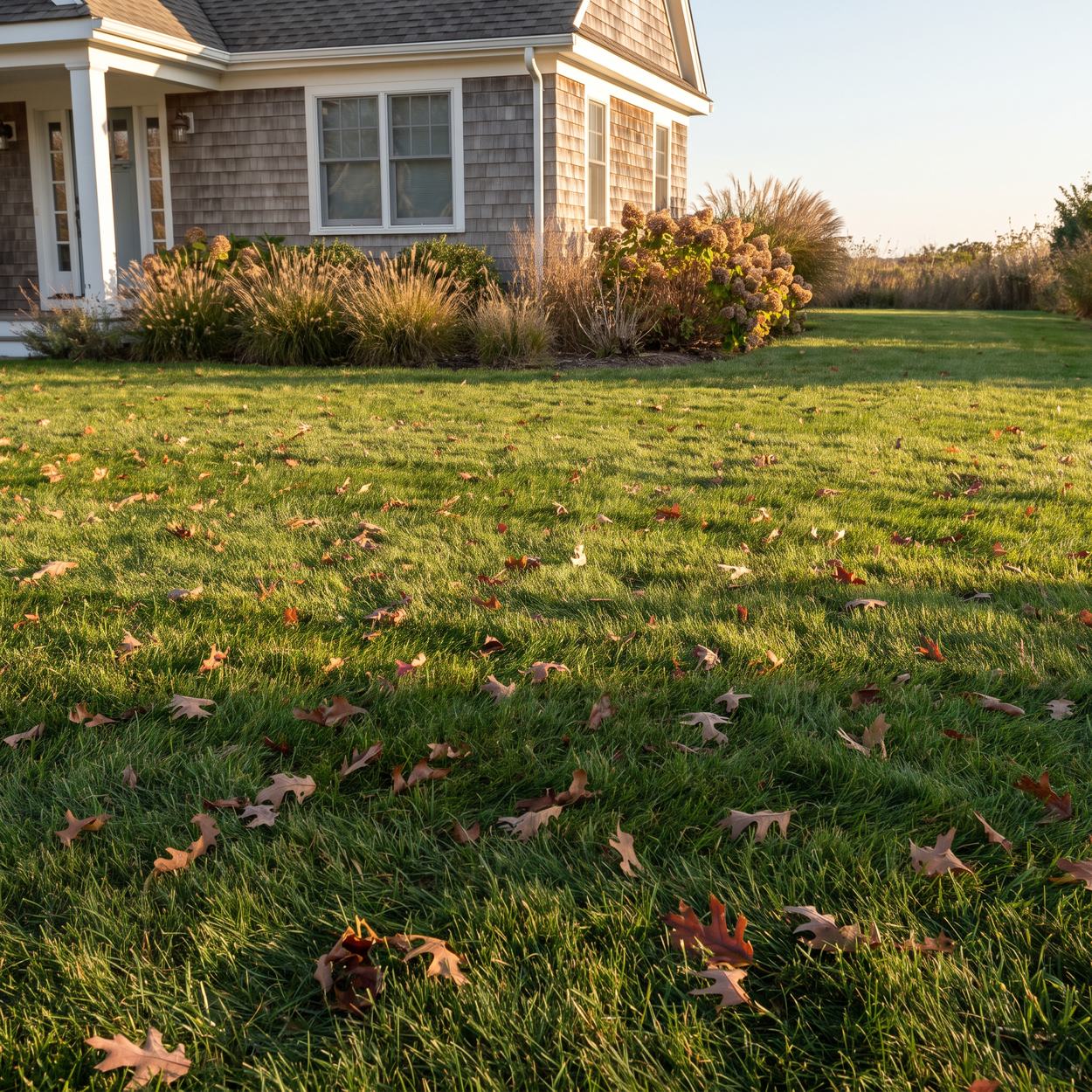
What a good final visit looks like on site is a lawn with no windrows of clippings, no piles left in low corners, visible edges along beds and walkways, and a uniform height with no scalped strips where the ground rolls.
What Does Leaf Load Actually Do to a Lawn?
Leaves harm turf by blocking light and holding moisture against the crown, not by their weight. A dry scattering that grass blades still show through is not a problem. A packed wet layer that stays damp a full day after rain is, and that is the condition our crews are actually looking for.
That distinction decides how each visit is handled. Light loads can be cut back into the lawn, where the material is reduced and the pieces fall between the blades instead of sitting on top of them. Heavier loads have to come off the property, because chopping a thick layer only produces a thick layer of smaller pieces.
The load arrives in waves rather than all at once, so a lawn cleared during the first drop looks untouched again a week later, which is why the transition usually needs more than one clearing pass.
Where material collects matters as much as how much of it there is. Open turf sheds leaves and clears fast. Fence lines, hedge bases, bed corners, and the lee side of any structure hold material, and on a windy lot near the bay those spots load up with debris that grew on somebody else’s property.
Turf under a matted layer through a mild wet winter is the most common avoidable damage we see. Handling the load properly is the core of a fall cleanup, and on a lawn that matters it is not optional.
How Do Coastal Conditions Change the Transition in Lower Cape May County?
Four coastal conditions move the schedule here: a later season, sandy soil, salt exposure, and a high water table. Each one changes a specific decision, and a program written for an inland property gets all four of them wrong.
The later season pushes every date back. Zone 7b and the moderating effect of the water mean growth continues past the point where inland lawns have stopped, so the last cut, the final height step, and the last clearing pass all land later in Del Haven and Erma than a general fall calendar would suggest.
Sandy soil changes how much margin the lawn has. It drains quickly and holds less water, so a lawn cut too short during a dry autumn stretch browns fast and stays thin. When rain does not come, hand watering during the transition is about keeping the crown alive through the root building period, not about pushing green color.
Salt is the condition most specific to this market. Storm driven flooding and blown spray both put salt into the root zone on bay side and low lying properties. Rutgers Center for Turfgrass Science advises that immediate remediation focuses on improving drainage and getting flood water off the site, then applying fresh water to leach residual salts below the root zone, with gypsum used as an amendment, and their saltwater flooding guidance also recommends testing soluble salts and pH rather than guessing at the damage. On grass selection, Rutgers notes that perennial ryegrass, slender creeping red fescue, and tall fescue are generally considered to have the best tolerance to salinity, while annual bluegrass and colonial bentgrass are the most sensitive.
The high water table decides what equipment goes where. Low corners in Green Creek and Cold Spring stay soft long after the surface looks dry, and a machine that leaves a rut in October leaves a rut that is still there in April. When ground will not carry weight, the crew works it by hand or comes back, and both are planned rather than improvised.
What Changes on Rentals, Second Homes, and Community Properties?
Properties that empty out after tourist season need the transition tied to dates as well as to growth. The lawn does not care that the season is over, but the owner is no longer there to see what is happening on it.
Second homes are the clearest case. A property in Del Haven or Green Creek that sits unvisited from October onward still accumulates leaf load, still needs its final cut at the right height, and still shows every bit of damage in the spring. The transition there should end with a defined closing visit, not with the owner leaving town and the visits stopping on their own.
Rentals run on the opposite pressure. The lawn has to stay presentable through late season turnovers, which means holding a normal interval longer than growth alone would justify, then compressing the height reduction into fewer cuts once bookings end.
Community and association properties carry a written standard that does not soften because growth has slowed. Meeting it through the shoulder season takes a defined visit plan, and the way HOA lawn standards are written usually decides how late the full interval has to hold.
How Should the Fall Transition Be Sequenced on a Property?
The sequence is the same on every lawn, and it runs in seven steps. Working them in order is what keeps the height reduction, the frequency change, and the debris handling from colliding with each other.
- Read the growth rate before touching anything else. How much blade came off at the last visit is the number that drives every other decision in the transition.
- Hold the summer height through the early flush. Cool season lawns often grow harder in early autumn than they did in August, and that growth is worth protecting.
- Stretch the interval only after growth genuinely slows. Two consecutive light visits, not one cool week, is the signal to move from weekly to a longer cycle.
- Start clearing the surface on every visit. Once material begins accumulating, each visit includes reading which areas hold debris and clearing them, whether or not the lawn needed much cutting.
- Step the height down across the final cuts. Take it in small reductions that respect the one third rule, so the lawn arrives at its finish height without ever being scalped.
- Set the last cut deliberately. Name the visit, scope it as a close out rather than a mow, and put it on the calendar so nobody is guessing in December.
- Leave the property in its winter condition. Edges cut, corners cleared, hard surfaces blown clean, and no piles or windrows left anywhere on the turf.
Those steps sit inside the larger annual plan, and a lawn managed on a year round schedule moves through them without anyone having to renegotiate the program every autumn.
Frequently Asked Questions
These are the questions homeowners ask most often when a lawn program moves into its autumn phase.
Should I cut my lawn shorter for winter?
Slightly shorter than the summer height, reached in steps rather than in one cut. Our crews step the height down across the final cuts of the year so the lawn finishes short enough that long blades do not mat down under wet coastal weather, but never so short that crowns are exposed on sandy ground. A single hard drop at the end of the season does more damage than leaving the lawn slightly long.
When should the last cut happen in lower Cape May County?
Later than most fall calendars suggest, because growth continues later here. The trigger is two consecutive visits with no meaningful new blade, which on bay side properties in Del Haven and Erma often lands well after inland lawns have finished. Setting the date by the grass rather than by the month is the entire point.
Can I just leave the leaves on the lawn?
Only if the layer is light enough that grass blades still show through it and it dries out after rain. A packed wet layer blocks light and holds moisture against the crown, which is how turf thins out over the winter. Light loads can be cut back into the lawn, and heavy loads need to come off the property.
Should I stop lawn service once growth slows?
Stopping early is the most common autumn mistake we see. The visits change character rather than losing value, because a lawn in the transition still needs its surface cleared, its edges held, and its final cut taken at the right height.
Does a second home need the same fall program as a year round property?
It needs the same work, ending on a firmer date. Nobody is on site to notice a problem, so an empty property in Cold Spring or Del Haven should finish with a defined closing visit that leaves it in a condition it can hold unattended until spring. The risk is not too much service, it is a season that stops without anyone closing the property out.
The turn of the season is where a lawn program either protects the work the grass is doing or quietly undoes it. Growth rate, height, and surface condition are all readable on site, and a program built around them finishes the year with a lawn ready for spring rather than one needing repair.
Want the lawn set up right for the turn of the season? Call 856-386-4600 to review the program.