TLDR: A fall cleanup is the last structured visit of the season, and done right it covers leaf removal down to the soil surface, cutbacks on the beds that need them, a final shaping cut on the hedges, and a re-cut edge on every bed line. In lower Cape May County it also takes judgment about what to leave standing, because sandy soil, salt exposure, and a high water table all punish stripped ground over winter. The work should run in one sequence, from the top of the hedges down to the turf and then the hard surfaces, so a finished area never gets littered again by the next stage. Handled that way, a property holds its shape through winter instead of needing to be rebuilt in spring.
What Is a Fall Cleanup?
Fall cleanup is a scheduled end of season service that clears leaf litter and spent growth from turf, beds, and hard surfaces, then resets the property’s edges and plant structure for dormancy. It is scope work, not one pass with a blower, and the standard is what the crew leaves behind.
What Does a Complete Fall Cleanup Include?
Most properties around Cape May need four separate workstreams in the fall, and a cleanup that covers only one of them is not finished work. Knowing the four makes it easy to compare what one company is offering against another.
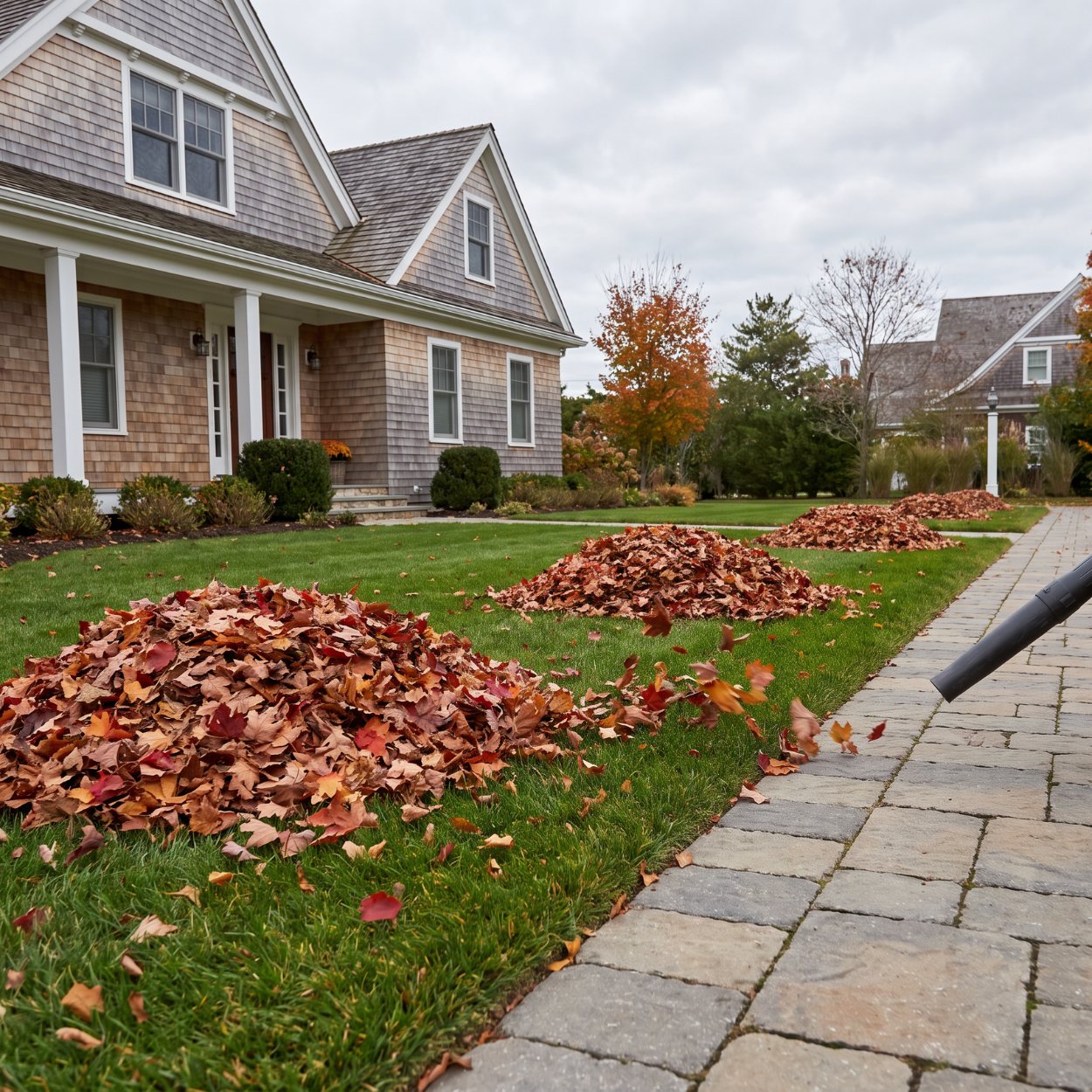
Leaf management. Clearing leaf litter off turf, out of beds, and away from walkways and driveway margins, then removing that material from the property rather than relocating it to a back corner.
Bed cutbacks. Cutting spent perennial growth down to the crown where it has collapsed, pulling finished annuals with their roots, and clearing debris that has blown into the plantings and packed around stems.
The final hedge cut. A light shaping pass that sets the outline every hedge and foundation shrub will hold until spring, plus full removal of the clippings.
Edges and detail. Re-cutting the vertical line where bed meets turf, clearing the margins along stone walkways and paver or gravel driveways, and hand-clearing the tight spots no machine reaches.
Boyes treats all four as one scope under seasonal cleanups instead of quoting them as separate visits, because they only work as a sequence. Cutting hedges after the beds have been cleared just puts the clippings back where the crew already worked.
How Should Leaves Actually Be Handled?
Leaves are the visible part of the job, and they are also where most of the shortcuts happen. The difference between a cleanup and a leaf-blowing pass shows up in three places.
The first is depth. Turf should come out of the visit with nothing on the canopy, and beds should be cleared down to the mulch or soil surface. On the coast, morning fog and steady humidity keep a leaf layer damp for days at a time, and damp leaves mat into a mask that holds moisture right against the crowns of the grass and the base of the plants. A clean surface dries. A matted one does not.
The second is where the leaves end up. Leaves raked to a curb line, a fence line, or the far edge of a lot in Erma are not gone. The first strong onshore wind returns a good share of them to the middle of the property, usually after the invoice has been paid. Full haul-off is the standard, and it is the part worth confirming before any crew starts.
The third is timing and repetition. On mixed canopy properties, the drop does not happen on one convenient afternoon. Maples finish early, and the oaks common on older lots around Cape May and West Cape May keep dropping for weeks after that. One pass in early November on a property like that means half the leaf load is still in the air. Two or three visits, scheduled around the drop rather than the calendar, is what actually clears the property, which is why scheduled leaf removal is priced and planned as a sequence.
Which Beds Get Cut Back, and Which Get Left Alone?
The instinct in fall is to cut everything to the ground so the property looks bare and orderly. That is the single most common mistake we correct on new properties, and it costs the owner both winter interest and root protection.
Our working rule divides the beds into three groups.
Cut back. Soft-stemmed perennials that collapse into a wet mass once frost hits, such as hostas and daylilies, come down to the crown. Anything with spotted or discolored foliage comes out and leaves the property rather than going into a pile behind the shed. Annuals are pulled with the root ball so the bed is not holding dead root mass all winter.
Leave standing. Ornamental grasses hold their form through the coldest months, and the standing mass shelters the crown of the plant while giving a flat winter bed some height. Seed heads on coneflower and similar perennials feed birds and read as intentional rather than neglected. Woody sub-shrubs keep their framework, since cutting into that wood in fall removes the structure the plant will build from.
Shape only. Spring-flowering shrubs get tidied, not reduced. A hedge that flowers early in the year carries that show on wood it grew this season, so a heavy fall cut trades an entire spring bloom for a slightly neater November. It is a bad trade, and it is not reversible.
The plant list itself drives most of these calls, and shore properties run a narrower list than inland ones. If the beds are being rebuilt rather than maintained, the selection guidance in our overview of coastal plants is the better starting point, because a bed planted for salt and wind needs far less corrective cutting every fall.
When Is the Final Hedge Cut of the Year?
The last cut of the season is a shaping cut. Its job is to set a clean outline that will still look deliberate in February, when nothing else in the landscape is carrying the design.
We keep that cut light on purpose. A hard reduction late in the year tends to push soft new growth at exactly the point the plant should be shutting down, and that tender growth is the first thing damaged when the temperature drops. Renewal cuts and heavy size reductions belong earlier in the year, matched to the plant type, not tacked onto a fall visit.
Clippings are part of the cut. Hedge debris that falls into the crown of a foundation planting or into the mulch below it packs down, holds moisture against the stems, and shows up in spring as a matted layer nobody accounted for. Scheduled hedge trimming includes getting that material out of the plant and off the property, which is why the hedges come first in the sequence and the beds get cleared after.
What Should Stay in Place Over the Winter?
Restraint is a real part of the standard here. A property scraped down to bare sand in November is exposed for four months, and on the coast exposure has a cost.
The mulch layer stays. Fall is not the season to strip and replace it, and it is also not the season to bury the beds under a fresh heavy layer to make them look dark for a listing photo. Depth is what matters, and both extremes cause problems, which is the whole argument in our breakdown of mulch depth on coastal beds.
Root flares stay visible. Leaf litter and mulch pushed up against trunks and woody stems traps moisture where the plant least wants it. Crews should be pulling that material back, not mounding it.
A thin natural leaf layer can stay under a tree line or inside a woodland edge where it is not sitting on turf or packed into a planting bed. That is different from leaving leaves on a lawn. It is a decision about where the material belongs, made bed by bed.
Bare soil does not stay bare well. Sandy ground with nothing holding it moves under winter wind and heavy rain, and low areas fill in with what the high ground loses. Where a bed has been cut back hard, the surface still needs cover before the season closes.
How Do Lower Cape May Conditions Change the Work?
This is where a generic fall cleanup checklist stops being useful. Conditions in lower Cape May County change both the sequence and the standard.
Sandy soil. The soil across most of the peninsula drains quickly and holds little organic matter. That is an advantage after a heavy rain and a liability the rest of the year, because there is not much of a buffer. Organic material that stays on the property in the right places, and comes off the property everywhere else, matters more here than it would inland.
Salt exposure. Onshore wind carries spray well past the dune line, and fall coastal storms push tidal water into low-lying yards in Cape May Point and along the bayside. The Rutgers saltwater guidance from the Rutgers Center for Turfgrass Science is direct about the order of operations after a flood event: improve drainage and get the flood water off first, then apply fresh water to leach the residual salts down below the root zone, with gypsum used as an amendment. Rutgers also recommends testing soluble salts and pH rather than guessing. Every one of those steps assumes the ground can actually take water in, which is precisely what a packed layer of wet leaves prevents. On a flooded property, clearing debris is not cosmetic. It is what makes the recommended remediation possible.
Rutgers also notes that perennial ryegrass, slender creeping red fescue, and tall fescue are generally considered to have the best tolerance to salinity, while annual bluegrass and colonial bentgrass are the most sensitive. That is worth knowing before deciding how hard to push a struggling area that took salt water in October.
High water table. Low spots stay wet here long after the surface elsewhere has dried. Debris dropped in one of those areas does not break down cleanly, it ferments, and the smell and the dead patch both show up in April. Those areas get cleared first and get cleared completely.
Zone 7b. Lower Cape May County sits in zone 7b. The USDA hardiness map, currently in its 2023 version, builds its zones from the average annual extreme minimum winter temperature and presents them as 10 degree Fahrenheit zones split into 5 degree half zones. A half zone is a real difference in practice, and the peninsula’s position surrounded by water is why the cleanup window here does not close on the same date it does for properties well inland.
Tourist season and second homes. Rental calendars empty out through October, and a good share of the properties in Cape May, West Cape May, and Cape May Point belong to owners who are not here to watch the leaves come down. That changes the job in two ways. The property has to be closed out to a standard that holds without anyone checking it, and the owner needs to see the result without standing in the yard. Photographs before and after, and a crew that has been on the property before, matter more than they would for a homeowner who can walk out the back door. Owner-led work is the practical answer here: Matthew Boyes is on site, and the standard does not drift because nobody is watching.
What Is the Right Order of Operations?
The sequence is not a preference. Working out of order means redoing finished areas, which is where quality and schedule both fall apart. This is how a complete fall property cleanup runs on a typical property.
- Walk the property first. Identify bed lines, standing perennials worth keeping, plants that are struggling, and any low areas holding water. Decisions get made before any machine starts.
- Cut the hedges and shrubs. Shaping cuts happen first, because everything that comes off falls into the beds and onto the turf below.
- Cut back the beds. Collapsed perennials to the crown, annuals pulled with the roots, diseased foliage bagged separately.
- Clear the beds to the surface. Hand work in tight plantings and along foundations, so mulch stays where it is and stems do not get damaged.
- Clear the turf. Leaves come off the grass completely, working with the prevailing wind rather than fighting it, in passes rather than one long push.
- Re-cut the edges. A fresh vertical edge on every bed line, plus clean margins along walkways, patios, and driveways. This is the step that makes the whole property read as finished.
- Clear the hard surfaces last. Stone walkways, paver and gravel driveways, patios, and parking areas get cleared after everything above is done, not before.
- Haul everything off. All material leaves the property. Nothing is stacked behind the shed or pushed into a tree line.
- Walk it again. A final pass with the owner where possible, and documented photographs where the owner is not local.
Frequently Asked Questions
When should a fall cleanup be scheduled?
It depends on the canopy over the property, not on a fixed date. Properties with mostly maples can be finished earlier, while lots carrying mature oaks are still dropping weeks later. The practical answer for most properties in lower Cape May County is a first visit once the bulk of the drop is underway and a final visit after the last of it, which is why the service is usually booked as more than one appointment.
Can leaves just be mulched into the lawn instead of removed?
A light scattering of leaves can be chopped and left without harm, and it returns organic material to sandy soil that has little of it. That approach stops working once the layer is thick enough to mat, which is the normal condition under an established canopy here. When in doubt, the test is whether grass blades are still visible after the pass. If they are not, the material needs to come off.
Should beds be re-mulched during the fall cleanup?
Usually not as a full refresh. Fall is the right time to pull mulch back off stems and root flares and to top off any area that has thinned to bare soil, but a heavy new layer applied over cold, wet ground creates more problems than it solves. Full mulch refreshes belong in spring, once the beds have been cut back and the soil has warmed.
Is one visit enough, or does the work take several?
Most properties with mature trees need two or three passes. A single visit can only capture the leaves that have already fallen, so a cleanup booked too early leaves the owner with a full lawn again in three weeks, and one booked too late means the material has been sitting wet on the turf for a month. Spacing the visits across the drop is what produces a property that is actually clear.
Does a second home still need a fall cleanup?
Yes, and arguably more than an occupied one. Nobody is there to notice a bed filling in, a hedge losing its line, or a low corner sitting under wet leaves for the winter. Properties that get closed out properly in the fall open in spring needing standard maintenance. Properties that get skipped open needing repair work, and on the coast that gap widens every year it is left alone.
Booking the Work
A fall cleanup is the visit that determines how much work spring takes, and the difference between a thorough one and a fast one does not show up until March, in the condition of the beds, the shape of the hedges, and whether the turf comes back evenly. Boyes crews work out of Villas across lower Cape May County, and the fall calendar fills in the order it is booked.
Ready to book the fall cleanup? Call 856-386-4600 or reach the team through the contact page.