TLDR: Seasonal cleanup scope comes down to six variables: how much ground the crew covers, how much tree canopy sits over it, how many feet of planting bed need hand work, how far debris travels to leave the property, what the crew has to work around to reach the yard, and how many visits the property needs before winter. Lot size on its own predicts almost nothing, which is why two properties on the same street in Del Haven can carry very different scopes. A quote is a description of work, not a rate card, so the fastest route to an accurate one is a walk-through with the person who will run the crew. Boyes scopes every cleanup on site and puts that scope in writing before anything starts.
A seasonal cleanup is a scheduled, whole-property reset performed at the turn of a season: leaves and storm litter collected and hauled off, beds cut back and cleared, edges re-cut, hard surfaces blown clear, and the yard handed back in a condition that will hold until the next cycle. It is a scope of work, not a fixed package.
What Actually Drives the Scope of a Seasonal Cleanup?
Three things drive scope: volume, handling, and access. Volume is how much material comes off the property. Handling is what has to happen to that material once it is down. Access is the friction sitting between the crew and the work.
Every other factor is a variation on those three. A property under heavy canopy with a wide driveway produces a great deal of volume and handles easily. A small yard behind a tight gate produces very little volume and handles badly. Scope follows the combination, not the lot line.
That is why the square footage on a tax record predicts so little. Two properties in Del Haven can share a footprint and still differ by most of a crew day once the beds, the canopy, and the walk from the back fence to the truck are counted.
For seasonal cleanups, the walk-through is the estimate. A scope built from an aerial photo is a guess with a number attached to it.
Does a Bigger Lot Always Mean a Bigger Cleanup?
No. Lot size sets a floor on time, not a ceiling. Someone has to cross the ground, and crossing more ground takes longer, but the open ground itself is rarely the expensive part of a cleanup.
What matters more is how much of the lot is actually worked. A half acre in Green Creek that is mostly open turf with a fence line and two beds is a straightforward job. The same half acre broken into island beds, a tree line, a side yard, and a stone area is several jobs sharing one address.
Open turf is the fastest surface on any property. It takes wide equipment and clears in passes. Beds, borders, tree lines, and hard surfaces all take narrower tools and hand work, so the ratio of open turf to detailed area tells us more about the day than total acreage does.
Second homes complicate this. A property that sits unvisited for months accumulates a full season of drift, and the first cleanup after a long gap is heavier than the ones that follow.
Why Does Tree Canopy Matter More Than Lot Size?
Canopy is the largest single swing factor in a fall cleanup, because it decides how much material lands on the property at all. A shaded lot can produce many times the debris volume of an open lot the same size.
Species and maturity matter as much as tree count. What our crews see across lower Cape May County is that mature oaks hold and release material in stages well into late fall, while other trees on the same property finish in a short window. A yard holding both is a yard that needs more than one visit.
Neighboring canopy counts too. Leaves do not respect property lines, and on a windy shore lot the prevailing direction can load a fence line, a hedge base, or a stone bed with material that grew somewhere else.
Where the material lands changes the handling as much as the volume does. Debris on open turf collects quickly. The same debris packed into a hedge base, a bed corner, or the gap behind a shed has to be pulled out by hand. That is why leaf cleanup is scoped by condition and location rather than by a count of trees.
How Do Planting Beds Change the Work?
Beds are where cleanup time concentrates. Bed work is almost entirely hand work: cutting back perennials, clearing debris out of shrub bases, lifting material off the mulch surface, and re-cutting the edge so the line reads clean from the street.
Linear footage of bed edge is a better measure than bed area. A long narrow border running along a driveway in Erma carries far more edge, and therefore more time, than a wide rectangular bed holding the same area of planting.
Bed composition drives it further. Beds carrying ornamental grasses and perennials that die back take more hand time than a bed of established evergreen shrubs that mostly needs debris pulled out of it. Choosing coastal plants with the annual cleanup in mind is one of the few ways a homeowner can lower future scope on purpose.
Hedges deserve their own line in any scope. Whether a hedge is trimmed during the cleanup or on a separate visit depends on the plant and the calendar, which is why the hedge trimming schedule gets set on its own terms instead of being folded into the cleanup date by default.
Where Does the Debris Go, and Why Does That Change the Quote?
Debris handling is a separate driver from debris collection, and it is the one homeowners most often leave out of their own mental math. Getting material into a pile is one job. Getting it off the property is another.
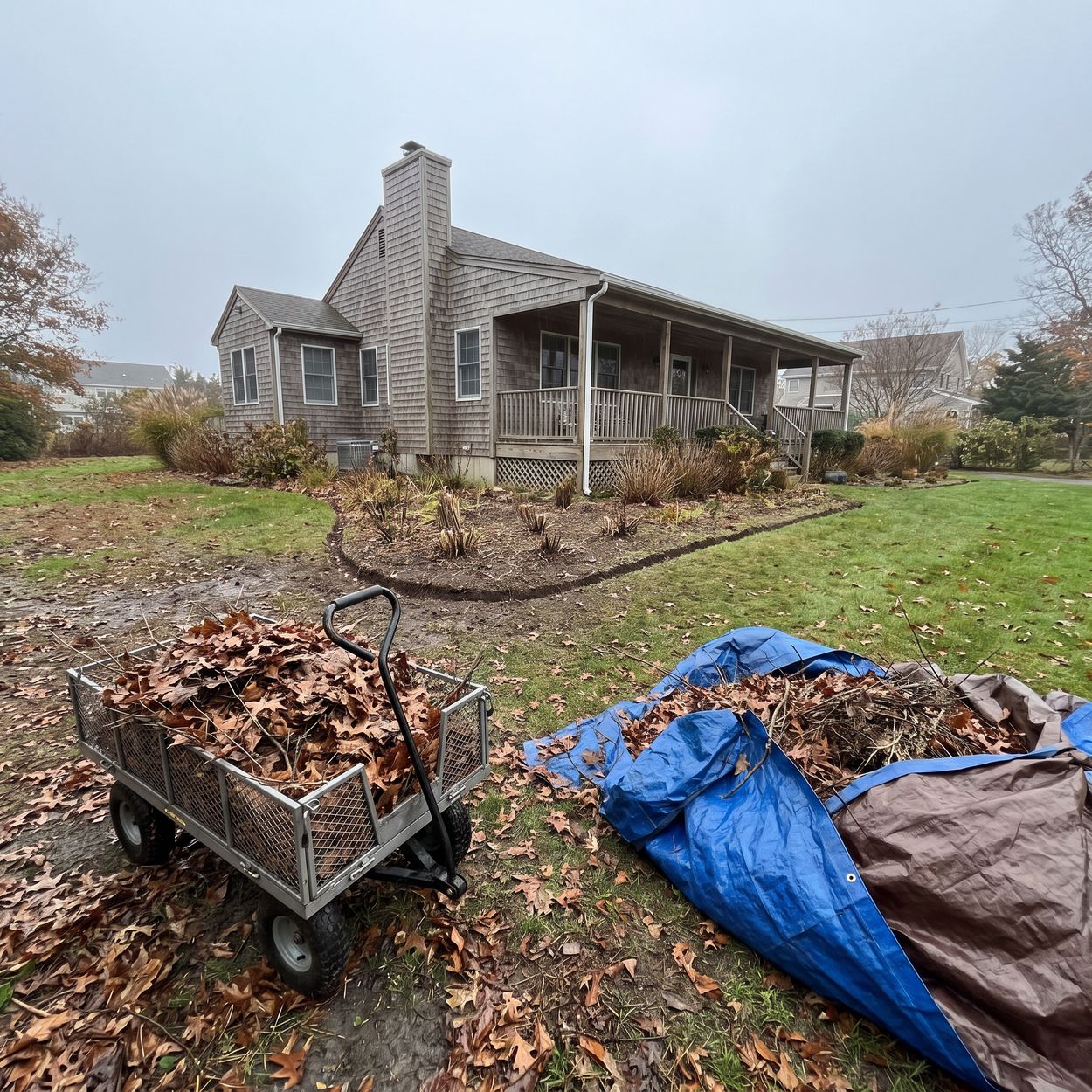
Three things set the handling scope: how material moves to the truck, how far the truck then travels, and what happens at the other end. A property where a truck can back close to the work is fundamentally different from one where every load crosses a lawn, a walkway, and a front yard by tarp or barrow.
Volume also sets the number of trips. A heavily wooded property can fill a truck more than once, and every additional round trip is time the crew is not on site working.
Homeowners often ask about leaving material on site. Composting or windrowing debris in a back corner can reduce haul-off, and on larger lots in Green Creek or Del Haven it sometimes makes sense. On a compact lot it usually just relocates the problem, and in our field experience wet matted material left against turf or a foundation becomes something to solve again in spring.
What Access Constraints Add Time on Site?
Access constraints are anything that stops a crew from bringing the right equipment to the right place. They rarely change what has to be done. They change how long it takes to do it, sometimes dramatically.
The common ones on shore properties are narrow side yards, gates too tight for a walk-behind machine, fenced rear yards with a single point of entry, elevated decks and stair runs, and pilings or under-house parking that limit turning room. Corner lots and shared driveways add a staging problem, because there may be nowhere safe or legal to park a truck and trailer near the work.
Street parking is a seasonal constraint of its own. A cleanup in Town Bank in early October runs differently from the same cleanup later in the fall, because the amount of curb available to a work truck is not the same in both months.
Soft ground is the constraint people forget. Lower Cape May County has a high water table, and after a wet stretch a low corner will not carry equipment. When that happens the choice is to hand-carry the work or come back, and both cost time.
How Many Visits Does a Property Actually Need?
Most properties under trees need more than one fall visit, and visit count is usually the largest single line in a cleanup scope. One pass works on an open lot with light canopy. It does not work under mature trees, however thorough that pass is.
The reason is the drop itself. Leaves come off in waves rather than all at once, so a property cleared during the first wave looks untouched again soon after. What our crews plan around is a staged sequence: an early pass to get ahead of the volume, a main pass through the heart of the drop, and a final pass to close the property out.
Coverage between passes is a separate decision, and it belongs to the homeowner. Some owners want the property presentable the whole way through, which means more frequent, lighter visits. Others want it left alone until the trees are bare and then handled once, which means fewer and heavier visits. Neither is wrong, but the choice has to be made before the schedule is built.
Rental and second-home properties usually want the last visit tied to a date rather than to the trees. A fall cleanup sequence built around a closing date, a final guest turnover, or a family holiday is a legitimate scope, and it is far easier to book in early fall than in the weeks when every property wants the same crew.
What Makes Cleanup Scope Different in Lower Cape May County?
Coastal conditions change the material, the timing, and the ground the crew stands on. This is not a generic fall cleanup market, and a scope written for an inland property will be wrong here in three specific ways.
The first is the calendar. Lower Cape May County sits in USDA zone 7b, and the USDA zone map assigns zones by average annual extreme minimum winter temperature, in 10 degree Fahrenheit bands split into 5 degree half zones, with the current version published in 2023. A milder winter low means the season runs later here than it does inland, which pushes the final pass later and compresses the window when every property wants one at once.
The second is what actually lands on the ground. On properties in Town Bank and Del Haven, crews are not only collecting leaves. Blown sand, marsh and dune litter, salt-burned foliage, and storm debris off the bay side all end up in the same beds, and sand-loaded material is heavier and slower to move than dry leaves.
The third is the ground itself. Sandy soil drains quickly, but a high water table keeps low corners soft, so the equipment decision moves with the week’s weather instead of staying fixed to the property.
Tourist season sets the rest of it. Crews work around guest turnovers deep into the fall, second homes sit unvisited for months at a stretch, and a property nobody has touched since summer carries a heavier first visit than one maintained all season. A contractor quoting the same scope here that they would quote inland is not accounting for the coast.
How Does a Cleanup Walk-Through Work?
A walk-through is a scoping visit, not a sales call, and it follows the same sequence every time. The point is to leave with a written description of the work rather than a number pulled from a range.
- Start at the truck. Look at where a vehicle and trailer can stage, what the turning room is, and how far material travels from the back of the property to the curb.
- Walk the perimeter first. Fence lines, hedge bases, and property edges collect the material that takes longest to remove, and they give the earliest honest read on how heavy the job is.
- Read the canopy, not the tree count. Note what is still holding, what has already dropped, and what neighboring trees are going to send across.
- Measure the bed edge. Linear footage of border, the number of separate beds, and what is planted in each one determine the hand-work portion of the day.
- Check access at every gate and corner. Gate widths, stair runs, slope, and any soft ground get recorded, because those decide the equipment list.
- Identify the hard surfaces. Driveways, walkways, stone areas, and decorative rock all have to be cleared, and stone takes longer than paving because debris settles down into it.
- Agree the visit count and the finish date. The homeowner decides how the property should look between passes and when the last visit needs to land.
- Put it in writing. The scope should name what is included, what is excluded, what leaves the property, and what finished condition looks like.
That final step is the one worth insisting on with any contractor. A written fall property cleanup scope is what makes two proposals comparable, because it shows whether both include haul-off, bed cutbacks, and the same number of visits.
What Should You Verify Before You Hire Anyone?
Registration and insurance are the two items to confirm before work starts, and both take only a few minutes to check. New Jersey requires home improvement contractors to register with the New Jersey Division of Consumer Affairs and to display a registration number, commonly called an NJHIC number. The state’s contractor registration guide also sets a minimum commercial general liability insurance requirement of 500,000 dollars per occurrence.
Ask for both in writing, and ask for a current certificate of insurance rather than a photograph of an old one. Verify registration status and current standing directly with the New Jersey Division of Consumer Affairs instead of relying on what appears on a truck, a business card, or any company website.
Municipal rules are the other thing to check yourself. Yard waste collection, bagging requirements, curbside pickup windows, and restrictions on burning or on-site disposal are set locally and differ between municipalities. Your municipal offices are the authority on what your address is allowed to do, so confirm with them before planning to leave anything at the curb.
Finally, get the scope and the payment terms onto the same document.
Scope of this guidance
Boyes performs seasonal property cleanups and scopes each one on site. We are not attorneys, insurance advisors, or a licensing authority, and nothing here is legal advice. Confirm contractor registration and standing with the New Jersey Division of Consumer Affairs, confirm coverage questions with your own insurer, and confirm yard waste and disposal rules with your municipality before any work begins.
Frequently Asked Questions
These are the questions that come up most often when we scope a seasonal cleanup.
Why will a contractor not quote a cleanup over the phone?
The factors that set the scope are not visible from the road or from an aerial photo. Canopy density, bed edge footage, gate widths, soft ground, and where a truck can stage all have to be seen in person. A phone call is the right way to book a walk-through, which is where an accurate scope comes from.
Is one fall cleanup enough, or do I need several visits?
It depends almost entirely on canopy. An open lot with light tree cover is often a single visit. A property under mature trees usually needs a staged sequence, because leaves drop in waves and one early pass will not hold. Agree the visit count before the schedule is built, not after the first pass disappoints.
Does the debris have to be hauled away?
Not always, but it usually should be. Haul-off is a separate part of the scope from collection, and leaving material on site only makes sense where there is genuinely somewhere for it to go. On compact lots, wet matted debris parked in a back corner becomes next spring’s problem.
When should I book a fall cleanup in lower Cape May County?
Earlier than most people do. The window when every property in Erma, Green Creek, and Del Haven wants a final pass is short, and it lands late here because the season runs later than it does inland. Booking in early fall is what secures a specific finish date rather than a place in a queue.
What is the difference between a cleanup and regular maintenance?
A cleanup is a scheduled reset of the whole property at the turn of a season, covering bed cutbacks, debris removal, edge work, and haul-off. Regular maintenance holds a property to a standard between those resets. Most properties use both, and the cleanup scope is smaller on a property that has been maintained all season.
Seasonal cleanup scope is knowable before anyone starts working. Canopy, bed footage, access, haul-off distance, and visit count explain nearly all of the difference between two properties on the same street, and every one can be settled in a single walk-through. Ask for the scope in writing and the rest of the season plans itself.
Getting the fall cleanup on the calendar? Call Boyes at 856-386-4600 and we will scope the property with you.