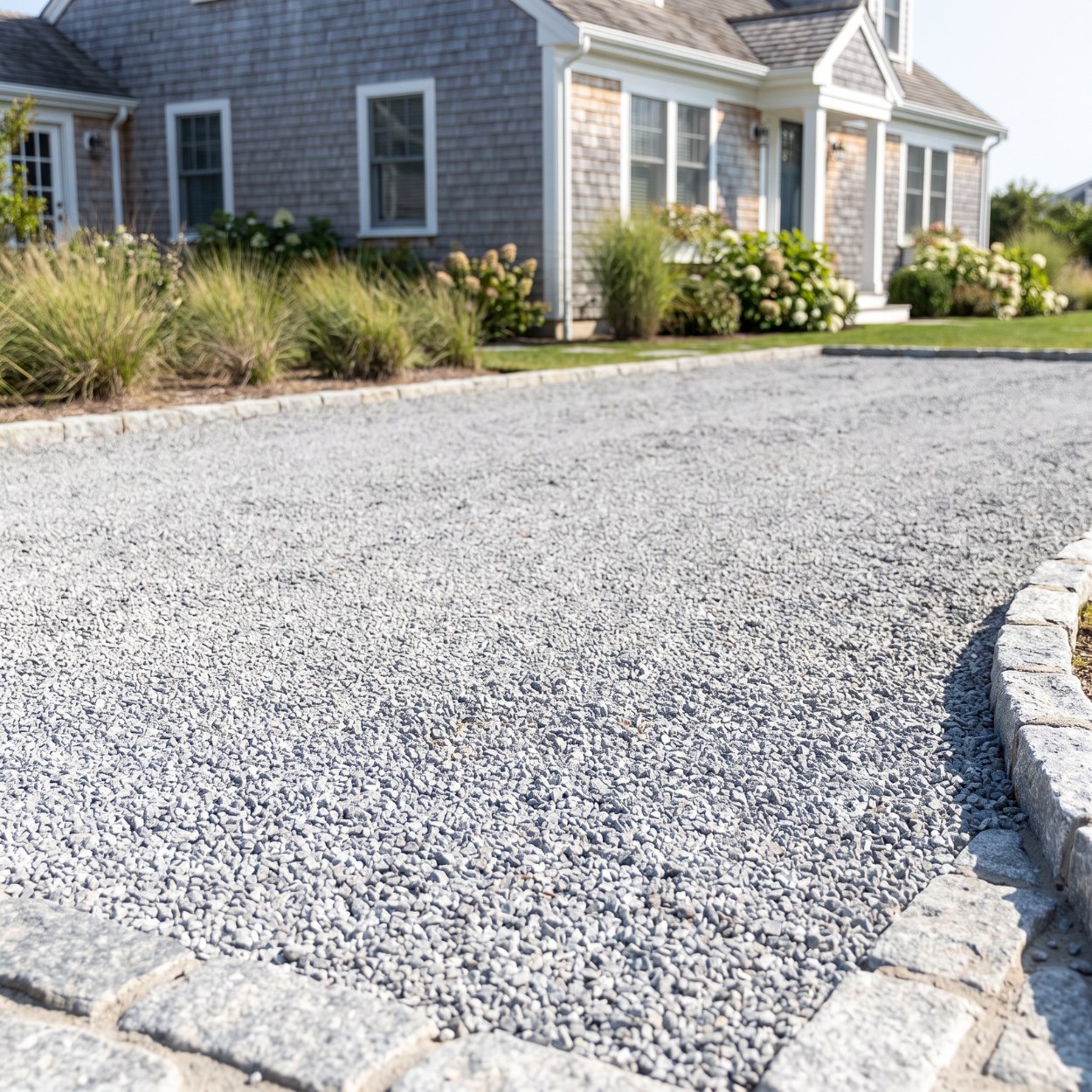
TLDR: A gravel driveway works well in lower Cape May County when the property has the room for it and the installer builds a proper base and a real edge. On sandy coastal soil, gravel laid directly on the ground migrates, thins, and disappears into the sand within a season or two. A gravel driveway built on a compacted stone base with Belgian block, steel, or timber edging holds its shape for years and drains better than any solid surface, which matters on a high water table. The gravel you see is the smallest part of the job.
Gravel driveways get dismissed as the budget option. On the larger rural lots around Green Creek and Del Haven, that reputation is wrong. A properly built gravel drive handles water better than asphalt, repairs in an afternoon rather than a weekend, and suits the character of a wooded property in a way a poured surface does not. A badly built one turns into ruts and scattered stone by the second winter. This guide covers the difference.
What Is a Gravel Driveway
A gravel driveway is a driving surface built from compacted layers of crushed stone, sized from a coarse structural base up to a finer surface course, contained by an edge treatment that prevents lateral migration. It is a permeable surface, meaning water passes through it into the ground rather than running off it.
That last sentence is the part homeowners in this county should pay attention to. Lower Cape May County sits on sandy soil with a water table that comes up close to the surface in much of the area. Every square foot of solid, sealed driveway is a square foot of ground that can no longer absorb rainfall, which pushes that water somewhere else on the property. A gravel drive takes water down through itself. The EPA’s guidance on permeable pavement explains the general principle, and it applies directly to a well-built aggregate surface.
When a Gravel Driveway Makes Sense in Lower Cape May County
Gravel is the right answer more often than people expect, and the wrong answer in specific, predictable situations.
Where Gravel Works Well
Long driveways on larger lots. The rural properties out toward Green Creek and Del Haven often have driveways running well back from the road. Gravel scales to that length in a way solid surfaces do not.
Wooded and semi-rural properties. A gravel drive under a tree line looks correct. It also tolerates root movement far better than a rigid surface, which cracks.
Properties with drainage sensitivity. On a lot where water already collects, adding an impermeable surface makes the problem worse. Gravel does not.
Secondary and utility areas. Side yards, boat and trailer parking, equipment areas, and overflow parking are natural gravel applications, which is why we treat parking pads and gravel areas as their own scope rather than an afterthought on a driveway job.
Properties where future change is likely. Gravel is the least permanent surface. If a homeowner expects to build, extend, or reconfigure within a few years, committing to a permanent surface first is backwards.
Where Gravel Is the Wrong Choice
Steep grades. Gravel migrates downhill under traffic and rain. Lower Cape May County is mostly flat, so this comes up rarely, but on the occasional graded lot or elevated approach it matters.
Tight urban lots with no edge room. A gravel drive on a narrow lot in a dense neighborhood scatters stone onto the sidewalk, into the lawn, and into the street. The edge treatment that prevents this needs space and a clean line.
Properties where the finished look is the point. On the historic-district homes in Cape May, a gravel drive can read as unfinished against a restored Victorian facade. That is an aesthetic judgment, not an engineering one, but it is a real one.
High-frequency turning areas. Wheels turning in place grind gravel and dig holes. A tight turnaround in constant use is hard on any aggregate surface.
Gravel Type Selection for Coastal Properties
“Gravel” covers a wide range of materials that behave very differently, and choosing wrong is the second most common failure after skipping the base.
Crushed angular stone has fractured faces that lock together under compaction. This is the material a driveway should be built from. It knits into a semi-rigid mat that carries vehicle weight.
Rounded river stone does not lock. The stones roll past each other under load. River rock is a beautiful bed material and a poor driving surface. We use it constantly in landscape beds and almost never on a driveway.
Dense-graded aggregate, a blend of crushed stone with stone fines, compacts into the tightest and most stable surface available. The fines fill the voids between the larger pieces and bind the whole layer. This is the standard structural material.
Clean, open-graded stone with no fines drains fastest but stays loose. It is excellent as a drainage layer and unpleasant to walk on or drive slowly across.
Jersey stone and decorative blends are surface-course materials chosen for appearance. They belong on top of a properly built base, not as the base itself.
Our normal build for lower Cape May County is a structural base of dense-graded crushed stone, compacted in layers, with a surface course selected for the look the homeowner wants. Getting the right gravel and edge combination is most of the design decision on a gravel job.
A note on color, because it comes up on every quote. Lighter stone reflects heat and shows up well against a dark tree line, which suits the wooded lots inland. Warmer tan and buff tones read as more traditional against a shingled shore house. Darker stone hides tire marks and organic staining better. None of these affect performance.
Base Prep on Sandy Coastal Soil
This is the section that determines whether the driveway exists in five years.
Sandy soil is a poor foundation for a driving surface. It has low bearing capacity, and worse, it will absorb gravel. Stone dropped onto bare sand under vehicle load works its way down into the sand, and the sand works its way up into the stone. Within a season or two the driveway is a mixture of both, and it behaves like neither.
A proper build excavates to a working depth, then installs a geotextile separation fabric across the subgrade. The fabric does one job and does it well: it keeps the stone and the sand apart. Skipping it is the single cheapest way to guarantee the driveway fails, and it is the item most often missing from a low quote.
Above the fabric, the structural base goes in and gets compacted in layers rather than dumped in one lift. Compaction in lifts is what produces an actual load-bearing mat. A single deep lift compacts on the surface and stays loose underneath. Our approach to gravel base prep is built around that layered sequence, and it is where the labor on a gravel job actually goes.
Depth depends on what the driveway carries. A passenger-car driveway on stable subgrade needs less than a drive that takes delivery trucks, a contractor’s equipment, or a boat trailer. We ask what will actually drive on it, including once a year, because the annual heavy load governs the design, not the daily one.
Before we quote a base, we look at what the ground actually is. The USDA’s Web Soil Survey gives a useful baseline picture for a parcel, though it never replaces digging a test hole on site, which we do.
Where the underlying grade is sending water toward the driveway rather than away from it, that gets corrected first. Building a driveway on top of a drainage problem produces a very well-built puddle. On properties where water is arriving from elsewhere on the lot, our water flow correction work happens before any stone goes down.
Edge Containment and Why It Matters
Gravel without an edge is gravel in your lawn.
Every vehicle that drives on a gravel surface pushes stone sideways. Every rain moves a little more. Without containment, the driveway spreads, thins in the middle, and deposits itself into the surrounding turf and beds, where it damages mower blades and looks like neglect.
Belgian block is the strongest and best-looking option, and it is what we recommend most often on properties where the driveway is visible from the street. Set correctly, the block gives the drive a finished line and a mass that resists lateral pressure indefinitely. It also transitions cleanly to a paver apron at the street if that is part of the plan.
Steel edging is lower-profile and less expensive, and it works well where the edge should disappear visually. It is less forgiving of impact. A wheel that runs up on it will bend it.
Pressure-treated timber suits rural and wooded properties aesthetically and installs quickly. It has the shortest service life of the three, particularly in the moisture conditions here.
No edge at all is a legitimate choice on a long rural drive running through woods, where a soft boundary is part of the look and the surrounding ground is not lawn. It is not a legitimate choice anywhere the drive meets maintained turf.
The edge also does a structural job people miss: it confines the base laterally, which is part of what lets the base carry load. An unconfined base spreads under pressure. Confinement is not just cosmetic.
Longevity Expectations and Maintenance Realities
A gravel driveway is not a maintenance-free surface, and any contractor telling a homeowner otherwise is setting up a complaint.
Annual or biennial top-dressing. Surface stone works down and works out. Adding a fresh surface course on a regular cycle is normal and expected, not a sign of failure.
Occasional regrading. Ruts and low spots develop, particularly in wheel tracks and turning areas. Pulling the surface back level with a box blade or rake restores it.
Edge inspection. Timber rots, steel bends, and block can shift if the base under it moved. An annual look at the edge catches problems while they are small.
Weed suppression at the surface. Organic material blows in, settles into the surface course, and creates a seedbed. Keeping the surface clean and the separation fabric intact underneath is the physical control. Periodic surface raking pulls it out.
Winter care. Plowing a gravel drive scrapes surface stone into the lawn if the blade is set too low. Skids or shoes on the plow blade prevent it.
Against that, the repair economics are genuinely good. A pothole in asphalt is a patch that will show and will fail again at the seam. A pothole in gravel is thirty minutes with a rake and a wheelbarrow, and afterward there is no seam.
Properties with commercial traffic have a different maintenance curve entirely, with more frequent regrading and heavier surface courses. That is a different scope, and we treat it as one, alongside the rest of our commercial hardscaping work.
Gravel Compared to Other Driveway Surfaces
A direct comparison, without pricing, on the factors that actually differ.
Drainage. Gravel is permeable. Asphalt and poured concrete are not. Pavers on an open-graded base are partially permeable. On a high water table lot, this is the most consequential difference on the list.
Repairability. Gravel is repaired in place with no visible seam. Pavers are lifted and reset with no visible seam. Asphalt and concrete patch visibly and fail again at the patch edge.
Frost and freeze-thaw behavior. Gravel has no rigid structure to crack, so it is essentially immune to freeze-thaw damage. Concrete cracks. Asphalt softens in summer heat and becomes brittle in cold. Pavers move as individual units and tolerate cycling well.
Salt exposure. Coastal salt air and road salt degrade concrete surfaces over time and attack the binder in asphalt. Stone is inert.
Appearance and formality. Pavers read as the most finished, then concrete, then asphalt, then gravel. This is the axis on which gravel loses, and for many homeowners it is the deciding one.
Maintenance attention. Gravel needs regular small attention. Asphalt and concrete need no attention for years and then need significant work. Pavers need occasional joint maintenance.
Homeowners who are genuinely deciding between surfaces usually benefit from seeing the base construction on both sides. The excavation and base sequence for a paver driveway base is more involved than for gravel, and understanding why explains most of the cost and durability difference between the two.
Permits and Approvals for Driveway Work
Requirements for driveway construction differ by municipality across lower Cape May County, and they change. Work that connects to the public right-of-way, work that changes the amount of impervious surface on a lot, and work in flood-sensitive or environmentally regulated areas can all trigger review.
We handle applicable permitting as part of the project and follow the requirements of the specific municipality, whether that is Lower Township for the Villas, Erma, Green Creek, and Del Haven areas, the City of Cape May, or the county for county roads. We are contractors, not a permitting authority, so homeowners should confirm current requirements for their specific property with their local building department or construction office before planning around any assumption.
Because a gravel surface is permeable, it often sits differently under stormwater and impervious-coverage rules than a sealed surface does. The New Jersey Department of Environmental Protection’s stormwater program is the state-level reference for how that thinking works, and municipal rules are built on top of it.
Who We Are
Boyes Lawncare & Landscaping is a family-run, owner-led lawn care, landscaping, and hardscaping company based in Villas, serving lower Cape May County. Owner Matthew Boyes walks every property before quoting, which on driveway work means looking at the subgrade, the water, and the traffic the surface will actually carry. We carry a 5.0 Google rating built on how the work holds up, not on how fast it went in.
Frequently Asked Questions About Gravel Driveways in Cape May County
How long does a gravel driveway last in lower Cape May County?
A gravel driveway built on a compacted stone base over separation fabric, with proper edge containment, has no fixed end of life. It is maintained rather than replaced, with periodic top-dressing and regrading. A gravel drive built directly on sand without fabric or edging typically degrades noticeably within one to two years and needs a full rebuild rather than maintenance.
What kind of gravel is best for a driveway on sandy soil?
Crushed angular stone, not rounded river stone. The fractured faces of crushed stone lock together under compaction and carry load, while rounded stone rolls under traffic. A dense-graded blend of crushed stone with fines makes the best structural base because the fines fill voids and bind the layer. Decorative stone belongs on the surface, over that base.
Do gravel driveways need edging?
Anywhere the driveway meets lawn or beds, yes. Without an edge, traffic and rainfall push stone laterally into the surrounding turf, thinning the drive and creating a maintenance problem in the lawn. Belgian block, steel edging, and pressure-treated timber all work, with different service lives and appearances. A long rural drive through woods is the one situation where no edge can be appropriate.
Is a gravel driveway better than asphalt on a high water table property?
For drainage, yes. Gravel is permeable and lets rainfall pass into the ground where it falls, while asphalt sheds all of it somewhere else on the lot. On properties in lower Cape May County where water already collects, adding impermeable surface makes the existing problem worse. Asphalt wins on finished appearance and on requiring no routine attention.
Can gravel be installed over an existing asphalt or concrete driveway?
Generally it should not be. The old sealed surface prevents the drainage that makes gravel work, and gravel over a hard surface has nothing to key into, so it shifts underfoot and under tires. If a homeowner wants to convert, the correct sequence is removing the old surface and building a proper base.
How much maintenance does a gravel driveway actually need?
Realistically, a top-dressing of surface stone every year or two, a regrading pass when ruts develop in the wheel tracks or the turnaround, an annual look at the edge treatment, and periodic raking to pull out organic material that has blown in and settled. It is frequent light attention rather than infrequent major work.
Ready to Talk About a Gravel Driveway
If you are weighing a gravel driveway anywhere in lower Cape May County, from the larger lots around Green Creek and Del Haven to the beach-block properties in Wildwood Crest, the useful next step is a site walk. We will look at the subgrade, the water, the access, and the traffic the surface has to carry, and give you an honest read on whether gravel driveways and surfaces are the right call for your property.
Call 856-386-4600 or use the contact page to set up a walkthrough. You can also see how gravel driveways fit alongside the rest of our hardscaping work.