
TLDR: Gravel driveway edging is the perimeter restraint that keeps loose stone inside the driveway, and on lower Cape May County sand it decides whether a drive still has a clean line in five years. Belgian block set on a compacted stone shoulder holds its shape best under wheel loading, which is why Boyes specifies it on most coastal driveways. Steel edging is the lighter option for tight curves and light traffic, and treated timber is the shortest lived of the three in salt air over a high water table. On a barrier island lot in North Wildwood or Diamond Beach the edge fails first, and the driveway follows it.
Gravel driveway edging is a continuous perimeter restraint, set into or onto a compacted base, that resists the sideways pressure loose aggregate exerts every time a wheel crosses it. It is a structural element rather than a trim detail, and it is installed to a line and an elevation, not simply laid along whatever shape the stone happened to take.
Why Does Gravel Spread on a Coastal Driveway?
Gravel spreads because a loose aggregate surface is a pile, and a pile keeps seeking a flatter angle unless something holds its sides. Every wheel that crosses it presses stone down and pushes stone outward, and every turn of a steered tire scrubs material sideways. None of that movement reverses on its own.
Sand sharpens the problem. On inland soils carrying clay or organic content, the ground outside a driveway forms a shoulder with some cohesion that pushes back. Coastal sand has almost none, so the perimeter slumps outward instead of resisting.
The result is a driveway that widens and thins at once. Stone thins in the wheel tracks where depth matters and piles into the yard where nobody wants it, so a surface built to the right depth is short of it within a couple of seasons. That is why gravel driveways in this county are an edging problem before they are a stone problem.
What Does a Driveway Edge Actually Have to Do?
A driveway edge does three jobs at once: it restrains stone laterally, it holds a line the surface can be maintained back to, and it takes the abuse of tires that overrun the surface. An edge that only does the middle job is decoration, and decoration is what most failing coastal driveways were sold.
Lateral restraint is the structural job. Loose aggregate under load behaves a little like a fluid, pushing outward at the perimeter, and the edge has to transfer that push into ground that will not move. On sand the edge cannot borrow resistance from the sand; it has to bear on compacted stone or a footing carrying its own weight.
Holding the line is what the owner sees, since a defined edge gives a crew something to rake and re-grade back to. Taking abuse is the job nobody specs for: delivery trucks, contractor vans, and unfamiliar guests all cut the corner, and the edge is what they hit.
How Does Belgian Block Edging Hold Up on Sand?
Belgian block is the most durable gravel driveway edge available on the coast, and Boyes specifies it on the majority of these projects. It is a cut granite unit, roughly the proportions of a large brick and several times the weight, set end to end in a continuous run along the perimeter.
Its advantage on sand is mass combined with bedding. A block set on compacted stone, haunched with concrete where traffic warrants it, resists lateral push through its own weight and through the compacted shoulder behind it, so the sand subgrade is no longer being asked to hold the line. Nothing in that system depends on a stake finding purchase in loose material.
Granite is also indifferent to the two things that shorten the life of everything else here: salt air does not corrode it, and wetting does not rot, swell, or split it. The trade is labor, since block has to be laid to a string line on a prepared shoulder and set consistently in height or the run reads wavy from the street. That is why Belgian block edging is treated as its own scope rather than a line at the bottom of a driveway quote.
Where Does Steel Edging Make Sense?
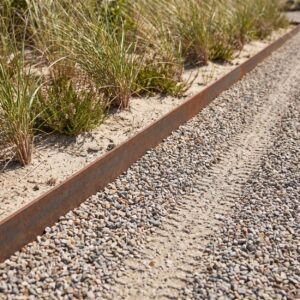
Steel edging is the right choice where the line is tight, the profile needs to stay low, and vehicles do not routinely run over the edge itself. It is a rolled steel strip driven into the subgrade with stakes at intervals, and it will follow a curve that block can only approximate.
Its strength is geometry. A steel edge disappears visually, sits nearly flush with the finished stone, and turns a radius cleanly, which suits the curved side of a parking pad, a border between gravel and a planted area, or a walkway shoulder.
Its weakness here is anchorage, because steel holds through stakes gripping the ground and loose sand grips poorly. Boyes sets stakes tighter than a manufacturer’s minimum on sandy sites and seats the edge against compacted stone rather than native sand, since a stake in beach-type material can be worked loose by repeated tire pressure alone. Corrosion is manageable: heavier commercial gauges with a factory coating outlast thin residential stock in salt air, so within sight of the water, gauge is the specification worth arguing about.
Is Treated Timber Edging Worth Using Here?
Treated timber is the shortest lived of the three edges in this climate, and Boyes uses it only where a shorter service life is understood and accepted up front. It is pressure treated lumber spiked into the ground along the perimeter.
Local conditions work against it. A high water table keeps buried wood damp rather than letting it dry between wettings, salt air is hard on fasteners, and ground contact is the hardest service condition treated wood faces. What fails is usually the connection before the timber: spikes back out, joints open, and a run straight in year one develops a step at every seam.
Timber also fights the shape of most coastal driveways, since lumber comes straight and a curve becomes a series of chords with a gap at each joint. Gravel finds every gap. There is a narrow case for it on a straight rear parking area or a temporary line while a larger project is staged, but anywhere a vehicle rides the edge it is the wrong material.
Which Edge Holds Shape Best Under Wheel Loading?
Belgian block holds shape best under wheel loading, steel is a clear second, and treated timber is last. The ranking follows from how each resists a sideways push, and wheel loading is that push repeated thousands of times.
Block resists with mass and with the compacted shoulder under it, so load spreads into a prepared structure. Steel resists at each stake, meaning restraint is a series of points with unsupported span between them, and on sand each point is only as good as the material around it. Timber resists through fasteners, the weakest of the three, because a fastener working loose takes the whole section with it.
Overrun behavior separates them further. A tire climbing a block edge meets something that does not move and rolls back off. A tire on steel deflects the strip and, over enough repetitions, opens a gap behind it. A tire on timber can roll the piece out of line in one pass. That is why hardscaping ROI on coastal property usually favors the detail that does not need revisiting.
What Does Winter Use Do to a Gravel Edge Here?
Winter damages gravel edges here through saturation and wheel loading rather than deep frost. Lower Cape May County sits in USDA zone 7b, and the 2023 USDA zone map assigns zones by average annual extreme minimum winter temperature, presented in 10 degree Fahrenheit zones split into 5 degree half zones. That is a mild band nationally, and in our field experience deep frost heave is not what pulls coastal edges apart.
Saturated ground is. Winter is the wettest stretch of the year on these lots, the water table already sits close to the surface, and sand holding water loses what bearing capacity it had. An edge anchored by stakes into that material has less to hold in February than in August. Shallow freeze and thaw cycling works lightly anchored components upward a fraction at a time, which is why stakes and spikes back out over a winter while a bedded block run does not.
Winter use is the third factor and the one owners underestimate. Off season deliveries, contractor trucks working on empty second homes, and vehicles turning on a soft wet surface all load the perimeter when it is weakest. A driveway that looked fine in October can show a spread edge by March.
How Does Boyes Install a Gravel Driveway Edge?
The edge goes in as part of the base, before the finished stone, set to a string line and a measured elevation rather than eyeballed against the existing driveway. This is the sequence a Boyes crew follows on a coastal gravel driveway.
- Walk the property and mark the layout. The crew sets finished width, turn radii, and tie-in points at the street and the structure, then checks how water moves across the area.
- Locate what is buried. Utilities are marked out through the required process before any machine breaks ground.
- Establish line and elevation. Stakes and string fix both, so the edge follows a plan instead of whatever shape the old stone spread into.
- Excavate the driveway and over-excavate the perimeter. We cut past the finished edge, roughly 6 to 12 inches each side as field practice, leaving room for a shoulder the edge can bear on.
- Shape and proof roll the subgrade. Loaded equipment runs the open cut while the crew watches for soft pockets, and anything that moves is replaced with compacted stone.
- Build the base in compacted lifts, including under the edge line. The shoulder under a block run is base material, not native sand, compacted with the same care as the driving surface.
- Set the restraint. Block is laid to the string on the prepared shoulder and haunched where traffic warrants, steel is seated against compacted stone with stakes spaced tight, and timber is set on stone rather than sand.
- Backfill behind the edge and compact it. An edge with a void behind it has half a structure, and that void is where movement shows first.
- Place and compact the finished stone, holding the surface slightly below the top of the restraint so the edge can work.
- Grade the surround and walk the result. Water is checked leaving the surface rather than pooling at the perimeter, and the run is sighted for line and height.
Steps 7 through 9 are the ones a homeowner watches. Steps 4 through 6 decide whether the edge is still straight in five years.
What Makes Gravel Edging Different in Lower Cape May County?
Four local conditions drive every edging decision here: sand with no cohesion, salt exposure, a water table close to the surface, and a calendar built around visitors. An edge detail copied from an inland job is wrong before the first stake goes in.
Sand comes first and changes the whole logic. On barrier island lots in North Wildwood, West Wildwood, and Wildwood, both native ground and decades of imported fill are sandy, and the perimeter is the least supported part of the site. That argues for restraint carrying its own weight rather than borrowing strength from the ground.
Salt and water come next. Properties in Diamond Beach and North Wildwood sit where salt air is constant and coastal storm water occasionally crosses a driveway, and moving water is efficient at carrying fine material out from behind an unsupported edge. The high water table sets how deep anyone can build: where groundwater sits close, the answer is not a deeper footing but a shoulder built up in compacted lifts, so the restraint bears on constructed material rather than saturated sand.
The season decides when work happens. North Wildwood and Wildwood run on rental turnovers and street parking gets scarce in summer, so this work books heaviest in the shoulder seasons. Second homes add the last wrinkle, since an owner visiting monthly misses the early spread and by then the stone has already thinned in the tracks. Choosing the right gravel and the right edge together is what keeps that from becoming an annual expense.
Where Do Walkways and Access Routes Change the Edge Detail?
Anywhere a pedestrian route crosses a gravel driveway, the edge stops being a landscape detail and becomes part of a walking surface. That changes both material and elevation, because a restraint standing proud of the stone is a trip point.
The published standards are worth reading before that transition is designed. The ADA ramp guidance from the US Access Board treats any level change greater than one half inch, and any route steeper than 5 percent, as a ramp. It sets a maximum running slope of 1:12 and a maximum cross slope of 1:48, requires at least 36 inches of clear width, and requires surfaces to be firm, stable, and slip resistant, with landings designed to prevent water from accumulating.
Loose stone does not meet firm, stable, and slip resistant, which is the practical takeaway for commercial and condominium properties. Where an accessible route crosses a gravel drive, the crossing becomes a paved element with the gravel edge terminating cleanly into it, and a paver driveway installation or paved apron is often the cleanest resolution.
How Do You Tell a Good Edge Detail From a Cheap One?
You read the written scope for what the edge sits on, because nearly every failed coastal edge was set on sand rather than compacted stone. A quote naming the restraint material, what it bears on, how far excavation runs past the finished edge, and whether the perimeter is haunched or backfilled and compacted is describing a structure. A quote that says only install edging is describing a line item.
Ask what happens where the driveway turns. Radii test block spacing, steel gauge, and timber joints alike, and a contractor who has thought about it answers without hesitating.
Watch the sequence on site if you can, because an edge installed after the finished stone, set against native sand, or driven in with no shoulder behind it tells you what the base looks like. Owner led work is the practical answer to a detail buried on day one. Matthew Boyes is on these projects, and the decisions that matter, how far past the line to dig and whether a soft pocket gets replaced or covered, get made on site. Owners weighing options often start with gravel driveway basics before choosing a restraint.
Frequently Asked Questions
These come up most often when we scope a coastal gravel driveway edge.
Does a gravel driveway need an edge on both sides?
In almost every case here, yes. Stone migrates toward whichever side is unrestrained, so a single sided edge just moves the failure across the driveway. The exception is a side already terminating against a structure, a curb, or a hard surface providing its own restraint.
Can Belgian block be added to an existing gravel driveway?
Yes, and it is common work. Stone along the perimeter is pulled back, the shoulder is excavated and rebuilt in compacted lifts, block is set to a string line, and stone is graded back up to the new edge. The prep matches a new installation, so the existing surface mostly contributes reusable material.
Will steel edging rust through near the water?
Eventually, though gauge and coating make a large difference. Heavier commercial steel with a factory finish outlasts thin residential stock in salt air, which is why we specify up rather than down close to the water. Where a client wants an edge they never think about again, granite is the more honest recommendation.
How high should the edge sit relative to the gravel?
Boyes holds the finished stone slightly below the top of the restraint, because an edge flush with or below the surface has nothing to hold back. The exception is a pedestrian crossing, where the edge is set flush and the transition is handled with a paved element instead.
Why does gravel still end up in the yard even with an edge?
Usually because the edge was set on sand, backfilled loose, or installed after the surface stone rather than as part of the base. Material also escapes where an edge stops short at a turn or tie-in, since gravel finds the one gap in a continuous run. The fix is almost always at the shoulder, not the visible restraint.
An edge is the smallest structural decision on a gravel driveway and the one that determines whether the others hold. Get the shoulder, the material, and the elevation right and the surface stays where it was put. Gravel spreading past the edge? Call Boyes at 856-386-4600 and we will look at the edge detail.