
TLDR: A commercial lawn care contract for a Cape May County property should state exactly what gets maintained, how often, by whom, and what happens when something goes wrong. Seven parts carry the agreement: scope of work, visit schedule, insurance and registration verification, communication and escalation, reporting, seasonal transitions, and termination terms. Most disputes on commercial sites trace back to a scope line nobody wrote down rather than to work that was done badly. Boyes writes commercial agreements in plain language so a property manager can hand the document to a new employee and have them understand the site in ten minutes.
A commercial lawn care contract is a written service agreement between a property owner or manager and a maintenance contractor that defines the maintained area, the tasks performed on each visit, the frequency and season of those visits, the standards the work must meet, and the terms under which either party can end the arrangement.
What Does a Commercial Lawn Care Contract Actually Cover?
A residential agreement usually has one decision maker and one property. A commercial agreement has an owner, often a manager, sometimes a board or a tenant, and almost always a budget cycle running on its own calendar. The contract is the one document all of those people read, so it has to survive being handed to someone who was never at the original walkthrough.
Seven parts carry the weight. Scope of work, visit schedule, insurance and registration verification, communication and escalation, reporting, seasonal transitions, and termination terms. A proposal that covers a number and little else is not a contract, only a quote with a signature line.
Most of the friction on commercial sites is not about workmanship. It is about a strip of turf nobody assigned, a visit nobody logged, or a fall cleanup that one party assumed was included. Those are drafting problems, fixable before anyone signs. A serious commercial lawn care agreement closes the gaps in advance instead of arguing about them in August.
How Should the Scope of Work Be Written?
Scope is the section that prevents almost every argument, and it is the section most often written in a single vague sentence. “Maintain the grounds” means nothing when a manager and a crew leader are standing in a parking lot pointing at different patches of ground.
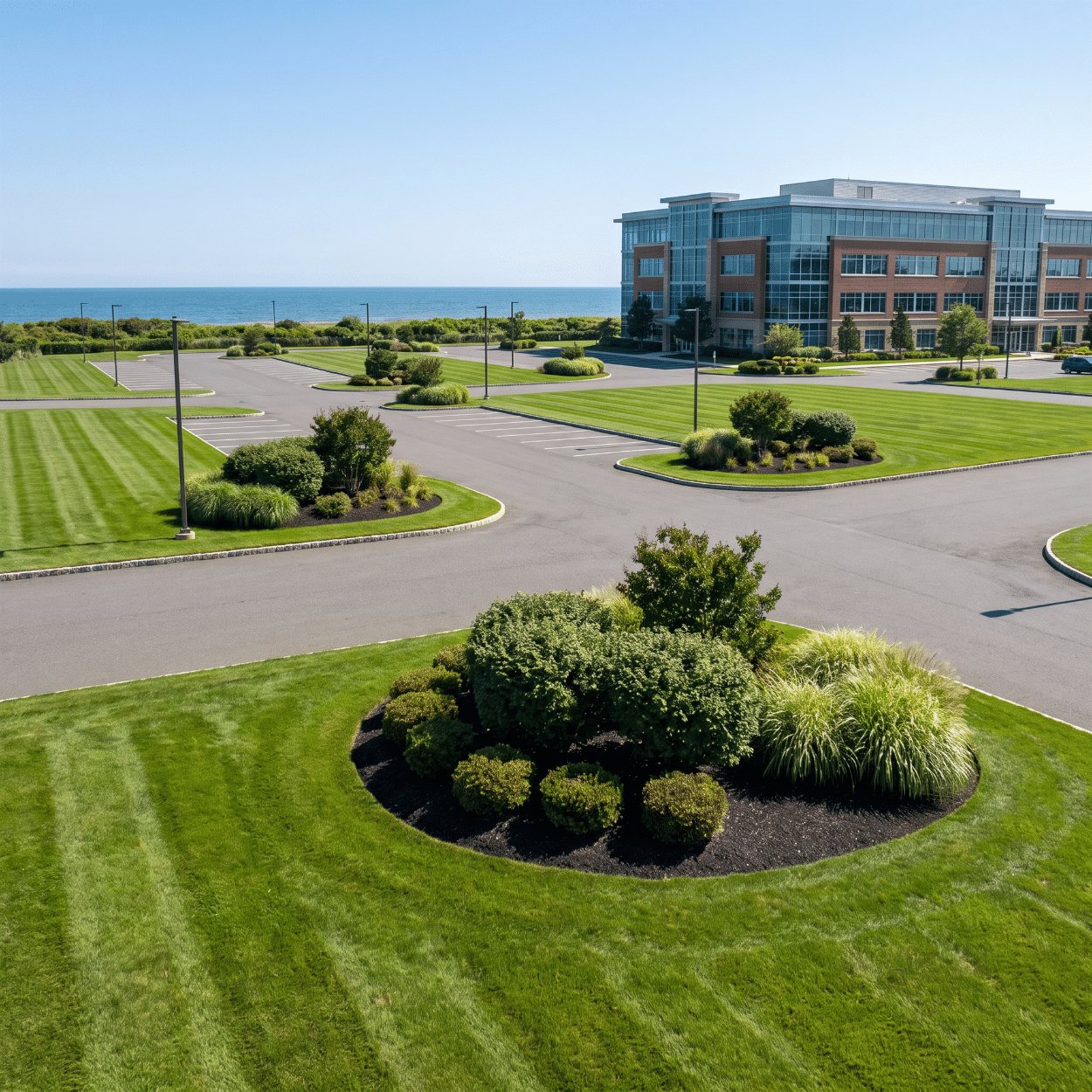
A usable scope has two halves: a defined maintained area and a defined task list. The area should be tied to a site plan or a marked aerial image attached to the agreement. Boundaries need naming, especially the ones people forget: curb strips between the lot and the road, the bank of a detention basin, the strip behind a dumpster corral, the ground between a building and a neighboring property line, and any island in the middle of the parking field.
What Belongs on the Inclusion List
Name the recurring tasks in the language a crew uses. Mowing the defined turf areas, trimming around posts, poles, signs, hydrants, and building foundations, edging along hard surfaces, and clearing clippings off walkways and parking areas before the crew leaves. If clippings blown into a bed or a curb line are supposed to be cleaned up, write that down.
Periodic work is separate from weekly work and should be listed separately with a season attached. Aeration and overseeding, for example, are annual or seasonal items on most commercial properties, not weekly ones, and burying them in a general maintenance sentence guarantees confusion about whether they were ever included.
What Belongs on the Exclusion List
An exclusion list is a clarity move, not a defensive one. Bed maintenance, mulch, hedge trimming, planting, and grading are real services with real labor attached, and a lawn agreement that stays silent about them invites the assumption that they are free. If the property needs the broader package, it belongs in a commercial landscaping agreement written alongside the mowing scope, not implied inside it.
What Should the Visit Schedule Say About Frequency and Timing?
Weekly service during the growing season is the standard on commercial property, and the contract should say what starts and ends that season. A calendar date is easy to administer. A growth trigger is more honest, because turf does not read a calendar. Many well written agreements use both: a target start month, with the actual first visit set by growth.
Day of week matters more on commercial sites than residential ones. A retail property on the commercial mowing schedule in Rio Grande may need crews finished before doors open, while a medical or office property in Cape May Court House may prefer mid morning once the lot has emptied. Put the window in writing, not the exact minute, and note who gets told when a crew has to shift.
Weather delays deserve one clear paragraph. Rain moves crews, and a contract that pretends otherwise creates a monthly argument. State how a missed visit is handled: rescheduled within a stated number of days, absorbed into the next visit, or credited.
Mowing standards belong here too. Cutting height, whether clippings are returned or removed, and the expectation that height stays consistent through the season are all schedule items, because a crew rushing a Friday route is where standards slip first.
How Do You Verify Insurance and Registration Before Signing?
Verification is the step property managers skip most often and regret most sharply. Ask for a certificate of insurance sent directly from the carrier or agent, not a copy forwarded by the contractor, and check that the policy dates cover the full contract term rather than the week the proposal was written.
New Jersey sets a floor worth knowing. The New Jersey Business Action Center explains in its contractor registration guide that home improvement contractors must register with the New Jersey Division of Consumer Affairs and display a registration number, known as an NJHIC number, and that the minimum commercial general liability insurance is 500,000 dollars per occurrence. That figure is a legal minimum for that category of work, not a measure of adequacy for a busy commercial lot, and many commercial properties reasonably ask for more.
Two other items belong in the same request. Workers compensation coverage, because an uninsured injury on your property becomes your problem, and confirmation of whether the property should be named as an additional insured. Ask for all of it in writing at proposal stage. A contractor who cannot produce documentation quickly is telling you something about how the rest of the year will go.
Who Handles Communication and Escalation?
Name a person on each side. Not a company, not a general inbox, a person, with a phone number and an email address written into the agreement. Commercial properties change managers, and a named contact with a defined backup keeps a turnover from erasing the site history.
Set a response expectation in plain terms. A routine question answered within one business day and an urgent site condition answered the same day is a reasonable standard that most serious contractors will accept. Define what counts as urgent so the word keeps its meaning: a limb down across a walkway is urgent, a request to discuss next season’s scope is not.
Owner-led service matters here in a way that is easy to underrate. When Matthew Boyes is the person answering a scope question, the answer does not have to travel through three layers before it reaches the crew that will do the work the following week.
What Reporting Should Come With Each Visit?
Reporting is what turns service into a record. At minimum, each visit should generate the date, the crew, and the tasks completed. Better agreements add exceptions: areas skipped and why, conditions worth flagging, and anything the crew noticed that the manager should know about before it becomes expensive.
Photos are worth requesting on properties with a board, an owner off site, or a second home owner who visits a few weekends a year. A short seasonal summary at the end of the growing year also gives both parties something concrete to review before renewal. The same documentation habits that hold up on larger accounts are covered in our notes on commercial landscaping standards, and they apply just as directly to a mowing-only agreement.
How Should the Contract Handle Seasonal Transitions?
The transitions are where commercial agreements get thin. Everyone understands what a July visit looks like. April and November are where scope tends to blur.
Spring should have a defined starting condition and a defined first visit scope, since the first pass on a property that sat through the dormant months is rarely a normal mow. State whether debris clearing and a bed edge cleanup are part of that first visit or billed as separate work.
Autumn needs the most detail. Leaf cleanup is a real cost driver on properties with mature tree lines, and the contract should say how many passes are included, whether leaves are hauled off or processed on site, and how the final visit of the season is determined. Properties in Burleigh with heavy canopy and properties in Rio Grande with a nearly bare parking field need genuinely different language, and a template that treats them the same will be wrong for one of them.
End of season should be explicit. Name the conditions that close the mowing season, state what the final visit includes, and say plainly what happens on the property during the dormant months so nobody is waiting on a crew that was never scheduled.
What Should Termination and Renewal Terms Cover?
Term length comes first. A one season agreement is easy to evaluate. A multi year term can be reasonable when the scope is stable, but it should carry a performance standard.
Notice periods should be symmetrical. If the contractor can exit on thirty days, the property should be able to as well. Watch for automatic renewal language that requires notice inside a narrow window months before the season starts.
A cure period is the fair middle ground between tolerating a problem and firing a contractor. Written notice of a specific deficiency, a defined window to correct it, and termination rights if it is not corrected gives both parties a path that does not begin with a lawyer. Add how the rate is reviewed between terms and when that conversation happens, so a renewal is never a surprise.
Finally, address the handoff. Site notes, gate codes, keys, and any equipment stored on the property should have a return path written into the agreement, along with how the final invoice is handled.
How Do Lower Cape May County Conditions Change a Commercial Contract?
Sandy soil is the first thing that changes the math. Sand drains fast and holds nutrients poorly, which means turf on a commercial lot here recovers from stress more slowly than the same turf would inland. A contract that assumes a lush stand all season on sandy ground is setting an expectation the site cannot meet.
Salt exposure is constant, arriving on the wind off the water and concentrating along road frontage. It shows up on curb strips and lot perimeters first, exactly the areas visitors see. The high water table across much of the lower county compounds it, because low areas that hold water stay soft under equipment and rut easily during a wet stretch. Both belong in the site notes attached to the scope, and both are the reason a good contractor will tell you a corner needs grading rather than mowing it into a scar.
Species selection is a durable answer to a durable problem. Rutgers Cooperative Extension, in its tall fescue guidance, notes that turf-type tall fescue suits sites where the mowing height is 2 inches or taller and inputs are minimal, which describes most commercial lots accurately. Rutgers also puts tall fescue and Kentucky bluegrass blends at 80 to 95 percent tall fescue with 5 to 20 percent Kentucky bluegrass by weight, and cautions against mixing tall fescue with perennial ryegrass, which can dominate the stand. If overseeding is in your scope, the species written into the contract deserves as much attention as the visit count.
Climate sets the outer edges. Lower Cape May County sits in zone 7b on the USDA Plant Hardiness Zone Map, a scale built on average annual extreme minimum winter temperature. That mild coastal profile stretches the growing season on both ends, which is a direct argument for growth-triggered start and end dates rather than fixed calendar ones.
Then there is the season that matters most commercially. Visitor traffic peaks from late spring through early fall, and that is precisely when properties are judged. A retail or hospitality property in Rio Grande, a professional office in Cape May Court House, and a mixed use building in North Cape May all have the same problem in July: the lot is full, the turf is stressed, and the crew has a narrow window to work in. Contracts that anticipate that pressure with defined service windows and a realistic mowing plan hold up. Contracts written in February without it do not.
How Do You Review a Commercial Lawn Contract Step by Step?
Work through a proposal in a fixed order. Reading a few proposals side by side is also the fastest education available on what a serious lawn care company actually commits to in writing.
- Walk the property with the contractor before reading anything. A scope written from a satellite image will miss the wet corner and the strip behind the building every time.
- Confirm the maintained area is defined by an attached plan or marked image, and that every boundary you walked appears on it.
- Read the task list out loud and check it against what you expect each week. Anything you assumed but cannot find in the list is not included.
- Find the exclusions. If there is no exclusion list, ask for one before you compare proposals, because two bids with different silent assumptions are not comparable.
- Check the visit schedule for season start and end, day of week windows, and the weather delay policy.
- Request insurance documentation directly from the carrier and confirm the term dates and coverage types, including workers compensation.
- Verify registration and ask whether any portion of the work will be subcontracted, then apply the same standard to that party.
- Confirm named contacts on both sides, the response expectation, and what the visit reporting will look like.
- Read the termination, notice, and renewal clauses last and slowly, including any automatic renewal window.
Run the same list against every proposal. The bid that looks cheapest usually has the shortest scope section.
Scope of this guidance
Boyes provides commercial lawn care. We are not attorneys, and a service agreement is still a contract. Have counsel review the terms before signing, and verify a contractor’s registration and coverage independently rather than taking it on trust.
Frequently Asked Questions
How long should a commercial lawn care contract run?
One full growing season is the cleanest starting point, because it lets both parties evaluate real performance before committing further. Multi year terms are reasonable once the scope is proven and stable, but they should include a written performance standard and a cure period rather than locking the property in on faith alone.
What happens when rain cancels a scheduled visit?
Whatever the contract says, which is why it needs to say something. Common approaches are rescheduling within a set number of days, folding the work into the next scheduled visit, or issuing a credit. All three are defensible. The failure mode is a contract that never addresses it, which leaves both parties improvising during the wettest week of the season.
Does a commercial lawn contract have to include bed work and hedge trimming?
No, and many do not. Mowing, trimming, and edging can stand alone as a scope. If the property also needs beds, mulch, hedges, and planting maintained, those are separate services that should be written as their own scope or bundled deliberately into a broader agreement. What matters is that the document is explicit either way. You can see how the pieces fit together across our lawn care services and the landscaping side of the business.
How do I compare two commercial proposals fairly?
Normalize the scope before you look at anything else. Line up the maintained areas, the task lists, the visit counts, and the seasonal items side by side, then ask each contractor to fill in whatever is missing. Proposals almost never differ only in number. They differ in what is inside the number, and that difference is usually found in the exclusion list.
What insurance should a commercial lawn contractor carry in New Jersey?
Ask for commercial general liability and workers compensation at minimum, verified by a certificate sent from the carrier. The New Jersey Business Action Center identifies 500,000 dollars per occurrence as the minimum general liability requirement for registered home improvement contractors, which is a legal floor rather than a recommendation for a high traffic commercial property.
A contract that names the areas, the tasks, the schedule, the people, and the exit is a contract both sides can work from for years. If you are holding a proposal that leaves any of those blank, the gap is worth closing before the season starts rather than during it. Reviewing a commercial lawn contract? Call Boyes at 856-386-4600 to talk through scope.