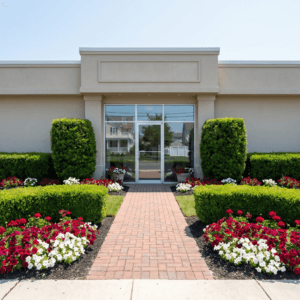

TLDR: If your commercial property has to look right before the season opens, you are working against a calendar that inland New Jersey does not share. A storefront on the Rio Grande corridor, a beach-block motel, an HOA common area: all of them are judged hardest in the same twelve-week window, and a landscape that limps into Memorial Day costs you customers when foot traffic is at its peak. The standard is not “tidy by July.” It is “right by the time the season starts.”
This guide sets out what good commercial landscaping looks like in a tourist-season coastal county, and how to evaluate whether your current program or your next contractor actually meets that bar. It covers the presentation standard the season demands, the signage and clearance details that commercial properties cannot ignore, and why the maintenance program, not just the install, is what holds the standard through Labor Day.
What commercial landscaping standards mean in lower Cape May County
Commercial landscaping standards are the benchmarks a business or HOA property has to meet for appearance, safety, and function: clean planting beds, healthy salt-tolerant plant material, clear sight lines to signage, safe pedestrian clearance, and a maintenance cadence that holds all of it through the season. In a tourist market, the standard is tied to a calendar, because the property is most visible exactly when the area is busiest.
That calendar is what separates lower Cape May County commercial landscaping from inland work. An office park in central New Jersey is judged year-round at a steady level. A Rio Grande retail property, a Cape May inn, or a Wildwood beach-block business is judged hardest from Memorial Day to Labor Day, when the visitors who drive the local economy are here and forming impressions. Curb appeal in that window is not decoration. It is a direct revenue signal.
For a property manager or business owner, that reframes the whole conversation. The question is not “does the landscaping look acceptable” but “is it at its peak when my customers are.” Our commercial landscaping work is built around that question. The standard is set by the season, the install has to land before the season opens, and the maintenance program has to hold the appearance through the busiest weeks of the year. A contractor who treats a commercial property like an oversized backyard is working to the wrong standard.
Tourist-season presentation: the standard commercial landscaping has to hit
In lower Cape May County, the presentation standard for commercial landscaping is set by a single window: Memorial Day to Labor Day. That is the revenue season for the area’s businesses, and it compresses the calendar in a way that changes how a commercial program has to be planned. The landscape has to be at its peak by Memorial Day, not building toward a peak in midsummer.
This is the timing argument that matters more for commercial than for residential work. A homeowner whose beds fill in by July is fine. A motel or storefront whose beds fill in by July has already lost six weeks of its most valuable impressions. The pre-season work, bed cleanout, fresh planting, mulch, and a clean first cut, has to be done early enough that the property looks established when the first wave of visitors arrives, not freshly disturbed.
That front-loaded calendar is also why the install and the early-season maintenance have to be coordinated rather than improvised. A commercial property that gets its spring cleanup late, or its plantings in too close to the season, presents as half-finished during the exact weeks it most needs to look settled. The counter-intuitive truth here is that the season punishes the property that waited and rewards the one that prepared. On a competitive stretch like the Rio Grande corridor, where retail and service businesses sit side by side and customers compare them at a glance, the property that hit the standard by Memorial Day stands out against the ones still catching up. Presentation timing is a commercial advantage, not a nicety.
Signage sight lines and pedestrian clearance in commercial landscaping
Commercial landscaping carries a responsibility residential work does not: it cannot obscure signage or block safe pedestrian movement. Sight lines and clearance are part of the standard, and they are where well-intentioned plantings most often go wrong on a commercial property. A hedge that looked right at install can grow into the line of sight to a monument sign, or crowd a walkway until two people cannot pass.
Maintaining sight lines means selecting and placing plant material so it frames signage rather than swallowing it, and then keeping it trimmed to that intent through the season as it grows. A business sign that customers cannot read from the road is a marketing problem created by landscaping, and it is entirely avoidable with the right plan and a maintenance cadence that keeps growth in check. On high-traffic commercial frontage, this is an operational concern, not an aesthetic one.
Pedestrian clearance is the safety side of the same standard. Plantings along walkways, entries, and parking edges have to leave clear, safe passage, which matters most on dense, high-foot-traffic commercial properties where people move through tight spaces. Beach-block commercial properties in Wildwood are a clear example: smaller planting beds, heavy pedestrian volume, and structures close together mean every planting has to earn its footprint without crowding the people moving past it. Hedge and shrub material on these properties has to be kept shaped and clear, which is ongoing trim work, not a one-time install. Getting sight lines and clearance right is a defining mark of a contractor who understands commercial work, and getting it wrong is one of the fastest ways a property looks unprofessional or becomes a liability.
The commercial landscaping install and maintenance program
On a commercial property, the install is only half the job. The maintenance program is what holds the standard through the season, and a beautiful install with no program behind it looks worse by August than a modest install that is maintained well. This is the structural truth of commercial landscaping: appearance is a function of upkeep cadence, not just of the day the work went in.
A real commercial maintenance program has structure. It covers the cadence of routine upkeep, the timing of mulch refresh as beds fade through the season, the scheduling of seasonal cleanups, and the ongoing trim work that keeps hedges and shrubs shaped and sight lines clear. Each of those has a timing that is tied to the season, and the program coordinates them so the property holds its appearance continuously rather than looking sharp only right after each visit.
Here is the counter-intuitive part that experienced property managers learn the hard way: a higher-quality install costs less to maintain across a tourist season than a cheap one. Properly prepared beds, well-chosen plant material suited to salt and sandy soil, and clean edges hold their appearance with less corrective work through the busy months. A cut-rate install that uses the wrong plants or skips the bed preparation demands constant patching exactly when the property is busiest and labor is tightest. The install and the program are one system. Evaluating a commercial landscaping contractor means asking not just what the property will look like on install day, but how the program keeps it looking that way through Labor Day. If you are weighing a proposal from another contractor and the maintenance program is vague, that is worth a second read. Want a second opinion on another contractor’s plan? Call us.
Plantings, mulch, and cleanup for commercial landscaping
The day-to-day appearance of a commercial property runs on three things: healthy plantings, fresh mulch, and well-timed cleanups. These are the components a maintenance program manages, and each one has to be matched to coastal conditions and the tourist-season calendar to hold the standard.
Plant selection on a commercial property has to answer to salt and sandy soil. Salt spray and onshore wind reach commercial frontage well back from the water, and the plant material in exposed beds has to tolerate it or it burns back and thins during the season. Sandy, fast-draining coastal soil rewards plants suited to those conditions and punishes ones that are not. Choosing salt-tolerant, site-appropriate species is the difference between beds that hold through the season and beds that need replanting in July. Rutgers Cooperative Extension publishes guidance on salt-tolerant plant material for New Jersey shore conditions, and matching the planting services to that guidance is what keeps commercial beds presentable. Mulch does the supporting work: a clean, even mulch installation sets off the beds, supports soil biology, helps the soil hold moisture through dry coastal stretches, and gives the property the finished look the season demands. A mid-season refresh keeps that look from fading.
Seasonal cleanups bracket the program. A thorough spring cleanup gets the property to the Memorial Day standard, and fall cleanup closes the season and prepares the beds for the next one. On commercial properties, the timing of these seasonal cleanups is driven by the revenue calendar rather than the homeowner’s convenience, which means the spring cleanup has to be early enough to land the property at peak before the season opens. Plantings, mulch, and cleanup are not separate line items. They are the three levers a commercial program pulls to hold the standard from Memorial Day to Labor Day.
HOA and multi-property commercial landscaping programs
HOA and multi-property landscaping introduces a challenge single properties do not have: consistency across many units or buildings to a single appearance standard. An HOA board or property management company is not maintaining one entrance. It is maintaining a coordinated look across common areas, entries, and shared spaces, and the program has to hold that look uniformly, not unevenly.
The consistency challenge is real operational work. Different beds, different exposures, and different plant material across a property still have to read as one cohesive, maintained landscape. That requires a program with a coordinated schedule rather than ad hoc visits, so that the cleanups, mulch refresh, plantings, and trim work happen on a cadence that keeps the whole property in step. An HOA where one common area looks sharp and another looks neglected has a scheduling and standards problem, and it shows.
For an HOA board or property manager evaluating a contractor, the question to ask is how the program maintains consistency across the full property over the season, not just how one showcase area will look. A contractor who can describe the schedule, the cadence, and how the standard is held uniformly is one who understands multi-property work. On a competitive residential-commercial mix like North Cape May, where properties sit close and comparisons are easy, that consistency is also a reputation signal: a well-maintained HOA or commercial property reflects on the management behind it. The program that delivers a uniform standard across every part of the property, on a coordinated schedule, is the one worth hiring. Anything less leaves gaps that the season will expose.
What commercial landscaping looks like with Boyes
When you bring us in on a commercial property, the process starts with a walkthrough of the whole site, not a quick look at the front beds. We read the property the way the season will judge it: where the salt and wind hit hardest, where signage and sight lines need protecting, where pedestrian clearance matters, and where the plant material has to be matched to the exposure and soil. That walkthrough is where the program gets built.
From there we set the program against the revenue calendar. The pre-season work is scheduled early enough to land the property at the Memorial Day standard. The maintenance cadence, mulch refresh timing, seasonal cleanup scheduling, and ongoing trim work are coordinated so the property holds its appearance through the busy months rather than sliding between visits. On a multi-property or HOA engagement, the schedule is built to keep the whole property consistent, not just the showcase areas.
What we focus on is the standard and the cadence that holds it, because on a commercial property those are what protect your customers’ first impression during the weeks that matter most. We talk through the plan, the timing, and the maintenance program directly, so a property manager or business owner knows exactly what the program covers and when each piece happens. You can see the full scope of our landscaping services and the commercial program built on top of it. The pitch is not the cheapest visit. It is a property that hits the standard by Memorial Day and holds it to Labor Day.
Commercial landscaping across Rio Grande, Cape May, and the county
Commercial landscaping standards apply across lower Cape May County, but the way they show up depends on the property and the town. On the Rio Grande commercial corridor, mixed retail and service businesses sit side by side, and curb appeal is a direct revenue driver. Customers compare adjacent properties at a glance, so the standard here is competitive: the property that presents best earns the look-in. Surface-level tidiness is not enough where the business next door is also maintained.
In Cape May, the historic district sets a premium aesthetic standard. Commercial properties, especially inns and storefronts in the Victorian district, answer to a refined look that fits the character of the district, which rewards careful plant selection and disciplined maintenance over flash. Wildwood brings the opposite density: high-volume beach-block commercial properties with smaller planting beds, heavy foot traffic, and structures close together, where landscaping has to maximize a small footprint and keep pedestrian clearance clear through constant foot traffic.
North Cape May rounds out the picture with a dense, competitive commercial and residential mix where consistency and presentation are reputation signals, and West Cape May contributes a smaller, garden-character commercial district where the landscaping leans into plantings and refined beds. Four very different commercial settings, one consistent standard underneath: hit the Memorial Day peak, hold it through Labor Day, protect the sight lines, and keep the program coordinated. That is what commercial landscaping means in a tourist-season coastal county, and it is the bar every property here is judged against.
Meeting the commercial landscaping standard before the season
Commercial landscaping in lower Cape May County is judged against the tourist season. The standard is to be at peak by Memorial Day and to hold that appearance through Labor Day, and meeting it takes more than an install. It takes a coordinated maintenance program that manages plantings, mulch, cleanups, and trim work on a cadence tied to the revenue calendar, while protecting signage sight lines and pedestrian clearance throughout.
For a property manager, business owner, or HOA board, the question to ask of any contractor is whether they are building to that standard: a pre-season install that lands the property at peak before the season opens, and a program that holds it through the busiest weeks. A vague maintenance plan or a cheap install that demands constant patching in July is the wrong answer in a market this seasonal.
If you manage commercial property in Rio Grande, Cape May, Wildwood, North Cape May, or anywhere in lower Cape May County, the time to set the program is before the season, not during it. Get a free estimate. Call 856-386-4600. Boyes Lawncare & Landscaping, 268 E Florida Ave, Villas, NJ 08251.