TLDR: Choosing a landscaping company in lower Cape May County comes down to one test: does the contractor understand coastal ground, and can they prove it with finished work? Sandy soil, a high water table, and salt exposure punish a plan built for an inland suburb. The right company reads those conditions on the walkthrough, leads the project with the hardscape that sets the structure, and tells you plainly what is and is not in its scope before you sign. This guide lays out exactly what to look for so you can tell a genuine local operator from a crew that swaps a generic plan onto your lot.
What a landscaping company in lower Cape May County actually needs to know
Design-build landscaping is a single-contractor model where the same company plans the project and installs it, from grading and hardscape through planting. On lower Cape May County’s sandy, salt-exposed lots, that continuity matters: the crew that designed the drainage and the grade is the crew that builds it, so the plan survives contact with the ground.
Coastal landscaping here is its own discipline. The soil is sandy and sandy-loam, which drains fast and behaves nothing like inland clay-loam when you set a base or establish a planting bed. The water table runs high near the bayfront, which constrains anything below grade. Salt-laden onshore wind ages plantings and finishes that were never chosen for it. A company that does not account for those four conditions will hand you a plan that looks fine on paper and fails in the ground. The simplest test of local competence is to ask how a contractor would handle drainage on a high-water-table lot or which materials they would choose for a salt-exposed property. A real local operator answers in specifics. A generalist changes the subject.
Portfolio review: what to look for in coastal hardscaping and planting work
Start with the hardscape, because it is where shortcuts hide and where they cost the most. When you review a company’s portfolio, look for during-construction photos, not just finished beauty shots. On a paver driveways project, the base and excavation are the whole game on sandy soil, and a contractor proud of their work will show you the sub-base, the compaction, and the fabric layer, not only the final surface. Look for Belgian block set level and true, which on shifting sandy ground separates a crew that understands setting from one that simply lays block on grade.
On the planting side, look for evidence of salt-tolerant, coastal-appropriate selections rather than generic big-box choices that struggle within a season on an exposed lot. Rutgers guidance on native plant selection, in fact sheet FS1140, is the kind of basis a real local plan rests on. Photos of completed work in Cape May, West Cape May, or the Wildwoods carry far more weight than portfolio images that could have been shot anywhere. We walk every property before we quote, because a phone estimate cannot see the grade, the drainage pattern, or the salt exposure that decide what will actually hold up. A portfolio full of local, in-progress detail is the clearest signal you are looking at a company that has done this work on ground like yours.
Scope clarity: what the company will and will not do
A good landscaping company tells you plainly what is in its scope and what is not, before the contract, not after a problem surfaces. Honesty about boundaries is a trust signal, and it protects you from a contractor who agrees to everything and delivers unevenly.
Boyes works two connected lanes. Hardscaping covers driveways, Belgian block edging, stone walkways, and rock and gravel install. Landscape design and install covers grading, land clearing, sod installation, planting, flowerbed design, mulch, hedge trimming, and seasonal cleanups. That is the list. Some outdoor work falls outside it and is handled by other specialists, and an honest company will tell you so rather than overpromise to win the job. When you evaluate any contractor, push for that same clarity. A plain statement of scope, in writing, tells you the company knows its own lane and respects yours.
Design-build capability versus maintenance-only crews
There is a real difference between a company that designs and installs and one that only maintains. A maintenance crew keeps an existing landscape tidy. A design-build operator can grade a lot, sequence a multi-phase project, choose plants for coastal soil and salt exposure, and set hardscape that the rest of the plan works around. If your project is anything more than upkeep, you need the second kind.
Design-build requires judgment that maintenance work does not. It means knowing to grade first, set hardscape second, and plant third, so the site is not torn up between phases or replanted after settlement. It means reading drainage before choosing where beds go. The questions that sort one type of company from the other are direct: Do you handle grading and drainage in-house? Can you sequence a project across phases without leaving the site disrupted? Will the person who designs the plan be on-site during install? A maintenance-only crew will hesitate on those. A design-build company answers them as routine. Our residential landscaping and commercial landscaping pages show how that full-scope approach is structured for each property type.
Hardscaping as the anchor of a landscaping project
Hardscape-anchored landscaping means the permanent structures, the driveway, the walkways, and the edging, are planned and set first, and the planting and grading decisions follow from them. The hardscape fixes the grade, the drainage lines, and the bed edges, so getting it right before plants go in prevents tearing work out later.
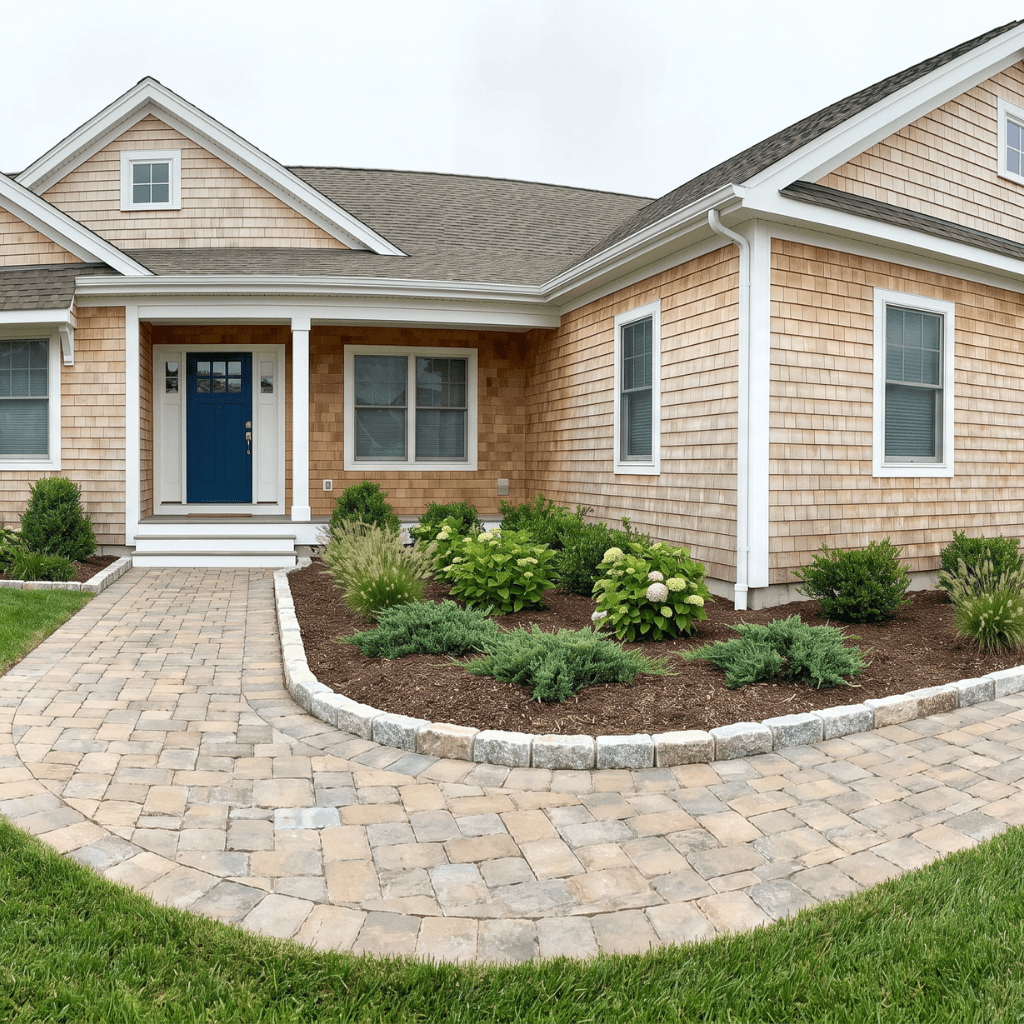
In lower Cape May County, hardscape usually sets the structure the rest of the plan obeys. A paver driveway in a year-round Villas neighborhood or a stone walkway on a historic Cape May lot dictates where water runs, where beds begin, and how the grade falls toward or away from the house. Treating hardscape as the finish layer, the thing you add at the end, is backward, and it is how homeowners end up regrading and replanting after a settlement problem. The structural elements, driveways, Belgian block edging, walkways, and decorative rock, are the frame. When you evaluate a company, ask whether they plan the hardscape first or bolt it on last. The answer tells you whether they think like builders or like decorators. Boyes leads with the hardscaping because on this ground it is what holds everything else in place.
Want a second opinion on another contractor’s plan? Call us at 856-386-4600.
Accountability: what owner-led means in practice
An owner-led company behaves differently on-site than a large regional crew-dispatch operation. The person who quoted the project is often the person running the crew, which means problems get addressed directly instead of routed through a phone tree. For a homeowner, that is the difference between a contractor who owns the outcome and one who manages a schedule.
Boyes carries a 5.0 rating on Google, and the themes that show up across those reviews are consistent: fast estimates, on-time arrival, thorough cleanup, and the owner walking the property in person before quoting. We lead on the quality of that record and on the craftsmanship behind it, not on volume claims. When you evaluate any company, weigh the substance of the reviews, not just the star count. Look for repeated, specific praise about communication, cleanup, and follow-through, because those are the things that go wrong on a poorly run job and the things a homeowner remembers.
Questions to ask before you sign
Run any landscaping company through a short, direct list before you commit. These are evaluation criteria, not a script, and the quality of the answers tells you most of what you need to know.
- Will you provide a written scope of work before we start, listing exactly what is and is not included?
- How do you handle grade and drainage before any planting goes in?
- Can you show me completed hardscape work in this area, including during-construction photos?
- Do you handle permitting with the specific municipality, whether that is Lower Township, the City of Cape May, or another jurisdiction?
- Who is on-site during the install, and is the person who designed the plan involved?
- How do you sequence a multi-phase project so the site is not left disrupted between phases?
- What does cleanup look like at the end of each phase and at completion?
A company that answers these plainly and in specifics is showing you how they work. One that deflects is telling you something too.
Registration and insurance: what to verify before hiring
New Jersey requires home improvement contractors to register with the state, and that requirement reaches landscaping and hardscaping install work. A registered contractor is issued a number that is supposed to appear on contracts, advertising, and business correspondence, so a legitimate company gives you theirs without hesitation. The state has tightened its rules in this area in recent years, so the reliable move is not to memorize the statute but to verify the contractor directly.
Do not take the number on faith. You can confirm a contractor’s standing directly through the New Jersey Division of Consumer Affairs, where you can check that a registration is active and look for complaints or disciplinary actions on file. Ask the contractor for the number directly, then verify it matches the business name you are dealing with. Ask for proof of general liability insurance as well, since that coverage is what protects your property if something goes wrong during the work, and for larger install work, ask whether the workers on-site are covered too. A contractor who answers these questions plainly, and whose registration checks out, has cleared a basic bar that a surprising number of door-knocking outfits cannot. One who deflects, claims to be exempt, or pushes you past the question has told you what you need to know.
Warning signs of the wrong landscaping company
Some signals tell you to walk away before you ever get to references. A door-to-door pitch with a same-day discount that expires if you do not sign is a pressure tactic, not an estimate. A refusal to put scope in writing, or to break the work out by phase, means you have no defined agreement to hold anyone to. A demand for a large share of the total up front, well beyond what materials require, shifts the risk onto you and is a known sign of trouble. The Federal Trade Commission’s guidance on hiring a contractor lists the same red flags, from cash-only demands to high-pressure, sign-today offers.
Watch for vagueness on the things that decide a coastal project. A contractor who cannot explain how they will handle grade and drainage on a high-water-table lot, or who waves off questions about the paver sub-base, is telling you they do not work at that level. Be wary of a portfolio with no during-construction photos and no nearby completed work you can point to. And treat cash-only insistence, no verifiable registration, and no real local references as disqualifying on their own. None of these is about price. They are about whether the company runs a real, accountable operation, which is the entire question this guide is built around.
When to schedule a coastal landscaping project
Timing shapes both the result and your access to a good crew. Hardscape install runs nearly year-round here because it does not depend on a planting window, but planting and sod establishment track the seasons. Many landscape plants and cool-season lawns establish best in the milder, moister stretches of spring and early fall, when roots can settle before summer heat or winter cold tests them. A salt-exposed lot pushes that logic harder, because a plant set during a hot, dry, windy spell on an oceanward parcel starts life under stress.
Demand is the other half of timing. From late spring through the tourist season, shore crews compress under second-home turnaround and weekend congestion, and the best operators book out. If you want a multi-phase project, grading, then hardscape, then planting, done in the right order without rushing, start the conversation before the season peaks rather than during it. A company worth hiring will tell you honestly when a phase should wait for the right window instead of forcing it to fit a calendar. Pushing sod or tender plantings into the wrong stretch to hit a date is how install work fails in its first season. Hardscape, by contrast, can often be scheduled in the off-season, which is frequently the smarter move because crews are less compressed and your project gets full attention. The right company will help you stage the work across the calendar so each phase lands in its best window rather than all at once.
What a written landscaping agreement should cover
Before any work starts, the plan should be on paper. A clear written agreement protects both sides and tells you whether the company runs an organized operation or works off handshakes and assumptions. You are not looking for legal complexity, you are looking for clarity.
At a minimum, expect the document to name the full scope of work, broken out by phase, so there is no ambiguity about what is included and what is not. It should describe how grading and drainage are handled before planting, since that is the step most often glossed over. It should specify the hardscape materials and the base approach, because on sandy coastal soil the sub-base is what determines longevity. It should set out the sequence and a realistic timeline, note who handles permitting with the municipality, and describe what cleanup looks like at each stage. Anything a contractor will not put in writing is something you should treat as not promised. A company that documents its scope plainly is showing you the same discipline it will bring to the ground.
What working with Boyes looks like
It starts with a walkthrough, not a phone quote. We walk the property, read the grade and drainage, note the soil and the salt exposure, and have the scope conversation with you on-site, before any number is set. That walkthrough is where the real plan comes from, because it surfaces the things a remote estimate misses: where water collects, how the lot drains toward the street, which areas take the hardest salt exposure.
From there we sequence the work in the order the ground demands. Grading and hardscape come first, because they set the structure. Sod or lawn establishment follows where it applies. Planting, flowerbeds, and mulch go in last, working around the frame the hardscape set. We keep you informed as the phases move, and we clean up as we go, not just at the end. The work is owner-led, so the standard set on the walkthrough is the standard on the ground. In Cape May, West Cape May, the Wildwoods, the bayfront stretches, and the commercial corridor through Rio Grande, that is the process, the same every time. No inflated promises, no guarantees we cannot stand behind, just a plan built for your lot and executed in the right order.
Pricing your project? Call 856-386-4600 before you sign with anyone else, or request a free estimate today.