TLDR: Sod installation in lower Cape May County succeeds or fails on ground preparation, not on the sod itself. On the sandy, salt-exposed, high-water-table soils common from Diamond Beach to Erma, the grade has to be corrected and the top few inches of soil have to be loosened and amended before a single roll goes down. After install, the first three weeks of watering decide whether the roots knit into the soil underneath or the sod sits on top and dies. Sod gives you a finished lawn in a day, but it only stays finished if the work under it was done properly.
Homeowners across lower Cape May County call about sod for the same reason: they want a lawn now, not in eight weeks. That is a legitimate reason, and sod delivers it. What most people do not expect is how much of a sod job happens before the pallet arrives. On the coastal soils here, the prep is the project. This guide walks the whole sequence, from the first site walk through the three weeks that determine whether the lawn takes.
What Is Sod Installation
Sod installation is the process of laying pre-grown turfgrass, harvested with a thin layer of soil and roots intact, onto a prepared soil surface where it knits in and becomes a permanent lawn. It replaces the germination and establishment phase of seeding with mature grass on day one. The prepared surface, not the sod, determines long-term survival.
That definition carries the whole argument of this guide. Sod is a finished product being installed onto an unfinished surface. If the surface is wrong, the finished product fails, and it fails faster than seed would, because sod arrives with a root system that expects immediate contact with living soil.
Rutgers Cooperative Extension makes the same point in its guidance on sodding, Steps to an Instant Lawn, which states plainly that proper soil preparation before placement is essential for turf survival, and that sod placed on compact or carelessly prepared ground will not produce the result the homeowner is paying for.
Site Evaluation Before Sod Goes Down
We walk every property before we quote it, and on a sod job the walk is doing real diagnostic work rather than just measuring square footage. Matthew Boyes handles the walk himself, and he is looking for a specific list of things that will change the scope.
The first is water. On a lot in Diamond Beach or along the bayfront in Town Bank, the water table sits close enough to the surface that a low corner in the yard is not a cosmetic issue, it is a drainage problem that will drown sod within a season. We look for the low spots, the places where turf has died out before, the downspout outfalls, and the direction water actually travels across the lot during a heavy rain. If the grade sends water into a pocket, that pocket gets corrected before sod, not after.
The second is soil condition. Sandy soil is not automatically good soil. Sand drains fast, which is helpful, but it also holds very little water and very little organic matter, which is not. Compacted sandy fill, which is common around newer construction and around driveways and walkways, is worse still: it has the drainage disadvantages of clay and the nutrient disadvantages of sand at the same time. We check compaction by hand, with a probe, in several spots rather than one.
The third is sun and salt exposure. A lot in Cape May Point on the open side of the property gets sustained salt-laden wind that a sheltered interior lot in Erma never sees. That changes the grass variety we recommend. A shaded north side under mature trees changes it again. Sun mapping matters more on sod than most homeowners expect, because the sod arrives as a fixed variety and cannot adapt the way a seed blend can shift over several seasons.
The fourth is access. Sod is heavy, it is perishable, and it has to move from the truck to the ground quickly. On a narrow beach-block lot in Diamond Beach or a fenced back yard in North Cape May, access determines the crew size and the staging plan. We would rather solve that on the walk than discover it on install day with a pallet of sod losing viability in the sun.
Rutgers also recommends a soil test as a baseline step for any lawn project, and its guidance on soil testing for home lawns explains what the test tells you about a soil’s condition and its need for lime. On the acidic sandy soils that show up across parts of lower Cape May County, that baseline is worth having before you commit to a new lawn.
Prepping the Ground for Sod in Coastal Cape May County
This is the section homeowners skim and contractors live in. Prep is where the job is won.
Clearing and Stripping
Whatever is on the ground now comes off. Old thin turf, thatch, debris, roots, and construction leftovers all get removed rather than tilled under. Sod needs soil contact, and a layer of dead organic material between the sod and the soil is exactly the barrier that prevents knitting. On lots that have been neglected, this stage can uncover buried construction debris, old landscape fabric, or a layer of builder’s sand that has to come out.
Grade Correction
The grade has to move water away from the house and away from any low pocket in the lawn. On the flat lots that dominate much of lower Cape May County, that is a matter of inches, carefully placed, over a long run. There is rarely a steep slope to work with, so the fall has to be deliberate. Our site prep and grading work on sod jobs is a shaping operation, not a scraping one, and on properties where the underlying grade is genuinely wrong we handle it as base prep for sod beds before any turf work begins.
A counter-intuitive point worth stating: on a high water table lot, you cannot always drain to daylight, and pretending otherwise produces a swale that holds water instead of moving it. Sometimes the honest answer is that the low area gets shaped to shed rather than to drain, and the planting plan around it changes. We would rather say that on the walk than build a feature that fails.
Loosening and Amending
Compacted ground gets broken up to a working depth so roots have somewhere to go. Then organic matter goes in. Sandy coastal soil benefits substantially from incorporated organic material because it improves the soil’s ability to hold water in the root zone, which is the single biggest limitation of sand. Rutgers guidance on lawn establishment recommends incorporating organic amendment into sandy soils rather than laying turf directly onto raw sand.
Final Grading and Firming
The last pass levels the surface and firms it so the sod sits flat and does not settle into ruts and dips over the following weeks. A surface that looks flat when it is loose will not look flat in a month. This step is what separates a lawn that looks laid from a lawn that looks grown.
Sod Variety Selection for Salt and Sandy Conditions
Most sod grown for the New Jersey market is built around Kentucky bluegrass, because bluegrass produces the dense rhizome network that lets sod be harvested and handled as a mat. That is a manufacturing reality more than a horticultural recommendation, and it matters for coastal properties.
Kentucky bluegrass performs well in open sun with consistent moisture. On a well-prepared, well-watered lot in Erma or North Cape May, a quality bluegrass-based sod does very well. On a shaded lot, or an exposed lot taking regular salt spray, it is a harder ask.
Rutgers guidance on sodding notes that blends including fine fescues are better adapted to shaded lawns, and that turf-type tall fescue and fine fescue are increasingly used in sod production. For coastal properties in lower Cape May County, that matters: fine fescues carry meaningfully better salt tolerance and lower water demand than bluegrass, and turf-type tall fescue brings deeper rooting and better drought resilience on sandy ground.
Our practical position on variety, developed on properties across the county:
- Open, sunny, irrigated-by-hand lawns with good prep: a bluegrass-based blend performs well and looks the part.
- Shaded lawns or lawns under mature trees: insist on a blend with a meaningful fine fescue component.
- Highly salt-exposed lots, especially bayfront and oceanfront edges: fine fescue content is not optional, and in some cases we will recommend seeding a fescue blend instead of sodding, because the right seed beats the wrong sod.
That last point is the one homeowners least expect to hear from a company that installs sod. If a property is genuinely better served by a fescue-heavy seeded lawn, we say so. Homeowners weighing the two approaches usually benefit from reading through the coastal grass seed mixes that perform here before committing to a sod variety.
Lower Cape May County sits in USDA hardiness zone 7b, which you can confirm against the USDA hardiness zone map for any specific address. That zone puts us squarely in cool-season grass territory, with a summer stress window that all of the above varieties have to survive.
The Install Process Step by Step
Sod is perishable. Once it is harvested it is on a clock, and heat accelerates that clock. Everything about install day is organized around minimizing the time between the pallet and the ground.
Delivery timing. Sod is scheduled to arrive the morning it goes down, not the day before. A pallet sitting overnight in August heat heats up internally and the sod comes off the pallet yellowed and stressed.
Starting line. The first row runs along the longest straight edge available: a driveway, a walkway, a bed line, or a string line if there is nothing straight to work from. Every row after that references the first, so the first row being off by an inch compounds across the lawn.
Staggered joints. Rows are laid in a running bond so the seams do not line up, the same logic that governs a brick wall. Aligned seams create continuous channels that dry out and separate.
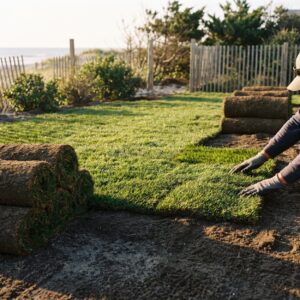
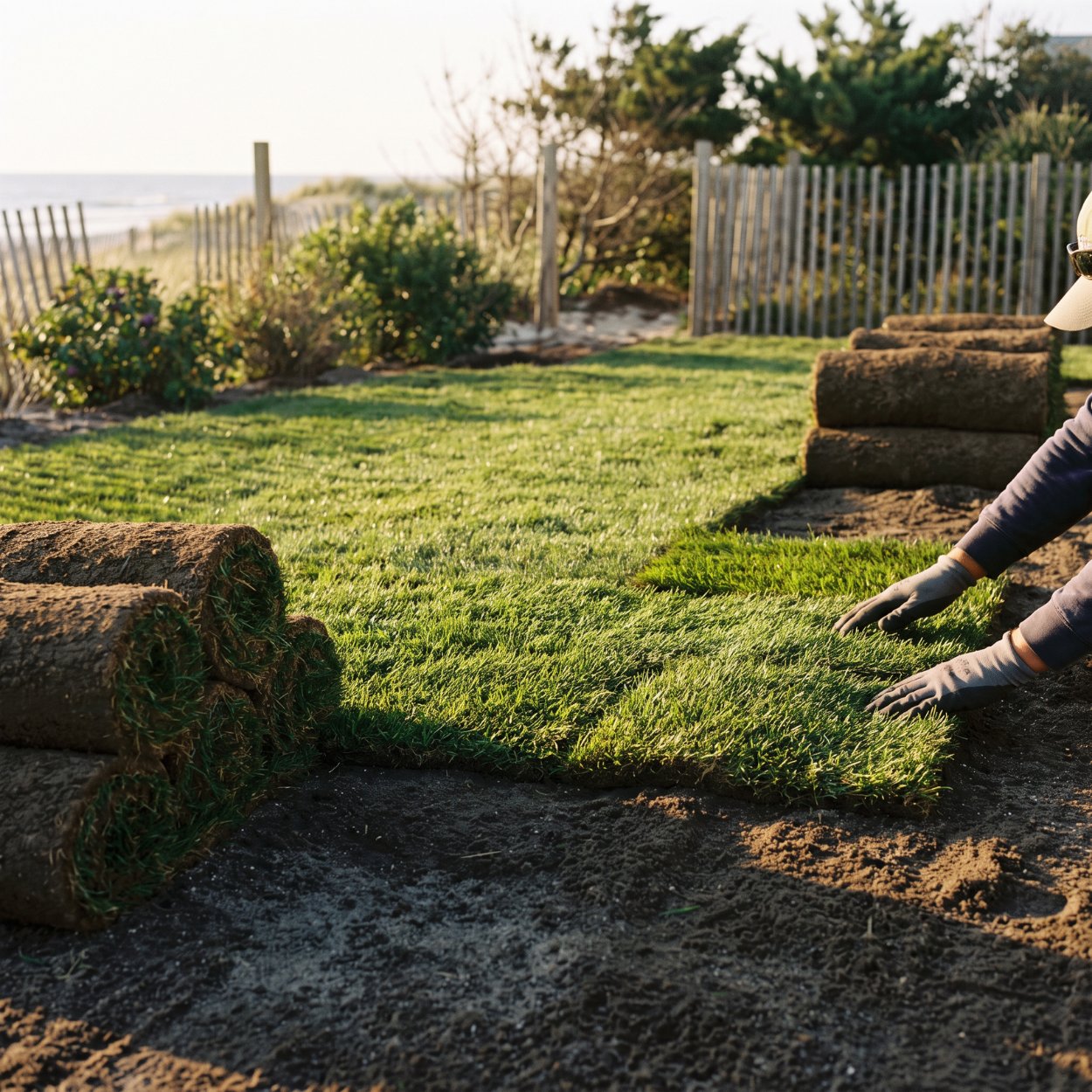
Tight seams, no overlap. Pieces butt against each other without gaps and without riding up onto one another. Gaps dry out and die back. Overlaps create ridges that scalp under the mower. This is the part of laying and fitting sod that separates a clean install from a patchwork one, and it is slow, deliberate work.
Cutting to shape. Curves, bed lines, tree rings, and utility covers get cut in with a knife as the crew works, not trimmed afterward. Trimming afterward produces ragged edges that never fully close.
Rolling. The finished surface is rolled to press the sod into contact with the prepared soil. Contact is the entire mechanism by which roots leave the sod mat and enter the ground. No contact, no rooting.
First watering. Water goes down immediately behind the roll, and it goes down heavily. This is not a light misting. The water has to penetrate through the sod mat and into the prepared soil below it.
On sloped sections and erosion-prone edges, the sequence changes: rows run across the slope rather than down it, and pieces get staked so they cannot creep before the roots take hold. That is a distinct enough problem that we treat sod on erosion-prone slopes as its own scope item rather than a variation on flat work.
The Critical First Three Weeks After Sod Installation
Everything up to this point was ours. This part is largely the homeowner’s, and it is where most sod failures actually happen.
Week one. The sod and the soil beneath it stay consistently moist. On sandy coastal soil in August, that usually means watering more than once a day, because sand does not hold what you give it. The test is simple and physical: lift a corner of a piece and look at the soil underneath. If it is dry, you are not watering enough. Nobody stays off the lawn this week. Foot traffic on sod that has not rooted shifts the pieces and opens seams.
Week two. Watering frequency drops and depth increases. You are now training roots downward instead of keeping the surface wet. Around the end of week two, the tug test starts working: gently pull up on a corner. Resistance means roots have entered the soil below.
Week three. Watering moves toward a deep, infrequent schedule. If the sod passes the tug test across the lawn, the first mow can happen. Mow high, with sharp blades, and remove no more than a third of the blade height. A dull blade on three-week-old sod tears rather than cuts and can pull pieces loose.
Getting the watering in new sod sequence right is the difference between a lawn and a very expensive short-term ground cover. We walk homeowners through it in person at the end of install day, because written instructions get lost and the first 72 hours matter most.
After establishment, the lawn joins the normal maintenance calendar. Homeowners who want to see how a new lawn fits into the rest of the year can work through our year-round lawn care schedule for lower Cape May County.
Signs Sod Is Failing to Establish
Catching failure early is the difference between a repair and a redo.
Visible seams that keep widening. Some seam visibility in week one is normal. Seams that are still opening in week three mean the pieces are drying at the edges and shrinking, which points to insufficient water or poor soil contact.
Sod that lifts easily at week three. No resistance on the tug test means no rooting. The usual causes are inadequate prep, inadequate rolling, or watering that wet the sod without reaching the soil below.
Yellowing that starts at the edges of pieces. Edge-first decline is a moisture pattern. Center-first decline is more often a disease or heat pattern.
Spongy, springy feel underfoot. The sod mat is holding water but the roots have not entered the soil. Common on compacted subgrade, where the roots hit a hard layer and stop.
A distinct rectangular pattern of dead and live pieces. This usually traces back to the pallet, not the install. Sod from the middle of a pallet that overheated behaves differently from sod at the edges.
Most of these have a window in which they can be corrected. Past that window they cannot. If something looks wrong in the first month, the right move is a phone call, not a wait-and-see.
Sod Installation Is a Landscape Decision, Not Just a Lawn Decision
One thing worth saying to homeowners planning a larger project: sod goes in last. If there is a driveway, a walkway, a Belgian block edge, or a bed line coming, those get built first. Hardscape construction runs equipment across the lawn area, changes the grade at the edges, and generates spoil that has to go somewhere. Laying a lawn and then driving a machine across it is a waste of the lawn.
The same logic applies to bed work. Planting beds get shaped, edged, and planted before the sod line is set, so the sod can be cut cleanly to a finished edge rather than approximated and re-cut later. Our ground prep and establishment work on the planting side is typically scheduled in the same phase as sod prep for exactly this reason.
Sequencing is the cheapest thing on a project. Fixing sequencing after the fact is one of the most expensive.
What a Real Sod Installation Quote Should Include
Homeowners collecting quotes for sod in lower Cape May County get numbers that vary widely, and the variation almost never comes from the sod. It comes from what the contractor did or did not include underneath it. Here is what a serious scope covers, so you can compare quotes on the same terms.
Removal and disposal of existing material. A quote that does not say what happens to the old turf is a quote that plans to lay over it. Ask directly.
Grade correction, stated specifically. Not “grading as needed,” which means nothing. A real scope names the areas being corrected and the direction water will move when the work is done.
Soil loosening depth. The contractor should be able to tell you how deep they are working the ground. On compacted coastal fill, shallow surface raking is not preparation.
Organic amendment, quantified. Whether and how much organic matter is being incorporated into sandy soil. This is one of the most commonly omitted line items and one of the most important on this county’s soils.
Sod blend specification. The actual grass composition, not just “sod.” A homeowner in a shaded yard should be able to see fine fescue named in the scope.
Rolling. It sounds minor. It is the mechanism by which the sod contacts the soil.
Aftercare instruction and a point of contact. Somebody the homeowner can call in week two when the sod looks strange, because it will look strange in week two.
Insurance and registration verification. Ask any contractor working on your property to show current general liability coverage and appropriate state registration for the work being performed, and verify it rather than taking it on faith.
We put these items in writing because they are where the money actually goes and where the outcome is actually decided.
Timing a Sod Installation in Lower Cape May County
Sod can be installed across most of the year here, but the months are not equal.
Early fall, roughly late August into October, is the strongest window. Soil is still warm, which drives root growth, while air temperatures have moderated, which reduces stress on the sod mat. Water demand drops off the August peak. Rutgers’ regional guidance consistently identifies the late summer to early fall period as the primary establishment window for cool-season turf in southern New Jersey, and that logic applies to sod as much as it does to seed. The Rutgers extension article on autumn turf renewal lays out why the fall window works.
Spring is the second-best window. Roots establish well, but the lawn then walks straight into summer with a young root system, which raises the stakes on summer watering.
Summer is workable and we do it regularly, particularly for second-home owners who want the property presentable for the season. It demands the most from the homeowner in watering discipline, and we are direct about that before we schedule it.
Late fall into winter is the weakest window. Sod laid into cold soil does not root before dormancy and sits vulnerable to frost heave and winter desiccation through the season.
For second-home owners in Diamond Beach and along the barrier-island edge, the practical question is usually whether anyone will be on the property to water. That answer, more than the calendar, drives our scheduling recommendation.
Who We Are
Boyes Lawncare & Landscaping is a family-run, owner-led lawn care, landscaping, and hardscaping company based in Villas, serving lower Cape May County. Owner Matthew Boyes walks every property personally before quoting, which is why our sod scopes tend to include grade and soil work that other quotes leave out. We carry a 5.0 Google rating built on the quality of the finished work, not on volume.
Frequently Asked Questions About Sod Installation in Cape May County
How long does sod take to root in lower Cape May County?
On well-prepared soil with consistent watering, sod typically shows meaningful rooting by the end of week two and holds firm to a tug test by week three. Sandy coastal soil can root slightly faster than heavy soil because roots move easily through it, but only if moisture is maintained. Compacted or unamended ground extends the timeline and sometimes prevents rooting altogether.
Can sod be installed in August in Cape May County?
Yes, but August is the least forgiving month to do it. Heat accelerates moisture loss from both the sod and the sandy soil beneath it, so the watering demand in the first week is substantially higher than it would be in spring or early fall. If the homeowner cannot commit to that watering schedule, we will usually recommend waiting for the early fall window.
Do I need to remove my existing lawn before sod installation?
Yes. Sod laid over existing turf does not make soil contact and will not root reliably. The old turf, thatch, and any debris come off so the new sod sits directly on prepared soil. This is one of the most common shortcuts in low-bid sod work and one of the most common causes of failure.
Will sod work on a shaded lot near the bay?
It depends entirely on the blend. Standard Kentucky bluegrass sod struggles in shade. A sod that includes a meaningful fine fescue component performs considerably better in shade and also handles salt exposure better, which matters on bayfront and near-shore lots. We specify the blend based on the actual light and exposure conditions we see on the walk.
What is the difference between sod and seed for a coastal lawn?
Sod gives an immediate finished lawn and immediate erosion control, at a higher install cost and with a narrower window for error in the first three weeks. Seed costs less, takes six to ten weeks to establish, and offers far more control over the grass blend, which is a real advantage on salt-exposed coastal lots. On some properties here, a well-chosen fescue seed blend outperforms sod long-term.
Does sod need special preparation on properties with a high water table?
Yes. On lots where the water table sits close to the surface, low areas will hold water that kills sod from below regardless of how well the sod itself was installed. Those areas need grade correction before install, and in some cases the honest recommendation is to redesign that portion of the yard as a planted bed rather than turf.
Ready to Talk About a Sod Installation
If you are considering a new lawn anywhere in lower Cape May County, from Diamond Beach and Erma to North Cape May and the Villas neighborhoods, the first step is a site walk. We will look at your grade, your soil, and your exposure, and tell you honestly whether sod installation is the right call for the property or whether a seeded lawn will serve you better.
Call 856-386-4600 or reach us through the contact page to set up a walkthrough. You can also browse the rest of our landscaping services to see how a new lawn fits into a larger property plan.