
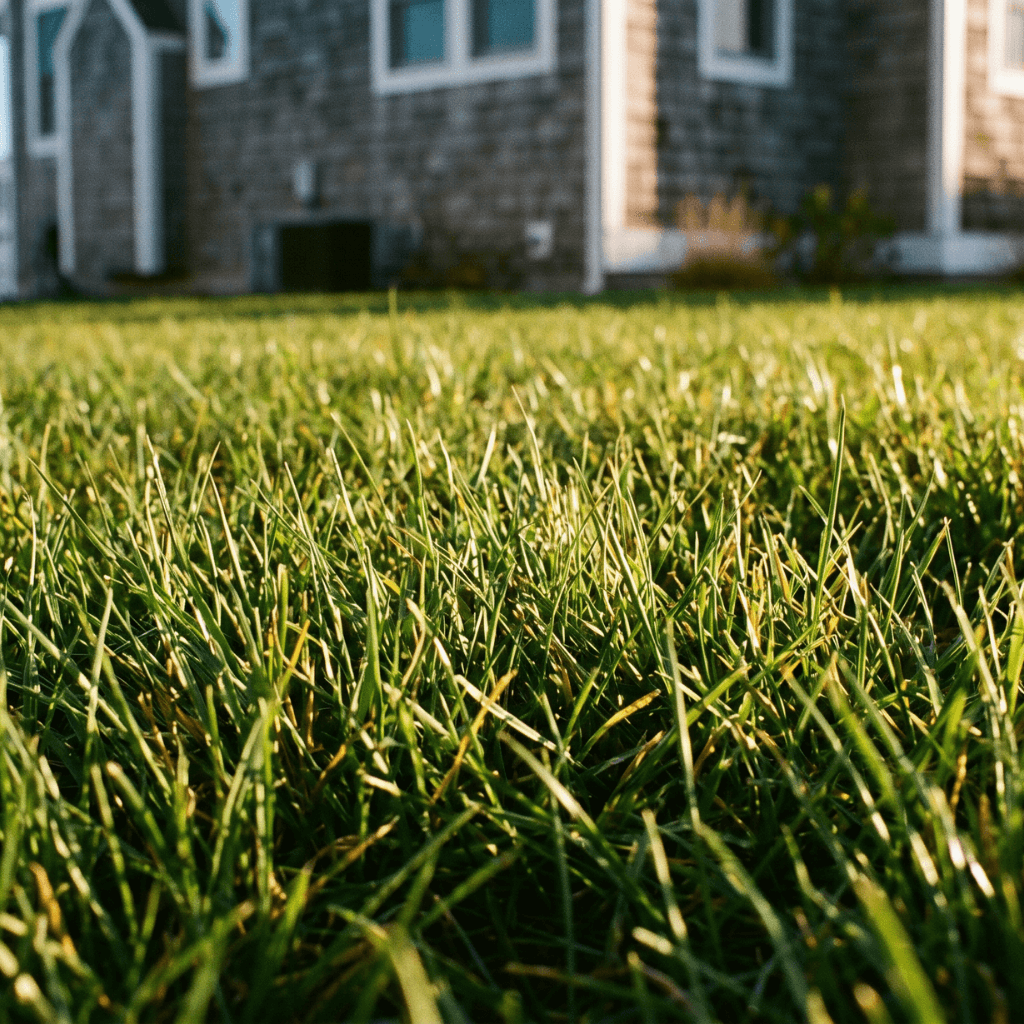
TLDR: Lawn mowing frequency in lower Cape May County is not a fixed number. It tracks how fast the grass is actually growing, and that rate swings with the season, the soil, and how much salt-laden wind your lot takes. For most cool-season lawns here in USDA zone 7b, weekly mowing through the active growing season is the right baseline, with the interval stretching to every ten to fourteen days during the late-summer slowdown. The honest answer is that the calendar sets a default and the grass sets the schedule. Below we walk through what changes that schedule on a coastal lot, and when handing it to a weekly lawn mowing crew makes more sense than managing it yourself.
Mowing frequency for cool-season lawns in lower Cape May County
Mowing cadence is the interval between cuts that keeps a lawn within a healthy height band without removing too much blade at once. On coastal New Jersey cool-season lawns in zone 7b, cadence rises and falls with growth rate rather than the calendar. For a homeowner here, the practical implication is simple: you mow on the lawn’s schedule, not a habit, and that schedule moves through the year.
The baseline most properties settle into is once a week during the active growing season. Cool-season blends, the fescues, perennial ryegrass, and Kentucky bluegrass mixes that perform on coastal New Jersey lots, put on most of their top growth in spring and again in early fall. During those stretches, a week is usually the longest you can wait without forcing a hard cut on return. The interval is not arbitrary. It comes straight from the one-third rule, which we cover below, and from how much blade your particular grass species pushes between visits. A dense, well-established fescue lawn on a sunny lot grows differently than a thinner, shadier parcel, and the cadence reflects that.
How coastal conditions shape mowing cadence
Salt spray, sandy soil, a high water table, and steady onshore wind all change how fast your grass grows, which means they all change how often it needs cutting. This is the part a generic mowing schedule built for an inland suburb gets wrong.
Sandy and sandy-loam soils, the dominant profile across this part of Cape May County, drain fast. That is good news after a heavy rain, because the lawn is not sitting waterlogged for days. It also means the soil dries quickly, so a lawn can move from lush to moisture-stressed within a week of dry weather, and stressed grass slows down. Recovery time between cuts lengthens when the soil is dry. Salt is the other lever. Lots that take direct salt-laden wind, the oceanward margins and exposed barrier-island parcels, carry more physiological stress through summer, and stressed turf grows slower than a sheltered inland lawn.
Microclimate matters more here than people expect. A bayside lot in Erma, with its sandy drainage and bay-influenced humidity, holds a different growth pattern than an ocean-adjacent property in Diamond Beach taking the full brunt of onshore salt wind. Two lawns a few miles apart can sit on different mowing intervals in the same week. We account for that when we set a route, because the goal is to cut each lawn at the right moment, not on a rigid grid.
Spring and early summer: the growth surge that drives mowing frequency
From roughly April through June, cool-season grasses hit their peak growth rate in zone 7b. This is when mowing frequency is least forgiving. Skip a week in May or early June on an established fescue or ryegrass lawn here, and you come back to grass tall enough that a single cut would scalp it.
That is where the one-third rule governs everything. Never remove more than one-third of the blade height in a single cut. Take more, and you shock the plant, thin the canopy, and open the turf to weed pressure and moisture loss. When a lawn gets ahead of you in the surge window, the correct fix is two passes a few days apart to bring the height down in stages, not one brutal cut. That double-cut stresses the turf and is exactly what consistent weekly service is meant to prevent. In the year-round residential pockets of Villas and the high-visibility historic-district lawns of Cape May, where spring density carries the property’s curb appeal, missing the surge window shows immediately.
Tourist-season scheduling pressure from Memorial Day through Labor Day
Tourist-season scheduling pressure is the compression that hits coastal lawn-mowing routes from late May through early September, when seasonal demand spikes, second-home owners want their lawns kept up while away, and weekend traffic congests the shore towns. For a homeowner, the practical implication is that reliability becomes harder to find right when curb appeal matters most.
North Cape May and Diamond Beach carry concentrated second-home density, and those owners are often not on-site to notice when growth is getting away from them. A lawn left a week too long during the surge does not just look unkempt; it sets up the scalping problem above. We route by geography to hold the season together, grouping nearby properties to cut drive time and keep each lawn on a consistent day. Consistency is the whole job in peak season. A lawn cut every Tuesday holds its height band far better than one cut whenever a crew happens to be nearby. If you want to see how a recurring schedule is structured, our lawn care services page lays out the maintenance side.
Late summer slowdown and the shift to fall mowing cadence
Cool-season grasses naturally slow through the heat of late July and August in zone 7b. As they do, mowing frequency on many properties drops to every ten to fourteen days. This is not neglect. It is the correct response to a plant that is conserving energy through heat stress, and cutting a slowed lawn on the same aggressive weekly cadence can do more harm than good.
As temperatures ease in September and October, growth picks back up before the lawn heads toward dormancy. Cadence tightens again toward weekly for that fall flush. Early fall is also the window when soil work pays off, and for many lawns here that means lawn aeration to relieve the compaction that builds up over a season of foot traffic and tight, sandy soil. Mowing height and frequency feed directly into how well a lawn carries itself into and out of that recovery period.
Mowing height: the variable that drives mowing frequency
Cut height is the lever most homeowners underuse. Cutting too short, scalping, forces the plant to regenerate aggressively, thins the canopy, and leaves bare, thin patches where weed seedlings find room. Cutting too tall on sandy coastal soil can trap humidity at the crown and invite disease. The window in between is where a coastal lawn holds density.
Rutgers Cooperative Extension guidance for New Jersey cool-season lawns puts the practical range at roughly two and a half to three and a half inches through spring and fall, and toward the taller end, around three and a half inches, in the heat of summer (see the Rutgers Cooperative Extension fact sheet FS102, Your Lawn and Its Care). Taller turf through summer shades its own root zone, holds soil moisture longer on fast-draining sandy ground, and stands up better to salt and heat stress. The height you hold sets how much blade grows back before the next visit, which is to say height and frequency are one system, not two. Get the height right and the cadence becomes easier to keep.
How your grass species affects mowing frequency
The blend in your lawn changes how often it needs cutting, because the common cool-season species grow on different habits. Knowing what you have on the ground makes the cadence predictable instead of reactive.
Turf-type tall fescue, a reliable choice for low-input coastal lots, is a bunch-type grass with deep roots and good drought tolerance. It grows steadily rather than in violent flushes, which tends to keep its interval consistent and forgiving through the season. Perennial ryegrass establishes fast and greens up early, so it can push hard in the spring surge and demand tighter intervals at that point in the year. Kentucky bluegrass spreads by underground rhizomes and knits itself back together after stress, which helps a lawn recover from a missed week but also means it can fill in and thicken quickly when it is happy. Most lawns here are a mix, so the practical reading is to watch the fastest-growing component during the surge and set the interval to protect it. A lawn heavy in ryegrass in a sunny Cape May yard will outrun a fescue-dominant lot nearby, and the schedule should reflect that rather than treating both the same.
Bagging versus mulching grass clippings on sandy soil
Whether you bag clippings or return them to the lawn changes more than cleanup time on fast-draining coastal ground. Mulching clippings, often called grasscycling, means the mower recuts the blades fine and drops them back into the canopy where they break down. On the sandy and sandy-loam soils across this part of Cape May County, that returned organic matter helps the soil hold moisture it would otherwise lose to fast drainage, and it supports the soil biology that keeps a lawn resilient through heat. Penn State Extension guidance on lawn management notes that clippings can go back to the lawn whenever mowing is frequent enough, which on a tight coastal schedule it usually is.
The catch is that grasscycling only works when you are already mowing on time. Fine clippings settle into the canopy and disappear. Long clippings from an overdue lawn clump on the surface, smother the grass beneath, and look worse than a bagged cut. This is one more reason cadence matters. A lawn cut on a tight weekly interval through the surge can be mulched cleanly, while a lawn left to get ahead has to be bagged to avoid matting. Bagging still earns its place in specific cases, clearing heavy spring growth, lifting leaf litter in fall, or removing material from a thin and struggling area, but on a well-timed coastal lawn, returning the clippings is usually the better call. We make that decision per property, not by habit.
Mowing wet grass and coastal morning dew
Coastal lots hold dew longer than inland lawns, and that changes when you can cut. Bay-influenced humidity in low-lying bayside areas like Erma keeps grass blades wet well into the morning, and onshore moisture can settle a second time as the day cools. Mowing wet grass tears rather than slices the blade, leaves a ragged edge that browns and invites disease, and lets clippings clump and slide instead of dispersing across the canopy.
The practical rule is to mow once the canopy has dried, usually mid to late morning on a humid stretch, rather than forcing an early cut on a soaked lawn. That timing pressure is one reason a fixed weekly slot beats a flexible one on the shore. A crew working a planned route can time a property for the part of the day its lawn has dried, where a homeowner squeezing in a cut before work may be mowing wet grass with little choice. Cutting dry also protects the mower deck and keeps the blade slicing clean, which matters more on coastal lawns already carrying salt and heat stress.
Mowing pattern and blade sharpness on coastal lawns
How you mow matters alongside how often. Running the same line every week presses ruts into soft, sandy ground and trains the grass to lean, both of which thin a lawn over a season. Alternating the mowing direction each visit, lengthwise one week and diagonally the next, keeps the turf standing upright and spreads wheel traffic so no single track compacts. On the loose coastal soils here, where a high water table already limits root depth, easing that surface compaction is not a cosmetic detail. It protects the shallow root zone the lawn depends on.
A sharp blade is the other half of a clean cut. A dull blade shreds the grass tip instead of slicing it, and a frayed tip loses moisture fast and browns at the cut line, which shows worst on lawns already stressed by salt and summer heat. A clean cut from a sharp blade seals over quickly and holds color. We sharpen on a schedule and alternate patterns as a matter of routine, because both are cheap to do right and expensive to ignore on a lawn you are trying to hold dense through a coastal summer.
DIY mowing versus hiring a lawn mowing service in lower Cape May County
A weekly mowing service makes sense when the cost of an unscheduled appearance lapse, in curb appeal, in turf health, or in time, outweighs the simplicity of doing it yourself. The decision usually comes down to who is on-site, how large the lot is, and how much the property’s appearance matters week to week.
Plenty of year-round residents on smaller lots manage their own lawns well, and there is no reason to hand off a job you enjoy and have time for. The math changes for three groups. Second-home owners who are not here during the surge window cannot react when growth gets ahead, and a managed schedule protects the lawn in their absence. Commercial properties cannot afford to look untended on a busy summer weekend, so a fixed cut day is not optional. And year-round residents managing larger lots often find the time cost of a properly timed weekly cut, held through the season, is the thing they would rather buy back. If any of that describes your situation, this is the point to call.
Call 856-386-4600 for a no-pressure walkthrough.
What lawn mowing frequency looks like with Boyes
We start every property the same way: a walkthrough before any schedule is set. We look at the grass species, the sun and shade pattern, the soil and how it drains, and the slope, because all of it feeds the cadence and cut height we recommend. A flat, sunny fescue lawn in Villas and a partly shaded lot in North Cape May do not get the same plan.
From there, the schedule is set and held. Weekly residential service through the growing season in North Cape May and Cape May, with the interval easing through the late-summer slowdown and tightening again for the fall flush. We manage the seasonal transitions so you do not have to track the calendar or guess when to back off. For commercial properties that need consistency, the cut day stays fixed. The work is owner-led, the crew that quotes the property is the crew you see, and the standard is a lawn kept inside its healthy height band every visit. No guarantees we cannot stand behind, no inflated claims, just a schedule built around how your specific lawn grows. If you run a commercial site, our commercial lawn care page covers how that service is structured.
Ready to hand off the schedule? Request a free estimate today, or call 856-386-4600 and we will walk the property with you.