TLDR: If you are planning a landscaping project for your home and want it to hold up rather than become a string of disconnected fixes, the work starts before any plant or stone arrives. Residential landscaping planning in Cape May County means reading your site’s conditions, setting clear goals, leading with the hardscape that sets the structure, and phasing the budget so the project unfolds in the right order. On coastal ground, planning is the difference between a landscape that ages well and one that gets reworked within a few seasons. This guide gives you the framework to plan smart and to have a productive conversation with a contractor before the first crew shows up.
What residential landscaping planning actually involves in Cape May County
Residential landscaping planning is the structured process of assessing a property’s site conditions, setting use and aesthetic goals, sequencing the services, and phasing the budget before any plant or stone arrives. For a Cape May County homeowner, it is what turns a series of disconnected service calls into a project that holds up over time.
Planning is the step most homeowners skip and most regret skipping. A landscape installed without a plan tends to fight itself: beds placed before the grade is set, plantings chosen before drainage is understood, hardscape added last when it should have come first. A planned project moves in the order the ground demands, so each phase supports the next instead of undoing it. On a coastal lot, where sandy soil, salt exposure, and drainage all push back on a generic approach, planning is not a luxury step. It is what makes the investment last. Our residential landscaping page covers how that full-property approach is structured.
Starting with site conditions: soil, drainage, and salt exposure
Before choosing a single plant or material, understand what your site offers and what it challenges. The three conditions that shape every Cape May County landscape are soil, drainage, and salt exposure, and reading them first saves expensive corrections later.
Sandy and sandy-loam soils here drain fast. That is an asset for most hardscape bases, but it means plantings either need more attention to moisture or need to be salt-tolerant, deep-rooted species that handle the conditions naturally. The water table runs high near the bayfront, in North Cape May and the Cold Spring and Town Bank stretches, which constrains below-grade work and drives grading decisions. Salt exposure varies sharply by orientation and distance from the water: an exposed lot near the ocean margin or in Cape May Point takes a far harder hit than a sheltered inland property in West Cape May. Mapping these three before picking plants or scheduling work is the foundation of a plan that holds. This is exactly the assessment we run on the initial walkthrough, on-site, before any plan is set.
Goal-setting for residential landscaping: use, aesthetics, and maintenance reality
What do you want the space to do? The honest answer shapes every service choice that follows, and it is worth pinning down before you talk materials. Curb appeal for resale, outdoor living, low-maintenance coverage, seasonal color, or some mix, each goal points toward different work.
The right plan also matches the property and the owner. A West Cape May cottage where flowerbeds and plantings carry the character calls for a different plan than a bayfront North Cape May property where drainage and hardscape have to anchor everything. Maintenance reality is the part homeowners most often underweight. A second-home owner who is not on-site week to week needs a design that does not demand constant intervention, which usually means leaning on structure and durable coverage rather than high-upkeep plantings. We have this conversation on the walkthrough, before the quote, because a plan that ignores how you will actually use and maintain the space is a plan that disappoints. The flowerbed design and planting pages show how those choices play out for residential lots.
Mapping your property into use zones
A strong residential plan starts by dividing the property into zones by how each part is used, then planning each zone to its job rather than treating the lot as one undifferentiated space. Most homes break into a few clear areas: the entry and curb zone that carries first impressions, the primary living or gathering area, the utility and access zones, and the low-maintenance margins where high-input planting makes no sense. Naming these up front keeps the plan honest about where to spend effort and where to keep it simple.
The zones interact through grade and drainage, which is why mapping them is a planning step and not just a sketch. Water moving off a paved entry has to be directed away from a planting bed downhill of it. A back living area on a high-water-table lot may need its grade resolved before anything decorative goes in. On a coastal property, the most exposed zones, the oceanward margin or a wind-funneled side yard, get the most durable, salt-tolerant treatment, while sheltered pockets can carry more varied planting. Working zone by zone turns a vague wish list into a sequence of defined, buildable decisions, which is exactly what a contractor needs to quote and build the project in the right order. It also helps you prioritize honestly. If the budget will not cover everything at once, zoning shows you which area delivers the most return now, often the entry and curb zone for resale value, or the primary living area for daily use, so you can stage the rest with a clear head rather than spreading a thin effort across the whole lot.
Lead with hardscape: why structural decisions come first
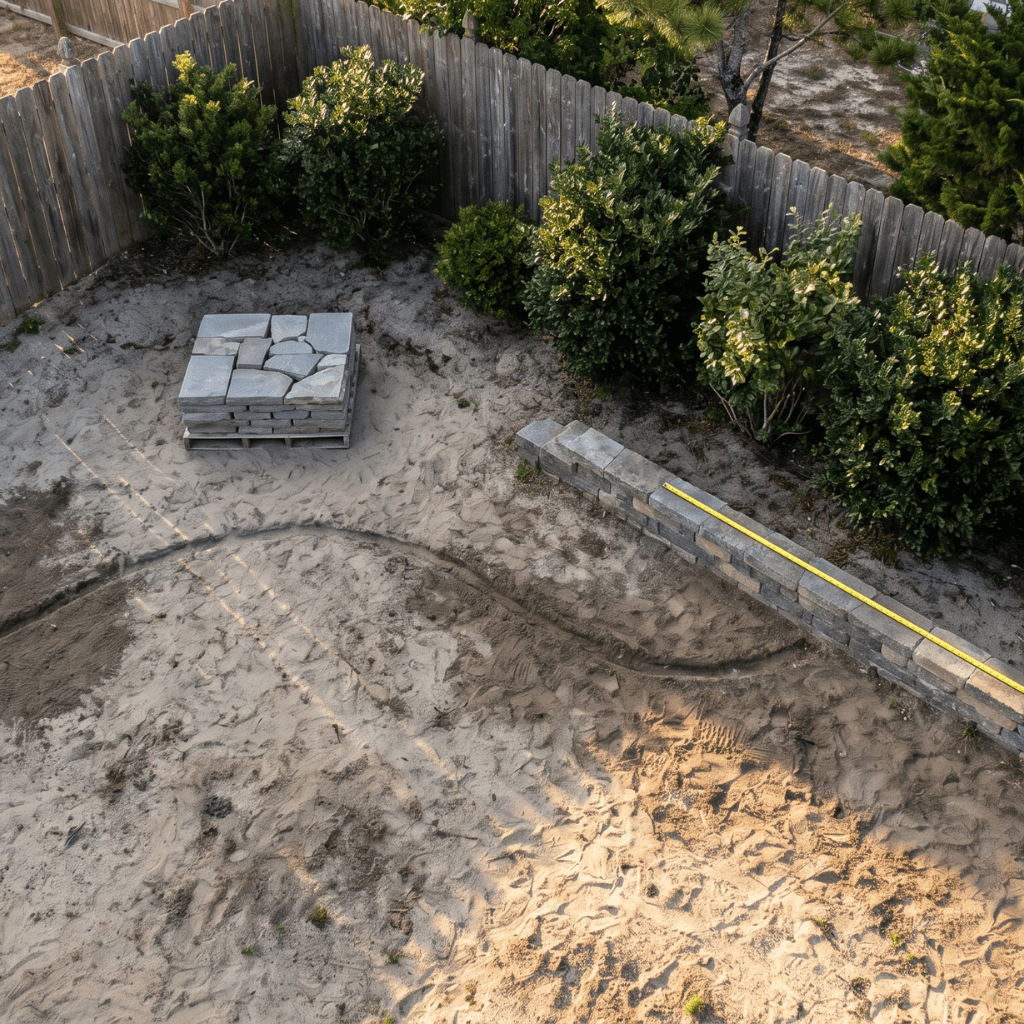
Phased project sequencing means doing the work in the order the ground demands: hardscape and grading first, lawn establishment next, then planting, beds, and mulch. Leading with hardscape sets the grade, the drainage, and the bed edges first, so nothing has to be torn out and redone when plants go in.
In residential landscaping, the hardscape is the frame. A paver driveways project in North Cape May dictates where the planting beds begin, how the grade drains, and what the transition to the street looks like. Belgian block edging defines where lawn ends and beds start. Decorative rock or gravel fills the low-maintenance zones. Plan the hardscape layer first and the rest of the project has a structure to work around. The industry’s published paver installation standards treat the base and grade as the foundation everything else depends on. Plan it last, and you end up regrading and replanting around hardscape that should have come first. Picture a Cape May colonial where the walkway and edging plan is settled before the flowerbed and foundation planting plan, the structure comes first, and the planting works with it rather than against it. Boyes leads with the hardscaping for that reason: on this ground it sets everything else in place.
Phased budgeting: how to sequence a multi-service residential project
Multi-service residential landscaping is almost always phased, both because it is easier on a budget and because the sequence reduces rework. Thinking in phases up front gives you control over what gets done when, and it keeps the project from stalling halfway through.
A typical sequence runs in four stages. First, hardscape and grading, the permanent, structural layer that everything else depends on. Second, sod or lawn establishment where the plan calls for it. Third, planting, flowerbed design, and mulch, which holds moisture and provides physical weed suppression in the beds. Fourth, hedge trimming and the ongoing maintenance cadence. This order is not arbitrary, it follows the ground: structure first, then the living layers that depend on the structure being right. How the budget gets allocated across those phases is a conversation to have with your contractor before work begins, so you can decide what to do now and what to stage for later. The point is the sequencing logic, not a dollar figure, and a good contractor will walk you through it plainly.
Not sure where to start? We will walk the property with you. Call 856-386-4600.
Timing a residential landscaping project across the year
When the phases happen matters as much as their order. Hardscape and grading can run through much of the year because they do not wait on a planting window, which makes the cooler off-season a practical time to get the structural layer done while crews are less compressed. Planting and lawn establishment, by contrast, do best in the milder, moister stretches of spring and early fall, when roots settle before summer heat or winter cold tests them.
For a phased project, that opens a useful strategy: schedule the structural work in the slower season and line up the planting phases for their proper windows, rather than forcing the whole project into one stretch. It also means starting the planning conversation early, because the best local crews book out ahead of the busy season, and a plan you want executed across multiple windows needs to be on the calendar before those windows arrive. A contractor worth hiring will help you stage the phases across the year so each one lands when conditions favor it, instead of compressing everything into a single visit that shortchanges one phase or another.
Salt-tolerant planting choices for lower Cape May County homes
Not every plant sold at a regional nursery survives the salt spray and sandy soil here. Salt-tolerant selection is a planning input, not an afterthought, and getting it right is the difference between plantings that establish and plantings you replace.
Exposure drives the choices. Homes in Cape May Point, on Diamond Beach, and along the oceanfront margins of Cape May face the most acute salt-laden wind, and plant selection there has to start from tolerance. Inland properties in West Cape May and North Cape May face more moderate, seasonal exposure, which widens the palette somewhat but does not remove the constraint. Rutgers Cooperative Extension publishes guidance on salt-tolerant species for coastal New Jersey conditions, and a plan grounded in that guidance, rather than in whatever looked good at the garden center, is one that establishes and persists. We do not prescribe a plant list from a desk. The selection follows from the exposure and soil we read on your specific lot, which is why the walkthrough comes first.
Designing a coastal landscape for low maintenance
Low maintenance is a design outcome, not a wish, and it is planned in from the start. The levers are the ratio of hardscape and durable coverage to high-input planting, the choice of plants suited to the site, and grouping plantings by their needs so a zone can be cared for as a unit. A second-home owner who is not on-site week to week benefits most from leaning on structure, edging, and stone or mulch coverage in the areas that would otherwise demand constant attention.
Plant selection carries a lot of this weight. Species adapted to local conditions establish faster and ask less once they are in, which is why native and coastal-adapted plants are the backbone of a durable shore landscape. Plant choices also have to clear the local winter, which the USDA hardiness zones define for this part of the coast. Rutgers Cooperative Extension fact sheet FS1140, Incorporating Native Plants in Your Residential Landscape, lays out how native species fit a residential plan and why they tend to need less intervention than imported ornamentals fighting the site. A plan that groups plants by water and exposure needs, leans on durable coverage in the hard zones, and chooses site-adapted species over fussy ones is a plan you can actually keep up with. We build that logic into the plan on the walkthrough rather than leaving maintenance as a surprise you discover later.
What to discuss with a residential landscaping contractor before signing
Before any work begins, run your contractor through a direct set of questions. The answers tell you whether you are dealing with a planner or someone improvising, and a few minutes here saves real money later.
- Will you provide a written scope of work before we start?
- How do you handle grade and drainage before any planting goes in?
- What plant species are you recommending, and how do they handle salt and sandy soil here?
- What are the base specifications for any hardscape, given the high water table?
- How will you sequence and time the phases?
- Who handles permitting with the municipality?
- What does cleanup look like at each phase?
A contractor who answers these in specifics is showing you a process. Boyes has this conversation at the walkthrough, not at the invoice, because the plan is the product, and it should be settled before a crew arrives.
Permitting for residential landscaping work in lower Cape May County
Permit requirements for residential landscaping work vary by jurisdiction and change over time, so the practical guidance is to expect your contractor to handle it rather than to memorize a rule that may be out of date. The wrong move is assuming no permit is needed and finding out otherwise mid-project.
Boyes handles applicable permitting as part of the project and follows the requirements of the specific municipality, whether that is Lower Township, the City of Cape May, or another jurisdiction. For historic-district properties in Cape May, design review can add a step worth planning for early, since it affects timeline. The clearest path for a homeowner is to fold permitting into the planning conversation up front and to direct any specific code questions to your local building department, which is the authoritative source for your exact property. A contractor who treats permitting as part of the job, not your problem, is the one to look for.
What residential landscaping planning looks like with Boyes
It starts with a walkthrough, on-site, before any number. We read the soil, the drainage, and the salt exposure, and we talk through what you want the space to do and how you will use and maintain it. That conversation is where the plan comes from, because the right sequence and the right plantings follow from the conditions on your lot, not from a template.
From there we lay out the scope and the order of work: structure and grade first, then the living layers in the sequence the ground demands, so each phase supports the next. We communicate the plan before work begins, so you know what is happening and why, and we keep the site clean as the phases move. The work is owner-led, so the standard set on the walkthrough holds on the ground. North Cape May and West Cape May residential clients typically work through site conditions, goals, the hardscape-first sequence, and phasing in that planning conversation, and a Villas property runs the same way. No inflated promises, no pricing games, no guarantees we cannot stand behind, just a plan built for your lot and executed in the right order. The landscaping services page covers the full range that a residential plan can draw on.
Pricing a project for your home? Call 856-386-4600 before you commit to a plan, or request a free estimate today.