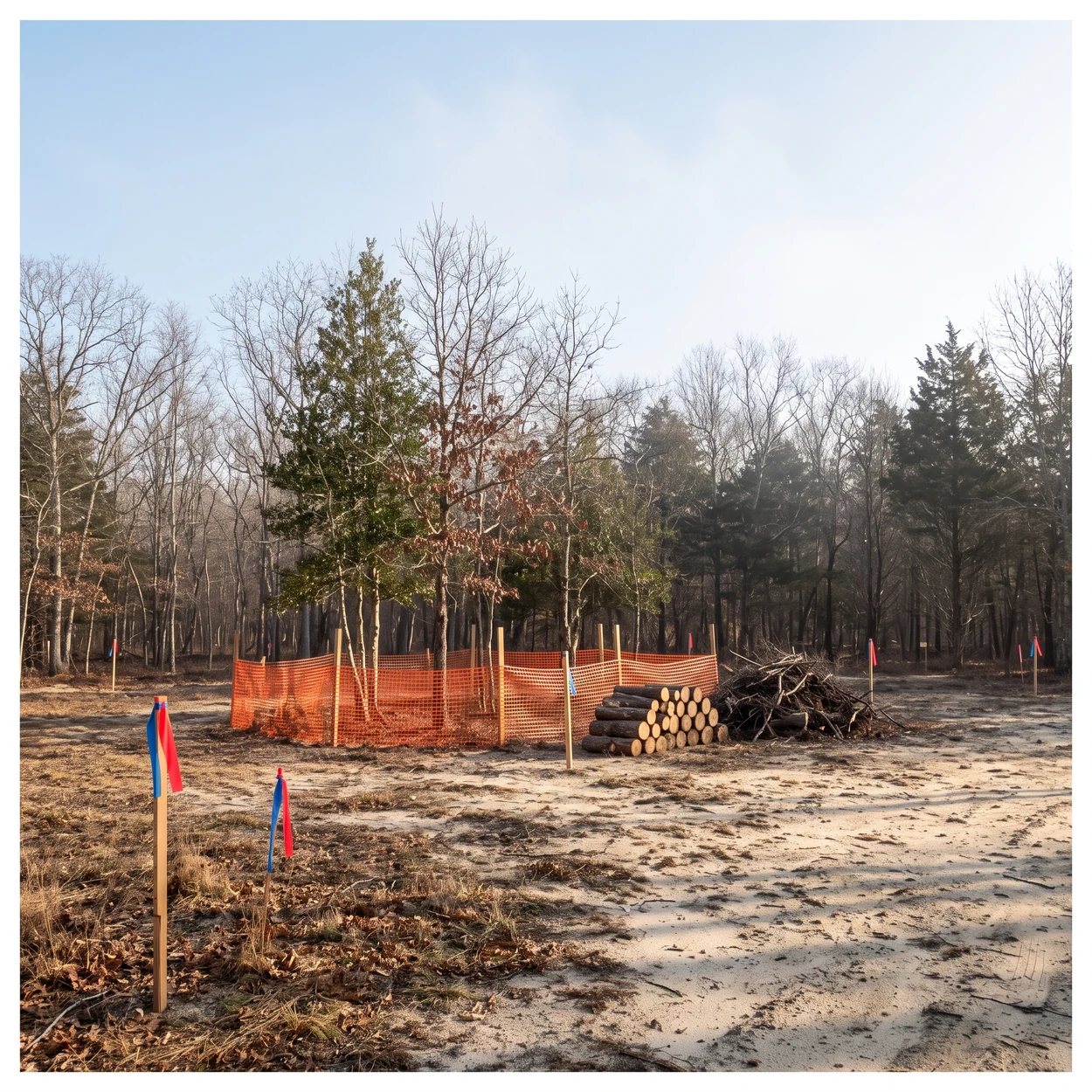
TLDR: Lot clearing before construction is the first decision on a new build, and the hardest one to undo. On wooded parcels in Green Creek and across lower Cape May County, the owner, the builder, and the clearing crew should agree in writing on the clearing limits, the trees to save, where topsoil goes, and how stumps and debris leave the site before any machine arrives. New Jersey soil erosion rules, wetlands, and coastal rules can all apply, so the permit questions get answered first. Clearing in the dormant season lets the build or planting start on a clean, graded site.
Lot clearing is the removal of trees, brush, stumps, and debris from the part of a property that a building, driveway, or major landscape will occupy, done to defined limits so the rest of the lot stays intact. It is the first earthwork on a project and sets the conditions every later trade inherits.
What Is Lot Clearing, and When Does It Happen in a Build?
Lot clearing happens after the house, driveway, and septic or utility locations are fixed on a plan, and before excavation or grading starts. It removes what is in the way of construction and nothing more.
That timing matters because clearing is permanent. A tree taken down by mistake cannot be put back, and a lot cleared wall to wall loses the screening, shade, and wind protection that made it worth buying. Clearing done to a plan leaves the building envelope open and the rest of the lot alone.
It is also narrower than general land clearing services that reclaim overgrown ground on an existing property. A build has a footprint, a driveway route, utility trenches, a staging area, and a set of trees that must survive heavy equipment. Lot clearing is organized around those, which is why it starts with drawings and stakes rather than with a saw.
What Should the Owner, Builder, and Clearing Crew Agree on First?
They should agree on the clearing limits, the trees to save, the access route, and where every kind of material goes, in writing and staked on the ground. Leaving any of the four unsaid is how clearing disputes start.
The clearing limit is the line beyond which nothing gets cut. On a building lot it usually wraps the house footprint, the driveway, the utility runs, and a working margin around the foundation for equipment and materials. The width of that margin is a builder decision, and it should be drawn rather than assumed.
The save list names specific trees, not “the nice ones.” Each is marked in the field with flagging or paint the crew can see from a machine seat.
Access matters on rural lots. One route in and out for trucks, kept narrow and used consistently, protects the rest of the lot from ruts and compaction. That route often becomes the base for the driveway, so it is worth placing where the driveway will actually go.
Material handling closes the list: where topsoil is stockpiled, where logs and brush go, whether stumps are pulled or ground, and what is hauled off versus kept. A clear plan for cleanup and haul-off keeps debris from being buried in the lot, where it will settle under a lawn or a slab later.
Which Trees Are Worth Saving on a Building Lot?
Save trees that are healthy, well rooted, the right species for the site, and far enough from construction to survive it. A tree that will lose half its roots to a foundation trench is not saved; it is just removed later at greater difficulty.
Start with location. Trees well outside the clearing limit are the easy keepers. Trees on the edge of the work zone need a harder look, because roots spread well beyond the trunk and a trench or grade change on one side can kill a tree that looks untouched.
Then condition. Trees with dead tops, large wounds, heavy lean toward the house site, or decay at the base are poor candidates, however large. On bayside lots, trees grown up in a dense stand often have narrow crowns and shallow roots; once their neighbors are gone they face full wind for the first time, and some do not stand up to it. That is a reason to save groups of trees rather than isolated individuals where the plan allows.
Species and purpose come last. Native trees that tolerate salt wind and sandy soil earn their place. So do trees that screen a road, a neighbor, or the afternoon sun. Where a buffer has to be thinned or removed, tree line clearing can open a view or a work zone while leaving the strongest edge trees standing.
How Are Saved Trees Protected While the Lot Is Cleared?
By keeping equipment, stockpiles, and grade changes out of their root zones for the whole project, not just during clearing. Much of the construction damage to trees happens underground, long before the tree shows it.
Penn State Extension’s article on construction-damaged soils describes the two mechanisms plainly: “Compaction by people or equipment crushes soil structure, impeding air, water, and root movement,” and organic soils “are often stripped and removed from construction areas,” leaving compacted ground behind. Both happen fastest around trees that look like convenient places to park or pile.
Protection is simple and has to be physical. Fencing set well out from the trunk keeps machines and materials away. Nothing gets stacked, parked, washed out, or burned inside it. Grade changes near saved trees are planned with them in mind, because a few inches of fill over the roots or a cut along one side can be enough to decline a tree over the next several seasons.
The fencing has to stay up through construction. Clearing crews usually respect it; the risk comes later, when deliveries, dumpsters, and other trades arrive. Builders who keep it in place and enforce it are protecting the owner’s investment in every tree that was saved.
Do You Need a Permit to Clear a Lot in New Jersey?
Often, yes, depending on how much ground the project disturbs, what sits on or near the lot, and what your municipality requires. The permit questions should be answered before clearing, because clearing is usually the first ground disturbance on a project.
The broadest rule is soil erosion and sediment control. The New Jersey Department of Agriculture explains on its soil erosion program that the state’s Soil Erosion and Sediment Control Act “requires that all construction activities greater than 5,000 square feet be developed in accordance with a plan to control erosion during construction.” Those plans are reviewed and certified by local soil conservation districts, and district staff inspect the sites. Whether a particular project needs certification depends on its scope, and the district or your builder’s engineer can confirm it.
Municipal rules can add another layer. Ask the municipal construction or zoning office whether tree removal, clearing, or grading on your lot needs approval, and whether that approval is tied to the building permit, before any tree comes down.
Then there are wetlands and coastal rules, which matter more on Delaware Bay lots than most owners expect. They get their own section below because they can change the clearing limits themselves.
How Do Wetlands and Coastal Rules Reach Bayside Lots?
They can reach further inland than the water you can see. Wet woods, ditches, and marsh edges near the bay may be regulated, and so may development in New Jersey’s coastal zone.
On wetlands, the EPA’s summary of New Jersey’s assumed wetlands program notes that the agency “has approved New Jersey’s request to assume and administer” the Clean Water Act section 404 program that permits dredged and fill discharges into regulated waters. In practice, freshwater wetland questions on a New Jersey lot run through NJ DEP. Clearing, filling, or grading in or next to a wetland is the kind of work that program looks at, so a lot with wet ground at the back needs that answer before the clearing limit is drawn.
On coastal development, NOAA’s coastal program summary for New Jersey states that the program “is administered by the New Jersey Department of Environmental Protection” and that the state’s coastal zone “encompasses tidal and non-tidal waters, waterfronts, and inland areas.” A core piece of that program is the Coastal Area Facility Review Act, or CAFRA, which the New Jersey State Policy Lab at Rutgers describes in its CAFRA history as establishing “a state permitting approval process for development in coastal areas” when it was signed in 1973.
None of that means every bayside lot needs a state permit. It means the question gets asked early, of the right office, with a site plan in hand.
What Happens to Topsoil, Stumps, and Debris?
Topsoil gets stripped and stockpiled, stumps come out wherever structures, paving, or finished grade will sit, and debris leaves the site rather than going into a hole. Each choice shows up years later if it is made badly.
Topsoil is the most valuable material on a wooded lot and the easiest to lose. The dark upper layer under the leaf litter is what finished planting areas will need. Stripping it from the work zone, piling it out of the way, and keeping it free of roots and construction debris saves it for final grading instead of letting it get buried under fill or hauled away with the brush.
Stumps are a location question. Under a foundation, slab, driveway, or patio they come out completely, because a rotting root mass leaves a void that settles. In an area that will stay wooded or become a natural buffer, cutting low and leaving the root system can be the right call, since it holds the soil. Areas meant for planting beds or open yard need stumps and large roots removed or ground deep enough that they do not interfere with grading.
Debris is the simplest rule: none of it gets buried. Brush, roots, and lumber buried in fill decay and settle, and the dip appears under whatever was built on top.
Why Is the Dormant Season the Right Time to Clear?
Late fall through winter is when a wooded lot is easiest to read and least disruptive to clear. Leaves are down, the structure of every tree is visible, and nesting season has passed.
Visibility is the practical advantage. With leaves off, the crew and the owner can see which trees are sound, how they lean, where the grade drops, and where the property markers sit. Save decisions get better when you can see the whole tree.
The calendar is the other advantage. Clearing in winter puts the cleared, rough-graded lot in front of the builder when the construction season starts, and it lets the site take a few heavy rains before anything is built, which shows where water collects while there is still time to adjust the grade. Birds nest in spring and summer, so clearing outside those months avoids disturbing active nests in the trees and thickets that are coming down.
Weather sets the limits. Very wet ground is hard on equipment and on the soil, so clearing is scheduled around the wettest stretches, especially on low lots near the bay.
What Makes Lot Clearing Different in Green Creek and Lower Cape May County?
Larger lots, wetter ground near the bay, sandy soil, and wind. Green Creek and Del Haven sit along the Delaware Bay side of Middle Township, where building lots are larger and more wooded than in the shore towns, and many back onto marsh or wet woods.
Those lots tend to carry dense mixed growth: cedar, holly, cherry, oak, and pine with a thick understory of vines and shrubs. Much of it is worth keeping at the edges. The interior thicket rarely is. Reading which is which takes a walk with the plan in hand.
The soil is sandy, which drains well and works easily, but sandy ground also loses its fine topsoil quickly once it is bare. Exposed sand moves in wind and washes in heavy rain, so stabilizing cleared areas quickly matters more here than on heavier inland soil. Near the marsh the water table rises close to the surface in wet seasons, which affects how deep stumps can be pulled, where equipment can travel, and how the finished grade has to be set.
Wind is the last factor. Bay-facing lots take steady wind off the water, and trees left standing alone after clearing face it without the stand that sheltered them. Planned privacy screening can replace lost buffer, but saving a strong existing edge is better.
Closer to Rio Grande and Cape May Court House, clearing tends to involve smaller parcels near roads, neighbors, and commercial sites, where access, noise, and staging space drive the plan more than wetlands do.
How Does Clearing Hand Off to Grading and the Build?
Clearing ends with a rough-graded, stable site and a clear record of what was removed and saved. Grading picks up from there, and erosion control has to hold until the ground is built on or planted.
Once stumps and debris are out, the work zone is rough graded so water moves away from the future foundation and off the lot in a controlled way. That grade prep is not the finished surface. It is the platform the builder excavates from and the starting point for the final shaping later.
Erosion control keeps that platform intact. On sandy bayside ground a cleared lot can lose a surprising amount of soil in one storm, and that sediment ends up in ditches, wetlands, or the neighbor’s yard. Silt fence, a stabilized entrance, and temporary cover on exposed soil are the usual tools, and where a soil erosion plan applies they are specified in it.
After construction, the lot comes back for grade shaping, topsoil return, and planting. The clearing decisions made months earlier, which trees stayed and where the topsoil went, decide how easy that final stage is.
What Should a Lot Clearing Scope Spell Out?
A good scope reads like a plan, not a price line. It names the area, the method, and the destination of everything that comes off the lot.
- The clearing limits, drawn on the site plan and staked in the field.
- The save list, with each tree marked and a protection method named.
- The access route for equipment and trucks.
- Where topsoil is stockpiled and how it is kept clean.
- How stumps are handled in each zone: removed, ground, or left.
- What is hauled off, what stays on site, and where it goes.
- Who confirms permits and soil erosion requirements, and before what date.
- The erosion control measures in place when clearing ends.
- The condition the site is left in: rough graded, stable, and ready for the builder.
Our land clearing guide covers the broader process, including brush and small-tree work on lots that are not being built on.
Scope of This Guidance
This post explains how lot clearing is planned and sequenced. We are a landscaping and hardscaping contractor, not attorneys, engineers, surveyors, or code officials, and nothing here is a legal or permitting determination for a specific property. Rules on clearing, soil erosion and sediment control, wetlands, and coastal development vary by site and municipality and change over time. Verify requirements with your municipal construction or zoning office, your county soil conservation district, and NJ DEP before clearing starts, and rely on a professional surveyor or engineer for property lines, wetland boundaries, and site plans.
Frequently Asked Questions
How Far From the House Should a Lot Be Cleared?
Far enough for the foundation, driveway, utilities, and a working margin for equipment, and no further. The builder sets that margin for the construction method, and it should be drawn on the site plan and staked before work starts.
Can I Clear My Own Lot Before Hiring a Builder?
You can, but it is risky. Clearing before the house and driveway are placed often removes trees that should have been saved or leaves stumps where the foundation goes, and it can start soil erosion or wetland issues before anyone has checked the permits.
Should Stumps Be Ground or Pulled on a Building Lot?
Pulled under anything structural, including foundations, slabs, driveways, and patios, because a decaying root mass settles. In planting areas grinding can work if it goes deep enough for grading, and in buffers that stay wooded, low-cut stumps can stay to hold the soil.
Does a Small Residential Lot Need a Soil Erosion Plan?
It depends on the area disturbed and the project type. According to the New Jersey Department of Agriculture, the state act covers construction activities greater than 5,000 square feet, and the county soil conservation district confirms whether a particular project needs a certified plan.
Clearing is the one stage of a build you cannot take back, so it deserves the same planning as the house. Agree on the limits, protect the trees worth keeping, save the topsoil, and get the permit answers first. Clear in the dormant season and the build, or the planting, starts in spring on a clean, graded site; call 856-386-4600 or ask for a free estimate to plan the winter clearing now.