TLDR: Hardscaping in lower Cape May County is the permanent structure of your outdoor space, the driveways, walkways, edging, and stone surfaces that frame everything else, and on this ground it lives or dies by what is underneath it. Sandy soil, a high water table, and salt-laden coastal air make hardscape decisions here different from anywhere inland. This guide walks through the materials that hold up at the shore, why the base matters more than the surface, and how hardscape decisions ripple into grading and drainage, so you can build a mental model before you call anyone.
What hardscaping means for lower Cape May County properties
Hardscaping is the permanent, non-living structure of a property’s outdoor space: driveways, walkways, edging, decorative rock, and paved surfaces. In lower Cape May County it is built to handle sandy soil, a high water table, and salt exposure. Unlike planting and grading, hardscape is set once and meant to hold for decades, which is why getting it right the first time matters.
Hardscape and landscape are two halves of one project, and they interact constantly. The hardscape sets the structure: where the driveway falls, where a walkway runs, where the edging defines the line between paved and planted. Grading and planting then work around that frame. On a coastal lot, treating these as separate jobs handed to separate crews is where problems start, because a paver surface that settles or a walkway that channels water the wrong way undoes the planting around it. Understanding hardscape as the structural layer, not a finishing touch, is the first thing a homeowner here needs to grasp.
Hardscaping materials that hold up on the Jersey shore
Material choice at the shore is a durability decision, not just an aesthetic one. Salt, freeze-thaw cycling, and fast-draining sandy soil all act on outdoor surfaces, and the materials that perform here are the ones chosen with those forces in mind. This stretch of coast sits in USDA zone 7b, where winter cold and repeated freeze-thaw are part of what any surface has to survive.
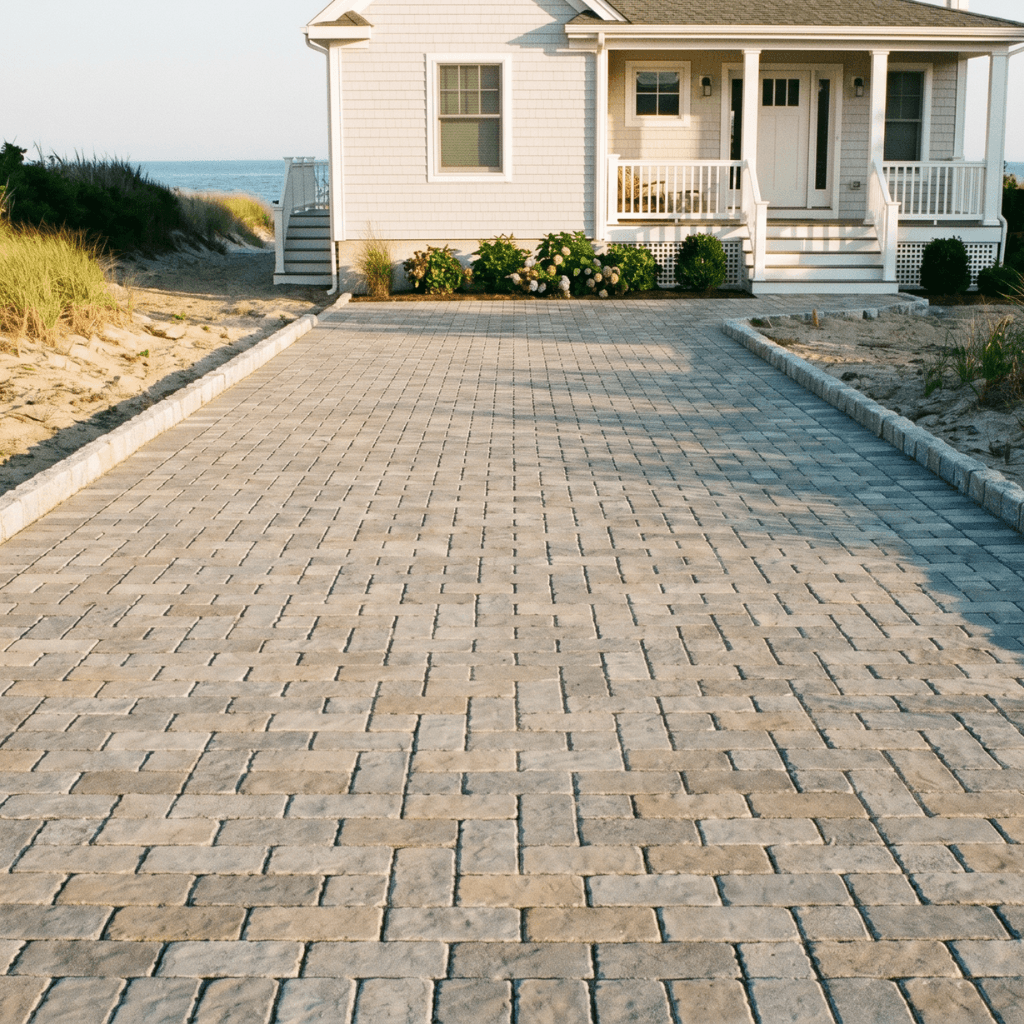
Pavers are the workhorse for coastal driveways and surfaces for good reason. They do not soften in summer heat the way a blacktop surface can, they hold color under sustained sun and salt exposure better than a sealed asphalt surface, and an individual unit can be lifted and reset if it is ever damaged, rather than forcing a full resurface. That repairability is a real advantage on a property that takes a lot of weather. Belgian block, set rather than simply placed, gives a permanent, defined edge that reads as cleanly on a historic Cape May lot as it does on a Wildwood beach-block property. For surface coverage and drainage, angular rock and Jersey stone move water and resist displacement in a way that rounded river rock does not always match. Each material earns its place by how it behaves on this ground, not by how it looks in a catalog. Our hardscaping services page lays out the full range.
Paver driveways in lower Cape May County: the case and the process
The driveway is usually the largest and most demanding hardscape on a property, and on sandy coastal soil the paver driveways job is won or lost below the surface. The pavers you see are the last and least difficult part. The base is everything.
A sub-base is the compacted layer of aggregate beneath a paver or stone surface that carries the load and manages water. On coastal sandy soil with a high water table, the sub-base is what decides whether a driveway stays level for decades or settles and heaves within a few seasons. Build it too shallow or skip the compaction, and the surface will telegraph that shortcut within a year or two.
The install sequence on a coastal lot runs through clear stages: excavate to depth, lay geotextile fabric to separate the native soil from the base, place and compact the aggregate base in lifts, set a bedding layer, place the pavers in the chosen pattern, and lock the joints. On a high-water-table lot in a bayfront stretch like Cold Spring or Town Bank, the base depth and the drainage approach carry more weight than they would on higher inland ground. Salt and freeze-thaw also act on the joints over time, so jointing and edge restraint are not afterthoughts. We treat the base and excavation as the heart of the job, because that is where a driveway’s lifespan is actually set. The base and excavation detail page covers this step specifically.
Pavers versus blacktop and asphalt on coastal driveways
The most common driveway decision here is pavers against a poured surface, and the honest comparison depends on whether the driveway is residential or commercial. On a residential lot, the case for pavers over blacktop comes down to how each handles a coastal summer. Blacktop softens under sustained heat and can scuff and rut where tires turn and stop, and it fades as sun and salt work on the surface. Pavers hold their shape in heat, keep their color far longer under the same exposure, and when a section is ever stained or damaged, individual units lift and reset with no visible patch. A blacktop repair almost always shows. Our pavers over blacktop page walks through that comparison in detail.
On commercial property the comparison shifts to pavers against asphalt, and the deciding factor is load. Concentrated, repeated commercial loading deforms asphalt over time, leaving depressions and cracking that spread. Interlocking pavers spread load across the surface as a connected system rather than a single slab, which is why they hold up under traffic that would rut asphalt. For either property type, the surface you see is only part of the decision. What sits under it determines how long the choice actually lasts.
Belgian block edging: the structural and aesthetic case
Belgian block edging does two jobs at once: it defines a clean line between surfaces and it holds that line permanently. It separates a driveway from a bed, controls the transition from lawn to hardscape, and keeps mulch and stone from migrating where they do not belong. On sandy soil, the difference between edging that holds and edging that wanders is in how it is set.
Belgian block is set, not simply laid on grade. A crew that understands setting in coastal sandy soil seats the block so it stays true through seasons of weather and use, often in a footing where the application calls for it. A crew that does not will leave you with edging that shifts within a year. The aesthetic case is real too. Belgian block reads as period-appropriate on a historic Cape May streetscape, as crisp structure on a Wildwood beach-block lot with a high hardscape ratio, and as durable definition on a coastal cottage property. The Belgian block edging pages show how it is set for different applications, from bed borders to driveway aprons.
Walkways and stone paths: material selection for coastal conditions
A walkway is where material selection and grade meet. The choice among natural stone, concrete pavers, and gravel paths is partly aesthetic and partly about how the surface handles water and frost on your specific lot. Get the material right and the path stays sound and safe through the seasons.
Drainage drives a lot of the decision near the bay, where the water table runs close to the surface in stretches like Cold Spring and Town Bank. A path that holds water or heaves with frost is both a maintenance headache and a hazard. Texture matters for year-round residents who use the path in every season, and grade matters because a walkway has to shed water without becoming a channel that undermines nearby plantings. Where site prep is needed, the walkway grade has to be reconciled with the overall grading so the path and the surrounding ground drain together rather than fighting each other. The stone walkways pages cover stone selection and base construction in more depth.
Decorative rock and gravel surfaces: practical and design uses
Decorative rock earns its keep on coastal lots where turf is limited and low-maintenance coverage makes sense. River rock, angular rock, and Jersey stone serve different roles: bed coverage, drainage swales, accent areas, and surface replacement where grass would struggle anyway.
On beach-block lots in North Wildwood or Wildwood Crest, where the hardscape-to-planting ratio runs high and grass is scarce, stone beds reduce upkeep while keeping the property clean and defined. Laid over fabric with a proper edge, decorative rock also provides physical weed suppression, the barrier is mechanical, the fabric and stone simply block light and growth, which makes it a practical low-maintenance choice for the right zones. Decorative rock works hand in hand with Belgian block, which contains the stone and keeps the edge crisp. The decorative rock and gravel driveways pages cover stone beds, bases, and surfaces in detail.
Not sure where to start? We will walk the property with you. Call 856-386-4600.
How long coastal hardscape lasts and what upkeep it needs
A properly built paver surface is a decades-long investment, and at the shore its lifespan tracks the base far more than the brand of paver on top. Set on a correctly excavated and compacted base with sound edge restraint, a paver driveway or walkway holds its line through years of freeze-thaw and salt. Skimp on the base and no amount of surface care will save it. That is why this guide keeps returning to what is underneath.
Upkeep on coastal hardscape is modest but real. Joint sand settles and washes over time, especially where runoff concentrates, and refreshing it keeps the units locked and the surface tight. Edge restraint should be checked periodically, since a failed edge lets the field of pavers spread. Stone beds and gravel surfaces need occasional topping and a clean edge to stay defined. The advantage of a segmental surface is that repairs stay local. A stained or cracked unit comes out and a new one goes in, with no seam across the whole driveway. We explain the upkeep a surface will need before we build it, so the maintenance is a known quantity rather than a surprise. The same logic applies to Belgian block and stone edging, which hold their line for years when set properly but drift quickly when they were only laid on grade. A surface built right asks little of you over its life. A surface built on shortcuts asks for repairs you did not budget for, on a schedule you did not choose.
Drainage, the water table, and permeable options
Drainage is the quiet decider on a coastal hardscape, because a high water table leaves less room below grade to move water away. A driveway or patio that sheds water poorly will pool, ice, and undermine the base from beneath, which is how a surface that looked fine in year one starts to settle in year three. Planning where water goes is part of designing the hardscape, not a separate fix applied later.
On lots where stormwater is a concern, permeable interlocking pavers are worth understanding. Instead of shedding water to the edges, a permeable system lets rainfall infiltrate through open, stone-filled joints into an open-graded base that stores it and releases it into the ground. On sandy soils that already drain well, that can keep water on your property and off the street rather than concentrating runoff. Federal Highway Administration material on permeable pavement explains how the open-graded base both stores and infiltrates stormwater. It is not the right answer for every lot, and it depends on the base design and the grade, but it is a real option a homeowner planning a driveway near the bay should know exists. Whether a surface is permeable or conventional, the base and the grade still carry it, which is the throughline of every hardscape decision here.
How hardscape decisions affect grading and planting
This is the part homeowners most often miss, and it is the most important. Hardscape sets grade. Grade drives drainage. Drainage decides where plantings thrive and where they fail. The three are a chain, and the order you build them in determines whether the finished project holds together.
Set a paver surface or a walkway, and you have just fixed where water will run for years. If the grading and planting were planned without that in mind, you end up correcting the grade or replanting after the hardscape settles in. On a sandy, high-water-table lot, getting the sequence wrong is expensive to undo. We evaluate grade and drainage as part of the project walkthrough, not as a separate engagement billed later, because the hardscape and the grading have to be planned together to work together. The industry’s published paver installation standards reinforce the same principle: the base and the grade carry the surface, so they have to be designed as one system.
Permitting and municipal requirements in lower Cape May County
Permitting for hardscape work varies by jurisdiction, and the requirements change, so the right approach is to handle it per project rather than quote a homeowner a rule that may be stale. Boyes handles applicable permitting as part of the project and follows the requirements of the specific municipality, whether that is Lower Township, the City of Cape May, or another jurisdiction.
For historic-district properties in Cape May, design review can add a step that is worth planning for early, since it affects timeline. The practical guidance for a homeowner is simple: expect your contractor to manage permitting as part of the work, and direct any specific code questions to your local building department, which is the authoritative source for your exact property. A company that treats permitting as your problem rather than part of the job is one to be cautious with.
What hardscaping with Boyes looks like
It begins with a walkthrough. We read the grade, the drainage, and the soil, and we talk through material selection on-site, because the right paver, stone, or edging depends on the lot in front of us, not a default. From there we plan the sequence so the structural work, the driveway, walkways, and edging, is set first and the grading and planting follow in the right order.
The base is where we spend our attention, because on this ground the base is what makes a hardscape last. We excavate to depth, build and compact the base properly, and finish the surface to hold the line for the long run. Cleanup is part of the job, not an afterthought, and the handoff leaves the property clean and the work explained. The work is owner-led, so the standard set on the walkthrough is the standard on the ground, in Villas, in the historic Cape May streetscapes, on the bayfront in Cold Spring and Town Bank, on the beach-block lots in the Wildwoods, and along the commercial corridor in Rio Grande. No pricing games, no guarantees we cannot stand behind, just hardscape built right the first time.
Ready to see what owner-led craftsmanship looks like? Call Boyes at 856-386-4600, or request a free estimate today.