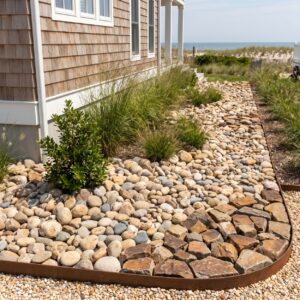
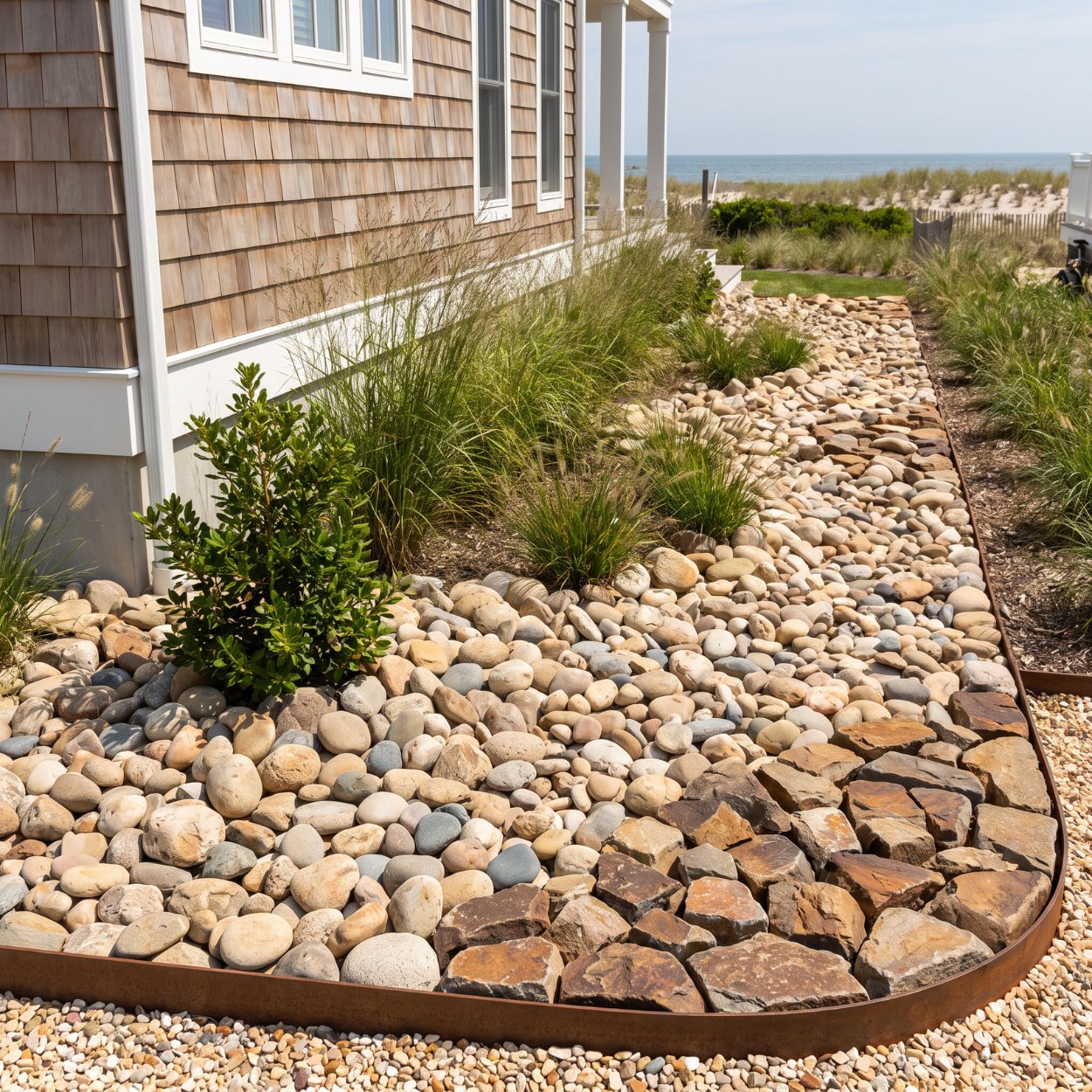
TLDR: Decorative rock earns its place on coastal Cape May County properties in four applications: bed cover where organic mulch keeps blowing away, dry creek beds that move water on flat lots with a high water table, borders and edge treatments, and accent boulder features. It succeeds or fails on what is underneath it. Stone installed over a proper base with separation fabric and a hard edge stays clean and stays put for decades. Stone dropped onto sandy soil sinks, mixes with the sand, and becomes a permanent maintenance problem within two seasons.
Properties along the bayfront in Town Bank and across the exposed lots of this county lose organic mulch to wind and water every year. Stone is the standard answer, and it is a good one, but it is also the material most often installed badly because the shortcuts are invisible on day one. This guide covers where rock genuinely belongs and what a proper installation involves.
What Is Decorative Rock Landscaping
Decorative rock landscaping is the use of graded, washed stone as a permanent ground cover, drainage feature, border, or accent element in a landscape bed, installed over a prepared base with a separation layer and a defined edge. Unlike organic mulch, it does not decompose, does not contribute organic matter to the soil, and is not replaced on a seasonal cycle.
The word permanent is doing real work in that definition. Organic mulch is a decision you revisit every year or two. Stone is a decision you live with, and removing it later is genuine labor. That makes the design thinking upfront more important than it is with mulch.
Bed Cover Applications
Using stone as the surface material in a planting bed is the most common application, and the case for it here is specific.
Wind. Onshore wind on exposed lots physically removes organic mulch. Homeowners on the barrier-island edge and along the open bayfront replace mulch that has migrated into the lawn or off the property entirely. Stone does not move.
Water. Beds that take runoff during heavy rain lose organic mulch to washing. On the flat lots common across this county, water spreads rather than channels, so the loss is broad rather than concentrated. Stone stays.
Longevity. A stone bed installed correctly does not need material added on a cycle. The maintenance changes character rather than disappearing, which is an important distinction covered below.
Design fit. Stone suits contemporary architecture, minimal planting schemes, and coastal settings where it reads as belonging rather than imported.
The honest counterweight is soil. Sandy soil in lower Cape May County is chronically short of organic matter, and a stone bed contributes none. Over years, the soil under a stone bed does not improve the way soil under an organic mulch bed does. On beds where establishing plants is the priority, that cost is real. On beds that are primarily structural, with established or low-demand plantings, it matters much less.
Heat is the other consideration. Stone absorbs and radiates heat, and a stone bed against a south-facing wall on sandy soil produces a genuinely hot root zone. Plant selection has to account for it, and this is not a place to put moisture-loving material.
Where those trade-offs land in stone’s favor, stone beds for lower upkeep are the appropriate call. Where they do not, organic material is better, and our even-depth mulch installation work covers that side.
Dry Creek Design for Drainage-Prone Lots
This is where decorative rock does its most valuable work in this county, and it is underused.
A dry creek bed is a shaped channel lined with stone that carries surface water across a property during rain and sits dry the rest of the time. On lower Cape May County lots it solves a specific and common problem: water that collects and sits because the ground is flat and the water table is high.
Why it suits conditions here. There is rarely enough fall on these lots to drain water decisively to daylight. A dry creek does not need much fall. It needs a defined path, and it moves water along the surface where it can spread and infiltrate over a larger area rather than pooling in one low corner.
What it does that a pipe does not. A buried pipe on a high water table lot can end up sitting in groundwater, which defeats it. A surface channel is above that. It is also visible, so a blockage is obvious rather than hidden, and it is a landscape feature rather than an invisible utility.
Design elements that matter. The channel needs a shaped and compacted base rather than just stone laid on turf. It needs a separation fabric so the stone does not sink. Stone sizing should vary, with larger material at the edges and at points where flow concentrates, and smaller washed stone through the run. The line should follow the natural direction water already travels rather than a route drawn for appearance, and the outlet has to go somewhere legitimate, not onto a neighbor’s property.
What it is not. A dry creek is not a fix for a lot that is simply below the water table. If the ground is saturated from below, surface routing does not help. That is a grading and site-level conversation, and where water is arriving from elsewhere on the property, water flow correction comes first.
New Jersey’s stormwater framework, published by the Department of Environmental Protection’s stormwater program, is the state-level reference behind municipal rules on managing runoff, and the EPA’s material on permeable surfaces covers the general principle of letting water infiltrate where it falls. We handle applicable permitting as part of the project and follow the requirements of the specific municipality, and homeowners should confirm current requirements for their property with their local building department before planning around any assumption, particularly on lots in flood-sensitive or environmentally regulated areas.
Borders and Accent Features
Two smaller applications worth covering.
Borders and transition strips. A band of stone between a lawn and a foundation, along a fence line, or under a deck edge handles the awkward zones where turf struggles and mulch disappears. It gives the mower a clean line to run against and stops the perpetual battle to grow grass in a place that will not support it. Under decks and along the drip line of a roof without gutters, stone is close to the only material that works.
Accent boulders. Larger individual stones used as focal points, as informal seating, as vehicle barriers at a driveway edge, or to anchor a planting composition. Placement is the whole job. A boulder that looks placed reads as decoration; a boulder that looks settled reads as landscape. That means burying a meaningful portion of it, orienting the most weathered face outward, grouping in odd numbers, and varying spacing rather than distributing evenly. Our approach to accent boulders and rock features treats placement as a design decision made on site rather than on a plan.
A practical note specific to coastal properties: boulders set into sandy soil need a compacted bearing surface underneath or they settle unevenly and tip over several seasons. On a lot with a high water table, that settling can be pronounced.
Color and Size Selection for Coastal Properties
Selection runs through size first, then color.
Size drives function. Smaller washed stone, roughly pea-sized to three-quarter inch, is comfortable underfoot, packs reasonably, and works well as bed cover. It also picks up debris most readily and is the easiest to displace by foot traffic. Mid-size stone, roughly one to three inches, is the general-purpose bed and channel material: it stays put, does not pack, and sheds debris better. Larger stone, three inches and up, is for drainage channels, edges, and visual weight, and it collects debris in the gaps between pieces.
Rounded versus angular. Rounded river stone looks natural, suits water features and coastal settings, and rolls underfoot. Angular crushed stone locks together and stays where it is put, which makes it better on any slope and in any channel where water moves with force.
Color against this county’s context. Lighter grays and tans read as coastal and reflect heat rather than absorbing it, which matters on sandy beds that already run warm. Warmer buff and tan tones suit weathered shingle and traditional shore architecture. Darker stone gives strong contrast and absorbs the most heat, which is a real consideration next to a foundation on a south exposure. Very white stone shows organic staining quickly in a humid coastal environment and looks dirty faster than people expect.
A consistency point. Natural stone varies by quarry run. Ordering the full quantity for a project in one delivery avoids a visible color break where a second load starts. This matters more with river stone than with crushed material.
Our work on river rock and stone beds starts from the function and the exposure rather than from a color sample, because the wrong size in the right color is still the wrong stone.
How Rock Interacts With Drainage
Worth being precise here, because stone is frequently sold as a drainage solution when it is not one.
Stone does not drain a wet area by itself. Placing rock over ground that stays saturated produces saturated ground with rock on it. Water still has to have somewhere to go. If there is no outlet and no infiltration capacity, the stone changes the appearance and not the condition.
Stone does move water when it is shaped to. A properly formed channel with a compacted base and appropriate sizing carries surface water along a route. That is the dry creek application, and it works because of the shaping, not because of the stone.
Stone is genuinely permeable as a surface. Rain falling on a stone bed passes through rather than running off, which is a real advantage over sealed surfaces on a lot where runoff is already a problem.
Fabric choice affects drainage. A woven separation fabric under stone lets water through while keeping stone and soil apart. Impermeable plastic sheeting under stone, which we still find on properties we take over, does the opposite: it holds water above it and kills the root zone below. That is one of the more damaging shortcuts in this category.
The high water table sets the ceiling. On lots where groundwater is close to the surface, infiltration capacity is limited during wet periods regardless of what is on top. The USDA’s Web Soil Survey gives a parcel-level baseline on drainage characteristics, though we always confirm with a test hole on the walk.
What a Proper Installation Involves
The part that determines whether the bed is still good in ten years.
Excavate to depth. Stone sits in a shallow excavation so the finished surface lands at the right height relative to lawn, walk, and foundation. Stone piled on top of existing grade spills out and sits proud.
Compact the subgrade. Loose sandy subgrade lets stone sink into it under foot traffic and over freeze-thaw cycles.
Install a proper separation fabric. Woven, permeable, and overlapped at the seams. This is the single most important item in the build. It keeps the stone above and the sand below from mixing, which is the failure mode that ruins stone beds on sandy soil. Once stone and sand have mixed, the only correction is removing everything and starting over.
Set a hard edge. Without containment, stone migrates into the lawn, where it damages mower blades and looks like neglect. Belgian block, steel edging, or set stone all work. This is not optional on a stone bed adjacent to turf.
Place the stone to a consistent depth. Deep enough to cover fully, not so deep that it becomes a pit that traps debris.
Plan for the plants. Cut clean openings in the fabric at each plant rather than laying fabric over the root zone and cutting an X. Plants need water and air reaching their roots, and stone beds installed without thought to planting are where shrubs slowly decline for no visible reason.
The full sequence is why stone bed base and fabric is the scope item that actually matters on a rock job, and why comparing quotes on stone alone tells you nothing useful.
The Maintenance Nobody Mentions
Stone is low maintenance, not no maintenance, and the maintenance is different in kind.
Organic debris blows in and settles between the stones. Over years it decomposes into a layer of organic material sitting on top of the rock, and at that point the bed starts behaving like a poorly maintained mulch bed with stone in it, including supporting the germination of whatever seed lands in it. Regular removal of leaves and debris, most efficiently done with a blower before material works down into the gaps, is what prevents that.
Stone can also be washed clean when it becomes stained or dulled, and it can be raked to redistribute where foot traffic has displaced it. Where the fabric has been compromised, usually by digging or by planting done later without care, sand starts coming up and that section needs correcting before it spreads.
Realistically: less frequent attention than mulch, but attention that has to actually happen. Homeowners who install stone expecting to never think about the bed again are the ones most disappointed at year five.
Who We Are
Boyes Lawncare & Landscaping is a family-run, owner-led lawn care, landscaping, and hardscaping company based in Villas, serving lower Cape May County. Owner Matthew Boyes walks every property before quoting, and on rock work that walk is where the water, the exposure, and the subgrade get assessed before any material gets specified. We carry a 5.0 Google rating built on installations that are still clean and still in place years later.
Frequently Asked Questions About Decorative Rock Landscaping
Is decorative rock better than mulch for coastal properties?
In specific conditions, yes. On heavily wind-exposed beds where organic mulch blows away, in areas where water runs during heavy rain, and on properties where nobody is present to maintain beds regularly, stone is clearly the better material. Where soil improvement matters or where plants need a cooler root zone, organic mulch is better, because stone contributes nothing organically and radiates heat.
Does decorative rock need landscape fabric underneath?
On sandy soil, yes, and it is the most important part of the installation. Without a woven, permeable separation fabric, stone sinks into the sand and the two mix, which cannot be corrected without removing everything and rebuilding. Impermeable plastic sheeting should never be used, because it holds water above it and damages the root zone below.
Will decorative rock sink into sandy soil?
It will, if the installation skipped the subgrade compaction and the separation fabric. That is the standard failure mode on properties in this county. A properly built bed with a compacted subgrade, woven fabric, and a hard edge holds its surface for decades.
Can a dry creek bed fix drainage problems in lower Cape May County?
It can move surface water along a defined route and spread it for infiltration, which addresses water that collects and sits on flat lots. It cannot fix ground that is saturated from below by a high water table, because that is not a surface routing problem. On lots with genuine grade issues, the grading conversation comes before the stone conversation.
What size decorative rock should I use in a landscape bed?
Roughly one to three inch stone is the general-purpose choice for beds, because it stays in place, does not pack, and sheds debris better than smaller material. Smaller pea-sized stone is more comfortable underfoot but traps debris and displaces under traffic. Larger stone is for channels, edges, and visual weight rather than general bed cover.
Does decorative rock need edging?
Anywhere it meets lawn, yes. Without containment, stone migrates into the turf where it damages mower blades and reads as neglect. Belgian block, steel edging, and set stone all work as containment, with different appearances and different transitions to the surrounding grade.
Ready to Talk About a Stone Installation
If you are considering decorative rock for beds, drainage, borders, or accent features anywhere in lower Cape May County, from Town Bank and the bayfront through the Wildwoods and Diamond Beach, the useful first step is looking at the exposure, the subgrade, and where water actually goes on the property.
Call 856-386-4600 or use the contact page to set up a walkthrough. You can see the full range of our decorative rock work and browse the rest of our hardscaping services for the county.