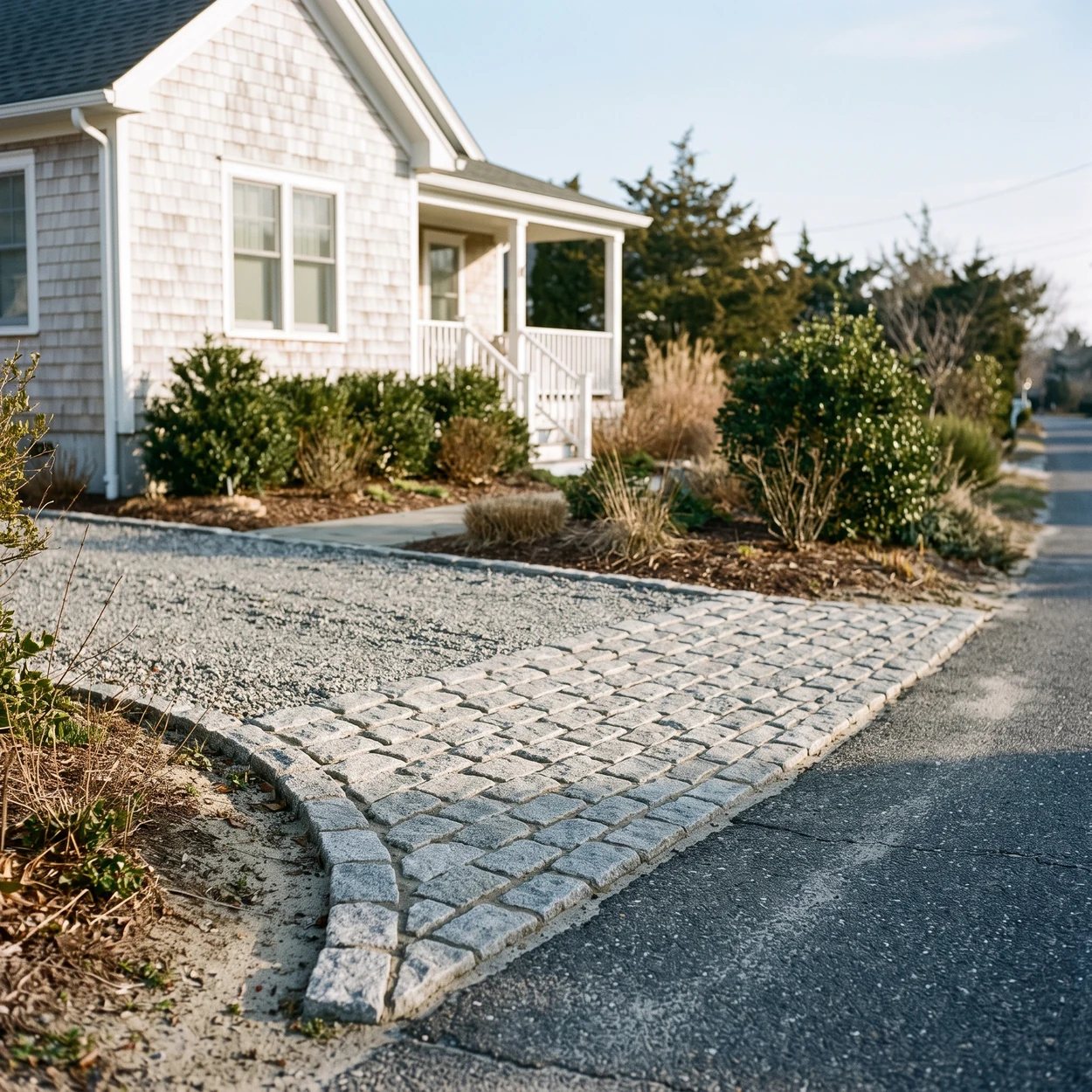
TLDR: A Belgian block apron is the granite border, or full block surface, where a driveway meets the street. In West Cape May and across lower Cape May County it does three jobs: it holds the driveway edge against turning tires, it draws a clean line between the public street and the private drive, and it keeps gravel or broken edge material out of the road. The decisions that matter are the layout, the flare, the concrete footing every block sits in, and how water crosses the transition.
Belgian Block Apron A driveway apron is the stretch between the street edge and the main driving surface, usually crossing the curb line and often a public sidewalk. A Belgian block apron uses rectangular granite blocks, set in a concrete footing, either as a border along the flared sides and street edge or as the apron surface itself.
What Does a Belgian Block Apron Actually Do?
The apron takes the hardest wear on the whole driveway, and the block is there to hold it together. Every vehicle that enters slows, turns, and brakes across the same few feet, so the apron edges take twisting loads that the straight run of the driveway never sees. A row of granite set in concrete gives those edges something heavy and fixed to push against.
It also does work that has nothing to do with load. A block line marks where the public street stops and the private driveway begins, so the transition looks deliberate rather than patched. On a gravel driveway, a block header across the mouth stops stone from riding out on tires and scattering along the curb.
Most owners first notice the apron when it fails. Crumbled asphalt at the street edge, a fan of gravel spreading into the road, or a broken corner where a delivery truck cuts the turn are all apron problems. Belgian block edging answers them because granite outlasts the conditions that cause them, as long as the footing under it is built right.
Which Belgian Block Apron Layouts Work on a Residential Driveway?
Four layouts cover nearly every residential apron. The right one depends on the surface behind it, the street edge in front of it, and how much of the entry the owner wants framed.
- Street-edge header. A single course of block runs across the mouth of the driveway, parallel to the street. It is the simplest layout and the natural partner for gravel, because it stops loose stone at the property line.
- Flared border. Block runs along both sides of the apron and curves or angles outward to meet the street, framing the entry. It suits paver, asphalt, and concrete driveways alike.
- Header plus border. The flared sides and the street-edge course join into one continuous frame. It gives the strongest visual line and holds the apron surface on three sides.
- Full block apron. The entire apron, not just its edges, is paved in Belgian block set in concrete. It reads as a cobbled threshold and handles turning loads well, though the textured surface is rougher underfoot and under wheels than a paver field.
The layout should also agree with the front walk. Where a walk leaves the driveway near the street, matching the block line to the stone walkway design keeps the street side of the property reading as one plan. A closer look at driveway apron edging shows how each layout ties into the driveway field behind it.
How Wide Should the Apron Flare Be?
The flare should follow the path the tires actually take, not a dimension pulled from a drawing. A driveway that is wide enough on its straight run can still be too tight at the street if a car has to swing out to make the turn, and that swing is exactly where an unflared edge breaks down.
Three things set the flare. The width of the street decides how sharp the turn is, since a narrow lane forces a tighter swing. The vehicles that use the driveway matter, because a pickup towing a small trailer tracks very differently than a compact car. And street parking close to the driveway mouth pushes the turn tighter still.
The practical method is to watch the turn. Pull in and out in the vehicles the household drives, mark where the tires cross the street edge, and design the flare to sit outside that line with room to spare. On a narrow lane that can mean a wider flare than owners expect for a modest driveway.
The flare also has limits. It cannot run past the property’s share of the street frontage, and it should not crowd a neighbor’s driveway, a storm inlet, or a utility pole. Where the curb line is involved, the road owner’s requirements come first, which is covered below.
Why Is Belgian Block Set in Concrete at the Apron?
Belgian block is set in a concrete footing, and at the apron that footing is what keeps the line straight. A granite block is heavy, but weight alone does not stop it from rocking or tipping when a tire turns against its edge. Concrete locks each block in position.
The sound method is a continuous footing under the block run, with concrete brought up along the outside face of the blocks as a haunch. The haunch braces the block against being pushed outward, and the footing spreads the load into the compacted base below. On sandy ground the base under the footing matters as much as the concrete, because sand shifts when it is loaded and not confined.
Joints between blocks are filled so water cannot work down beside each block and wash out what it sits on. A concrete footing also holds every block at a consistent height, which matters at an apron where the surface has to meet the street without a lip.
How High Should the Block Sit at the Apron?
At the apron, the block should finish flush or nearly flush with the surfaces on both sides of it. A raised reveal that looks crisp along a garden bed becomes a trip edge and a tire strike at the street, and the first car that clips it starts loosening it.
Orientation sets the look. Block laid with a broad face up makes a wider band that reads as a deliberate border. Block stood on its narrow edge makes a slimmer line and puts more of the stone’s depth into the concrete, which suits the street-edge header where wheels cross it straight on.
The stone itself is a choice. Reclaimed block, salvaged from old streets, has softened edges and a worn face that suits older homes. New-cut block is crisper and more uniform. The weathered look tends to sit comfortably in front of the porch-front cottages of West Cape May and the Victorians in the Cape May historic district, while newer construction usually suits the cleaner cut.
How Does the Apron Meet the Street, Curb, and Sidewalk?
The apron has to tie into three things it does not control: the street pavement, the curb line and its drainage channel, and on many streets a public sidewalk. Each transition must stay flat enough to drive and walk across without a lip, and each sits partly in the public right-of-way.
At the street, the block line should finish flush with or slightly below the road edge so tires roll onto it rather than strike it. Where the curb carries a drainage channel, the apron must not dam its flow line. Water running along the curb has to keep moving past the driveway rather than pond against it.
The sidewalk crossing is the strictest part. In its public right-of-way guidelines, the US Access Board limits the cross slope of a pedestrian access route outside a crosswalk to 1:48 maximum. Where a sidewalk runs through a driveway, that keeps the walking band close to level from side to side, and the apron takes up its change in grade between the sidewalk and the street or between the sidewalk and the house.
Because this part of the apron belongs to the public way, its width, materials, and grades are set by whoever owns the road, whether that is the municipality, the county, or the state. Confirm those requirements with the right office before any block is ordered.
How Should Water Cross a Belgian Block Apron?
Water should cross the apron in a sheet and leave it, never collect against the block line. The apron is often the low point between a driveway and the street, so every rain sends water from the driveway field toward it, and a block row set too high turns into a dam.
The block line is set to finished grade so it carries water across rather than holding it back. Where the driveway pitches toward the street, the apron continues that pitch to the street edge. Where the street sits higher than the driveway, which happens on older streets that have been resurfaced many times, the apron has to be shaped so street water does not run up into the property.
That condition is worth checking on any older street. On flatter blocks in Cold Spring and near the bay, the street and the lot can sit at nearly the same elevation, which leaves little pitch to work with. Correcting the grade behind the apron with water flow correction keeps the new block line from becoming a catch basin. The same thinking runs through edging and drainage on a paver driveway, where the border and the water plan are designed together.
Which Driveway Surfaces Pair Best With a Block Apron?
Belgian block pairs with every common driveway surface, but it does a different job behind each one. The block is a fixed edge, and the surface behind it decides how much that edge has to restrain.
- Gravel. The block header works hardest here. It holds loose stone at the property line, gives the gravel a firm edge to compact against, and keeps the street clean. A gravel driveway with a block apron reads as finished rather than temporary.
- Pavers. Block makes a strong border for a paver field, and the apron is where the two meet the street together. The pavers still need a solid restraint where they meet the block, and both are built on the same compacted base.
- Asphalt. A block border protects the weakest part of an asphalt driveway, the outer edge near the street, where unsupported asphalt crumbles first.
- Concrete. Block on a concrete driveway is mostly visual, framing the slab and breaking up a large expanse of gray. The joint between block and slab needs room to move with temperature.
Whatever the surface, the apron and the field behind it should be planned as one job. An apron built after the fact can be done well, but the joint between new block and old surface is where water and movement show up first.
What Makes Apron Work Different in Lower Cape May County?
Apron design on the peninsula answers to sandy subgrade, salt, the storm season, and the summer calendar. A detail copied from an inland catalog misses most of them.
Sand comes first. Most lots in West Cape May, Cape May, and North Cape May sit on sandy ground that drains well and carries a load poorly. A block footing poured on loose sand settles at the corners, so the ground under it is excavated and compacted in thin layers before any concrete goes in.
Salt is the condition granite handles best. Salt air and road salt corrode metal and can work into concrete surfaces over time, but dense granite is largely unaffected. The concrete footing is the part worth protecting, which is why it sits below the finished surface where it stays covered.
The storm season shapes both the details and the schedule. The Office of the New Jersey State Climatologist at Rutgers notes in its climate overview that coastal storms, often nor’easters, are most frequent between October and April. Those storms push water up streets and across aprons, so a block line that dams water or a footing on unconfined sand gets tested every year.
The calendar is the last factor. Near the beaches and the historic district, summer parking is tight and work in the right-of-way is hard to stage around visitors and rental turnovers. Apron work fits best in the quieter months, which is also when the coastal climate is on the installer’s side.
Can a Belgian Block Apron Be Installed in Winter?
Yes, weather permitting, and the quieter months often suit apron work better than summer. The limiting factor is the concrete footing, not the granite. Fresh concrete needs warmth to gain strength, and the schedule is built around giving it that.
The Federal Highway Administration’s cold weather brief explains why. It notes that below 40 degrees Fahrenheit, hydration in normal concrete is considered insignificant, and that when free water in early-age concrete freezes it can cause loss of compressive strength, cracking, or surface spalling. In practice that means pouring when mild days are forecast, protecting the footing while it cures, and never setting block on frozen or saturated ground.
The peninsula has an advantage here. The same Rutgers climate overview notes that in autumn and early winter, when the ocean is warmer than the land, the coastal zone runs warmer than interior regions. That tends to leave more workable days near the water than inland, and quiet streets make right-of-way work easier to stage.
What Should a Written Apron Scope Include?
A written scope should describe the apron as a structure, not just a material. Granite is the visible part, while the footing, the base, and the grades decide whether it stays straight.
Look for these items in writing:
- The layout: header, flared border, full frame, or full block apron, with the flare drawn on a sketch.
- How the block is set: a continuous concrete footing with a haunch on the outside face.
- Base preparation under the footing, including excavation and compaction in lifts.
- How the apron meets the street edge, the curb line, and any sidewalk, and who confirmed the road owner’s requirements.
- The water plan: which way the apron pitches and where the water goes.
- Removal and haul-off of the old apron material.
- The weather conditions for pouring and how the footing is protected while it cures.
It also pays to check who is doing the work. New Jersey’s Division of Consumer Affairs lists driveways, sidewalks, and patios among the work described on its home improvement contractor page, so verify a contractor’s state registration before signing. A neighbor’s apron that has stayed straight through several winters is the best reference there is, and it is worth asking who built it.
Scope of This Guidance
Boyes Lawncare & Landscaping is a landscaping and hardscaping contractor, not a firm of attorneys, engineers, or code officials. Rules for work in the public right-of-way, including curb cuts, sidewalk crossings, apron widths, and materials, vary by municipality and by road owner. Before any apron work, verify the requirements with your municipal construction or zoning office or the agency that owns the road, and confirm contractor registration with the New Jersey Division of Consumer Affairs.
Frequently Asked Questions
Does a Belgian Block Apron Need Municipal Approval?
Often, because part of most aprons sits in the public right-of-way. The municipality, county, or state that owns the road sets the rules for curb cuts, sidewalk crossings, and apron materials. Ask the local construction or zoning office before work begins and keep any approval in writing.
Can Belgian Block Be Added to an Existing Driveway?
Yes. The old edge is cut back to sound material, the ground under the new block line is excavated and compacted, and the block is set in a concrete footing against the existing surface. The joint where new block meets old asphalt, pavers, or concrete is the detail to watch, because water finds any gap.
Will Road Salt Damage a Belgian Block Apron?
Granite is dense and resists salt well, so the block itself is rarely the problem. The parts that need care are the concrete footing and the joint fill, which should stay covered and full. A footing left exposed at the street edge is the first place salt and water go to work.
How Long Does a Belgian Block Apron Take to Install?
Most of the time goes into preparation and curing rather than setting block. Removing the old apron, excavating, building the base, and pouring the footing come first, and the concrete needs time to cure before vehicles cross it. In winter the weather sets the pace, since pours wait for mild days.
Is a Full Block Apron Better Than a Border?
Not always. A full block apron carries turning loads well and makes a strong statement, but its texture is rougher under wheels, bikes, and strollers. A flared border with a smooth field behind it gives most of the protection with an easier surface to cross.
The apron is the first part of a property anyone sees from the street, and it takes more wear in a few feet than the rest of the driveway takes along its whole length. Granite set in concrete, with the flare and the water planned before the first block goes down, keeps that first impression straight for the long run. Winter installs run weather permitting while the streets are quiet, so call 856-386-4600 or book a free estimate to plan your apron.