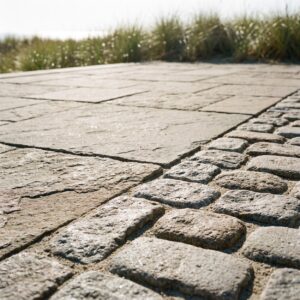
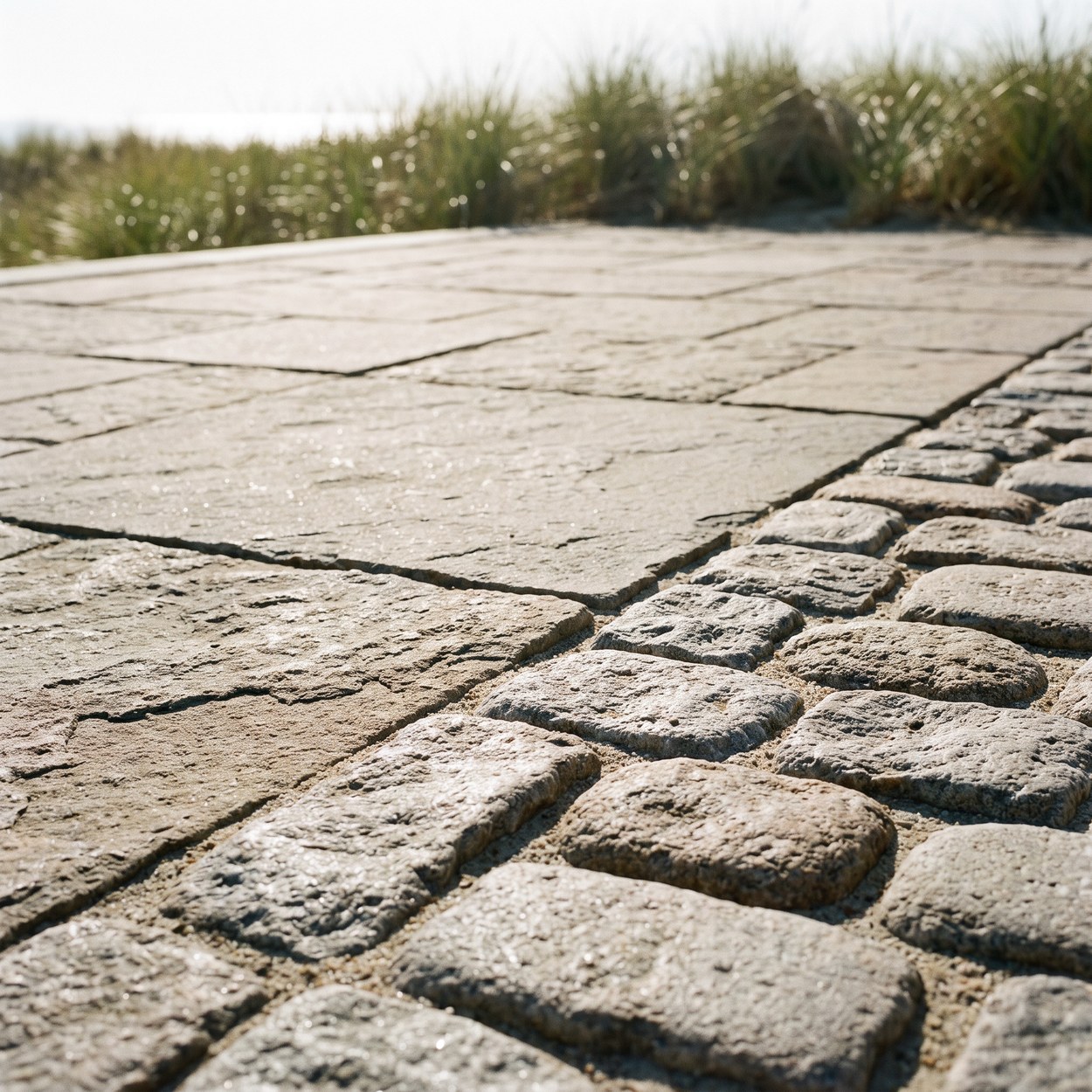
TLDR: The hardscape materials that last near the water are the ones that absorb the least water and sit on a base that drains: dense concrete pavers, tight natural stone, granite Belgian block, and angular decorative rock. Salt and frost damage masonry the same way, by working into pore space and then expanding, so absorption is the property that best predicts how a surface ages on a Cape May property. Base depth, drainage, and joint stability decide more than the surface material does, because a unit that stays saturated fails no matter what it is made of. Pick the material after the site conditions are known, never before.
Coastal hardscaping materials are the paving units, edging, and loose stone chosen for sites within reach of ocean and bay air: concrete pavers, natural stone, granite Belgian block, and decorative rock. The term also covers the aggregate base beneath them and the material filling the joints between them, because those two layers control how much water the surface holds.
What Actually Destroys a Hardscape Surface Near the Ocean?
Water destroys it. Nearly every coastal failure our crews tear out, from flaking paver faces to lifted edges, sunken sections, and open joints, traces back to water that got into a material or under it and then moved. Salt and frost are the forces that move it, and both act on the same weakness: pore space.
Porosity is the open volume inside a material; absorption is how much water that volume takes on. A dense unit takes on very little and gives it back fast. A porous one holds water for days after a rain, which is exactly the condition under which a freeze or a salt load does damage.
When we pull up a failing surface, the useful evidence is on the underside of the units and in the base below them. A stained, damp underside and a base that smears rather than crumbles mean the surface has been sitting in water. The material usually gets blamed for a problem the drainage created.
How Does Freeze-Thaw Work in a Zone 7b Coastal Winter?
Freeze-thaw damage happens when water already inside a material freezes, expands, and pushes the material apart from within. The face fails first, shedding thin flakes or popping small craters, a pattern called spalling. None of that requires an extreme cold snap, only water in the pores and a crossing of the freezing point.
Lower Cape May County sits in zone 7b. The USDA zone map, current in its 2023 version, defines zones by the average annual extreme minimum winter temperature, presented in 10 degree F zones and 5 degree F half zones. That tells you how cold the coldest night gets. It does not tell you how often a surface crosses freezing, and for hardscape the crossings are what matter.
Water moderates temperature, so a shore winter hovers near freezing rather than settling far below it. Our crews see the result as uneven aging on one driveway: the south-facing run thaws in the afternoon sun, refreezes overnight, and wears first, while the shaded strip along a north wall stays cold and wet. Same material, same install, two microclimates.
Why Does Salt Damage Stone and Concrete Even Without a Freeze?
Salt damages masonry by crystallizing inside pore space, and growing crystals press on pore walls the way ice does. A surface near the water can deteriorate through a mild winter with almost no frost, which is why blaming cold alone misreads the problem.
Salt reaches a hardscape here three ways. It arrives as airborne spray carried inland on the wind, which is why exposure in Cape May Point differs from exposure a few streets back from the beach. It arrives in bulk during a storm surge or tidal flood. And it arrives when someone spreads salt for winter traction on steps and walks, which Boyes does not do as a service but designs around, because on a rental or second home somebody eventually will.
Two symptoms get confused. Efflorescence is the white haze that migrates to the surface and sits on top of it, common on new concrete pavers and usually temporary as the units weather. Subflorescence is crystal growth that stays below the face and pushes outward, and that one is destructive.
How Do Concrete Pavers Age in Salt Air and Freeze-Thaw?
Concrete pavers age well on the coast for two reasons: they are manufactured dense enough to resist absorption, and they are laid as independent units on a flexible base rather than one rigid slab. A poured slab here has to crack somewhere, because it cannot move. A field of pavers absorbs that movement in the joints.
That flexibility also makes them repairable. A section that settles over a soft spot can be lifted, the base corrected, and the same units reset, a different maintenance picture from patching a slab. It is one reason paver work holds its value on shore properties, a point covered in our look at hardscaping ROI. Not every paver is equal, either: units colored through their full thickness hold their appearance as they weather, and driveway units are made heavier than patio units.
Expect some early efflorescence bloom on new work, especially on damp fall installs; it is a normal part of curing and fades with weathering. What is not normal is a face that flakes or pits within a few seasons, which points to water sitting in or under the units. Our approach to paver driveway installation puts most of the effort below the surface for that reason.
Which Natural Stone Survives a Coastal Walkway?
Dense stone survives here and porous stone does not, and the gap between them is wider than a showroom sample suggests. Granite is the most durable common choice, with very low absorption and high resistance to both salt crystallization and frost. Dense bluestone performs well and remains the regional favorite for good reason.
Softer, more absorbent stone is where coastal projects go wrong. Porous sandstone and similar materials take on water readily, and in a wet winter near the bay they can begin delaminating along their bedding planes within a handful of seasons. The same stone would last decades inland. Thickness matters alongside type, since thin stone over a flexible base needs mass to resist cracking under point loads.
Finish affects traction as well as aging. A thermal or cleft face keeps its grip when wet, which counts where surfaces stay damp with morning fog for much of the year. Our stone walkways work leans toward dense stone with a textured face, and the tradeoffs between materials are laid out in our guide to stone walkway design.
Is Belgian Block the Right Edge for a Coastal Driveway?
Granite Belgian block is the most durable edge available for a coastal driveway, and edge restraint is where most paver and gravel surfaces actually fail. The field rarely gives way first. The perimeter does, and once it releases, the field spreads, joints open, and water gets under everything.
Belgian block set in a concrete footing does two jobs at once. It holds the surface laterally against the constant outward push of vehicle traffic, and it gives the driveway an edge that will not migrate into surrounding sand. On a sandy lot with no natural lateral confinement, that second job is not cosmetic. Buried plastic restraint and its steel spikes, by contrast, fight salt for their whole service life and cannot be inspected once the job is done.
The footing detail is where the work is. The block sits on a compacted base with a footing and a back-up haunch that carries load into the ground rather than balancing on it. Our Belgian block edging installs are built around that detail, because an edge that moves takes the surface with it.
How Does Decorative Rock Handle Salt and Frost?
Loose decorative rock is the most freeze-thaw tolerant surface available, because it has no rigid structure to break. Individual stones freeze, thaw, and shift without consequence, water passes straight through, and there is no continuous face for salt to spall.
The tradeoff is containment rather than durability. Loose stone migrates, especially on a slope or drive lane, so it needs a defined edge and a prepared base with separation fabric to keep it from working down into sandy subgrade. Without that, the stone slowly disappears and the bed needs topping up too often.
Stone shape matters more than most people expect. Angular stone locks together and holds a surface. Rounded river stone stays loose by design and rolls under foot and tire, which makes it good for a decorative bed and poor for a parking area. On a low lot that takes tidal water, displaced stone can also be raked back rather than rebuilt.
Why Does the Base Decide How Long the Surface Lasts?
The base decides the lifespan, not the material. A dense granite walkway on a bad base will move, open at the joints, and hold water. A mid-grade concrete paver on a properly built base is still tight years later. Material sets the ceiling on performance; the base determines whether you reach it.
Sandy coastal soil is a mixed inheritance. It drains beautifully, a genuine advantage, but it offers poor lateral stability and it migrates, working up into an aggregate base and contaminating it. That is why separation fabric between subgrade and base is standard on our coastal work rather than an upgrade.
The high water table sets the second constraint, and it separates this county from inland work more than anything else. There is a depth past which excavating deeper stops helping, because the hole simply fills. When the seasonal water table limits base depth, the answer is an open-graded base that stays permeable, with grade and drainage solving the water instead of more stone. Compaction settles the rest: base goes in and is compacted in shallow lifts, because a deep lift compacts on top and stays loose underneath, and that loose portion is where settlement comes from two winters later. Our hardscaping services treat the base as the product and the surface as the finish.
What Do Joints Do on a Coastal Surface?
Joints hold the units together as a working system and give water a controlled path out. A tight joint transfers load from one unit to its neighbors, which is what lets a flexible pavement carry a vehicle, and an open joint lets water into the base where it does the most harm.
Joint material follows the base. A dense base pairs with a fine jointing sand that stays put; an open-graded base pairs with a clean angular chip that keeps the assembly permeable from surface to subgrade. Mixing the two produces a surface that drains at the top and traps water at the bottom, the worst arrangement available.
Polymeric jointing products bind the sand into a semi-firm fill that resists erosion. They earn their place, but they are not permanent and they are not a repair for a base problem. Where a joint keeps opening in the same spot, it is reporting movement below, and refilling it resets the clock on the same failure. Surface sealers are a separate homeowner decision, not something we build around, because durability comes from the material and the base.
What Does Lower Cape May County Change About Material Choice?
Four local conditions change the answer here: sandy subgrade, a high water table, direct salt exposure, and a heavy summer use season on properties that sit empty the rest of the year. Together they rule out materials that perform perfectly well an hour inland.
Salt exposure is graded by distance and wind, not by zip code. A driveway two blocks off the beach in Cape May takes a different airborne load than one tucked behind a tree line in West Cape May, and both differ from an exposed lot in Cape May Point. We walk the site before specifying material because that gradient is visible in how existing surfaces on the street have aged.
Flood events change the ground itself, not just the surface. Rutgers Center for Turfgrass Science, in its saltwater flooding guidance, describes immediate remediation as enhancing drainage and removing flood water, then applying fresh water to move residual salts below the root zone, with gypsum used as an amendment and soluble salts and pH tested. That matters to a hardscape plan because where we send water off a surface is where those salts end up, and routing runoff into a planting bed has consequences for the plants in it.
Usage patterns finish the picture. A shore property carries its heaviest traffic in a narrow summer window, then sits unused through the wet season while frost and salt work unobserved. A surface in Town Bank that nobody looks at from November to May has to survive without intervention, because there will not be any.
How Do We Evaluate a Coastal Site Before Choosing Materials?
We work through the site in a fixed order, and the material is the last decision rather than the first. Every later choice depends on an earlier finding, and jumping ahead to the material is how projects end up with a beautiful surface on the wrong base.
- Walk the exposure. Note distance to open water, the prevailing wind path, whatever shelters the site, and how neighboring surfaces have aged.
- Read the existing surfaces. Spalled faces, open joints, settled sections, and stained edges show where water collects and how it moves.
- Check the grade, following water from the high point to wherever it leaves, and flag anything sending water toward the house or a low bed.
- Dig test holes. This one cannot be skipped on a coastal lot, because it shows the subgrade and how close the seasonal water table sits.
- Set the base design from what the holes show: depth, dense-graded or open-graded assembly, and where separation fabric is needed.
- Decide the edge restraint before the surface material, because the edge holds everything and has to survive salt.
- Select the surface material against the exposure, the traffic, and the base, prioritizing low absorption on exposed sites.
- Match the jointing material to the base so the whole assembly drains as one system.
Matthew Boyes runs this walk-through himself on hardscape projects, which is why the material conversation tends to be short. Once the exposure, the grade, and the test holes are known, the list of materials that makes sense on that property is usually down to two or three.
Frequently Asked Questions
Do Concrete Pavers Crack in a Coastal Winter?
Individual pavers rarely crack from cold alone, because they are manufactured dense and free to move slightly within the field. What does happen is surface spalling, where the face flakes because water inside the unit froze or salt crystallized under the skin. On young work, that points to water sitting in or under the surface rather than a defective unit.
Will Salt Air Stain Natural Stone?
Salt air does not usually stain dense stone, though it can leave a light mineral haze that weathers off. The real concern is structural, because salt that gets inside a porous stone crystallizes and pushes the face apart from within. Choosing a dense stone at the start avoids both problems.
Is Decorative Rock a Better Choice Than Pavers on a Flood-Prone Lot?
On a low lot that takes tidal water, loose angular rock drains instantly, holds no rigid face for salt to attack, and can be raked back after a storm rather than rebuilt. Pavers still work there when the base is designed for the water table, but they demand more attention to grade and edge restraint. The choice depends on how often the lot actually takes water.
How Long Should a Coastal Hardscape Surface Last?
Nobody can promise a number, and any contractor who does is guessing. Lifespan on the coast tracks base quality and drainage far more closely than it tracks the material on top. A dense surface on a well-drained base with a solid edge outlives a premium material on a shallow base by a wide margin.
What Is the First Sign a Coastal Hardscape Is Failing?
The joints go first. Sand thinning out of the joints, a joint that keeps opening in the same place, or a slight dip that holds water after a rain all point to movement in the base below. Caught early, that is a lift-and-reset on a small section. Left through a few salt and frost cycles, it becomes a rebuild.
Material choice on the coast is really a drainage decision wearing a different name, and the honest version of that conversation starts with the site rather than a sample board. If you are weighing pavers against stone, a walk-through answers it faster than a catalog will. Choosing materials for a coastal project? Call Boyes at 856-386-4600 to talk through how each one ages.