TLDR: Your lawn needs aeration when water pools or runs off instead of soaking in, when thin areas keep returning even though the lawn is watered and mowed on a sensible schedule, when the ground feels hard underfoot, and when a spongy mat of thatch has built up between the green growth and the soil. Sandy shore soil is not exempt from any of that, because foot traffic, parked vehicles, and a heavy summer season pack it down the same way heavier soils pack down. If two or more of those signs show up in the same lawn, compaction is the likely cause and the fix is mechanical, not another round of watering. The season to act is the stretch when the turf is actively growing and has time to recover.
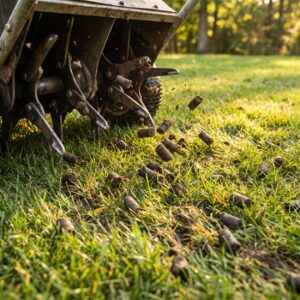
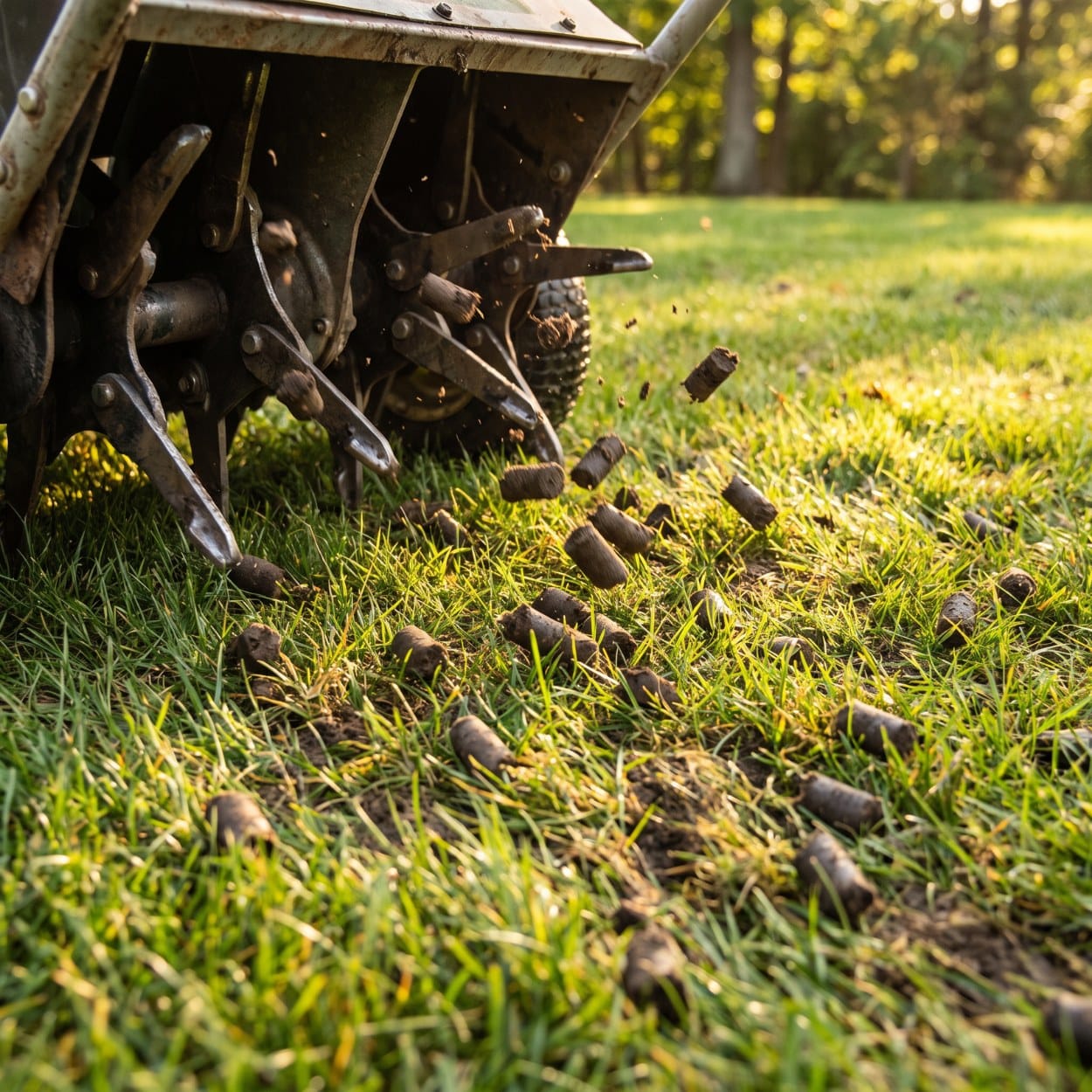
Core aeration is a mechanical process in which a machine fitted with hollow tines pulls thousands of small soil plugs out of a lawn and drops them on the surface. The open channels left behind reduce density in the root zone. Those plugs break apart over the following weeks and work back into the turf on their own.
Why Does Sandy Coastal Soil Compact at All?
The most common objection on a first walk-through is that the soil here is sand, and sand does not compact. It does. Sand grains vary in size, and the finer fractions, along with silt and organic matter, settle into the gaps between the larger grains. Add weight from above and the whole profile tightens.
That weight arrives in ordinary ways. A path worn between the driveway and the side door. A boat trailer parked on the grass for a long weekend. A contractor truck in the side yard during a kitchen remodel. Kids and dogs running the same loop from June through Labor Day. Each wet and dry cycle settles the surface a little further.
What compaction costs you is pore space, meaning the small voids between soil particles that hold air and let water move down. Roots need oxygen in those voids as much as they need moisture. When the pore space collapses, roots stay shallow, water sits on top or slides away, and the lawn ends up living off whatever lands in the top inch of soil. Core aeration is the direct answer to that problem, because nothing else reopens the profile without tearing the stand apart.
What Are the Clearest Signs a Lawn Needs Aeration?
None of these signs is conclusive on its own. Two or three together, in the same areas of the lawn, make a strong case.
Water Pools, Runs Off, or Sits on the Surface
Watch the lawn during the next steady rain, or put a hose on one section and stand there for ten minutes. Soil in good condition takes water in nearly as fast as it lands. Compacted soil beads first, then puddles in the low spots, then sends the rest toward the driveway or the curb.
Runoff on a gentle slope is the version most homeowners miss, because there is no puddle to point at. The tell is a lawn that stays dry despite regular watering, with a soaked apron of mulch or pavement at the bottom of the grade. That water never reached a root.
Thin Turf That Keeps Coming Back Thin
Some lawns green up for two weeks after every bit of attention, then fade in the same places. When the maintenance above ground is handled and the same patches still refuse to fill in, the problem is usually below ground.
Root systems in dense soil are short and blunt. A plant with two inches of root runs out of available water within a day or two of the last rain, no matter how much water was applied. That is why thin areas on compacted ground get worse in July even when the hose comes out every evening.
Ground That Feels Hard Underfoot
Walk the lawn early in the morning, before the surface dries. Turf over healthy soil gives slightly under a heel. Turf over compacted soil feels like a rug thrown over a gym floor, and a mower will bounce and scalp across the high spots because there is no cushion under it.
If a screwdriver stops dead two inches down in moist soil, you have found the layer. That resistance is exactly what soil compaction relief targets: opening enough channels through the dense band that roots and water can get past it.
A Spongy, Matted Layer Above the Soil
Thatch is the layer of dead stems, roots, and runners that collects between the green blades and the soil surface. A thin layer is normal and helpful. Once it thickens past roughly half an inch, the lawn starts to feel springy underfoot, and water and air begin to hang up in that mat instead of moving into the soil.
Pulling cores through a thick mat brings soil up and lays it on top, which is the mechanism behind thatch breakdown. Soil contact speeds the decay of that layer without stripping the lawn back to bare ground.
Worn Lanes, Shortcuts, and Gathering Spots
Compaction is rarely uniform. Look for the lanes people actually use: gate to shed, deck stairs to the yard, the route to the outdoor shower, the strip beside a parking pad, the spot under the grill where everyone stands. Those lanes go thin and hard first while the rest of the lawn still looks acceptable.
On rental and second-home properties, the pattern is sharper because most of the year’s traffic is concentrated into about twelve weeks. The lanes tell you where the traffic went, and they are usually where a machine needs a second pass.
How Can You Test for Compaction Yourself?
You do not need equipment to reach a solid answer. Run these steps on a suspect area and again on a healthy area for comparison.
- Water the test area lightly the day before. Dry soil resists everything and will exaggerate your result.
- Push a long screwdriver straight down into the soil with steady hand pressure. Note the depth where it stops. In workable soil it usually slides most of the way in.
- Repeat the probe in an area of the lawn that looks healthy. The difference between the two depths, not the absolute number, is what matters.
- Cut a wedge of turf four to six inches deep with a spade and lift it out. Look at where the white roots stop. Roots that flatten and turn sideways at a definite depth are telling you where the dense band sits.
- Measure the brown, fibrous mat on top of that wedge, between the green growth and the soil. Anything much past half an inch belongs on the list of problems.
- Run a timed water test. Set a hose on low in both areas for ten minutes and note where water stands or runs.
- Sketch the lawn and mark every area that failed. If the failures line up with paths, parking, and gathering spots, you have your diagnosis.
Set the wedge back in place and step on it when you are done. It will knit back in within a couple of weeks.
What Makes Lower Cape May County Lawns Different?
The 2023 USDA zone map places this end of the peninsula in zone 7b. Those zones are built on the average annual extreme minimum winter temperature and are mapped in 10 degree Fahrenheit bands with 5 degree half zones, which is a useful way to understand our long growing season and mild winters. A long season means more months of traffic on the same turf, and more months in which a compacted lawn is under stress rather than resting.
In Cape May Point, lot sizes are small and outdoor living space is doing a lot of work. A quarter of the lawn may double as a parking area, a path to the beach, and a spot for chairs. That concentrates in one season what a large inland lot spreads across several. It is also the reason a Cape May Point lawn can look fine in May and look worn out by mid August.
Water table depth is the second local factor. Along the bay side in Town Bank and in the low ground around Erma, the water table can sit close to the surface for stretches of the year. A dense layer a few inches down, sitting above ground that is already saturated below, leaves incoming rain with nowhere to go. That is when you see standing water on soil everyone assumed drained well because it is sandy.
Then there is salt. Bay wind carries it, and storm tides push it across low lawns outright. The Rutgers saltwater guidance from the Rutgers Center for Turfgrass Science describes remediation that begins with enhancing drainage and removing flood water, then applying fresh water to leach residual salts below the root zone, with gypsum used as an amendment and soil testing for soluble salts and pH to confirm the situation. Every one of those steps depends on water actually moving down through the profile, which is precisely what compacted ground prevents.
Rutgers also notes that perennial ryegrass, slender creeping red fescue, and tall fescue are generally considered to have the best tolerance to salinity, while annual bluegrass and colonial bentgrass are the most sensitive. That helps explain why two lawns two blocks apart in Cape May Point can respond very differently to the same wind off the water.
The last factor is ownership pattern. Many properties in Cape May Point and North Cape May are second homes, so the owner sees the lawn on weekends and often notices a decline a full season after it started. Compaction develops quietly, and by the time a lawn looks bad from the street it has usually been thin for a while.
When Is Aeration Not the Answer?
An honest assessment includes the cases where a machine will not fix anything. Aeration relieves density. It does not manufacture sunlight, kill insects, or undo a bad mowing habit.
Dense shade under a mature tree line is a light problem. Grass thins out under those canopies regardless of soil condition, and the practical answers are trimming the canopy back or accepting a planted bed instead of turf.
Turf that lifts like a loose carpet when you tug it usually points to insect feeding on the roots rather than compaction. Brown, shredded blade tips point to a dull mower blade. Scalped high spots point to grading or cutting height. A lawn that has taken direct saltwater needs the leaching and testing sequence described above before anyone worries about density.
Some of what looks like compaction is simply an inconsistent program: cut too short, cut too infrequently, watered in short bursts that never wet the root zone. That is a residential lawn care question rather than an aeration question, and it is cheaper to fix.
What Does a Professional Aeration Visit Involve?
The visit starts with a walk. Matthew Boyes or a lead crew member probes the suspect areas, checks the thatch layer, and looks at where the traffic patterns run before any machine comes off the trailer. If the lawn does not need the service, you get told that.
Soil moisture is the variable that decides the day. Bone dry ground makes tines bounce and produce shallow, broken cores. Saturated ground smears rather than opening. Slightly moist soil, a day or two after rain or a good watering, produces full plugs.
Before the machine runs, shallow utility lines, invisible fence wire, cable runs, and any low-clearance obstacles get marked. Then the lawn is aerated in a pattern, with a second pass across the worn lanes and gathering areas that failed your tests.
The plugs stay on the lawn. Raking them off removes the soil and the biology that helps break down thatch. Rain and the next few mowings will melt them back into the surface, usually within two to three weeks.
When Should Aeration Happen This Season?
The principle is straightforward: aerate when the turf is actively growing and has enough season left to close the holes and put on root growth. That rules out the peak of summer heat, when the lawn is already under stress, and it rules out frozen or waterlogged ground.
For cool season lawns in this zone, that puts the strongest window in the second half of the growing year. The local specifics are worked through in our note on fall aeration timing, including how our mild coastal fall stretches the usable window compared with lawns further inland.
The other timing question is traffic. If the property runs as a rental or hosts family through the summer, book the work for after the season ends rather than in the middle of it. Aerating in June and then running twelve weeks of foot traffic across the same ground undoes most of the benefit.
Frequently Asked Questions
How often does a coastal lawn need aeration?
It depends on traffic and soil, not on a calendar rule. Lawns with heavy summer use, parking on turf, or a history of standing water often benefit from an annual pass. Quiet lawns on looser ground can go longer between visits. Fitting it into the rest of the year is covered in our year-round care schedule.
Can I rent a machine and aerate the lawn myself?
Physically, yes. The variables are machine weight, tine depth, overlap, and soil moisture on the day. A light rental unit run over dry ground punches shallow holes and pulls short, crumbly cores, which does very little for a dense layer three inches down. There is also the matter of getting a heavy machine off a trailer and around a tight coastal lot.
Do spike shoes or a garden fork accomplish the same thing?
No. Spikes and solid tines push soil sideways, which increases density around every hole. Hollow tines remove a core and take that volume of soil out of the profile. Removal is the part that relieves pressure, so solid-tine tools cannot substitute for it.
Will my lawn look rough afterward?
For a couple of weeks there will be soil plugs on the surface and visible holes in the turf. Both disappear with rain and normal mowing. If you have an event on the property, schedule the work two to three weeks ahead of it rather than the week of.
Does aeration help a lawn that took saltwater?
It can support recovery, but the order matters. Rutgers describes improving drainage and removing flood water first, then leaching residual salts below the root zone with fresh water, alongside testing for soluble salts and pH. Opening the soil helps that water move, but it is a part of the sequence and not a substitute for the testing.
Aeration is one of the few lawn services where the diagnosis is straightforward and the result shows up in the same season. If two or three of the signs above describe the ground you walk on every day, the next step is a walk-through with someone who will give you a plain answer about whether density is really the problem.
Not sure whether your lawn needs aeration? Call Boyes at 856-386-4600 for an honest assessment.