TLDR: Fall overseeding means spreading fresh grass seed into an existing lawn so thin turf thickens back up before winter. In lower Cape May County that work belongs in the late August through early October window, which Rutgers Cooperative Extension identifies as the primary lawn establishment period for New Jersey from Trenton south. Four things decide the outcome: prep that puts seed in direct contact with soil, a mix built for sandy and salt exposed ground, a correct seeding rate, and steady moisture through the four weeks that follow. On a shore lawn the failure is almost never the seed, it is the water that stops in week two.
Fall overseeding is the practice of broadcasting grass seed across living turf in late summer and early autumn without tearing out the existing stand. It sits between two other jobs: patch seeding, which treats isolated bare spots, and full renovation, which kills and replaces the lawn. Overseeding raises plant density everywhere at once.
Why Do Shore Lawns Thin Out by Late Summer?
A lawn in Del Haven usually finishes August with less grass than it carried in June, and the reasons stack up. Sandy soil holds very little water, so the plant spends July under stress it cannot fully recover from overnight. Heat, foot traffic, and long gaps between rains thin the stand from the top down.
Salt finishes the job. Bay wind carries spray inland, and low lying yards take on salt from tidal push and storm water. The Rutgers Center for Turfgrass Science explains that soluble salts in the root zone hold water away from roots, and that species differ sharply in how much of that they will tolerate.
Whatever opens a gap gets filled by something. Bare ground is not a neutral state near the water. It is an opening for weeds, and by the following June those weeds are the lawn. Overseeding closes the gaps while they are still small enough to close.
When Does the Fall Overseeding Window Open?
Timing is the part homeowners get wrong most often, and it is the part with the least room to argue. The Rutgers seeding guidance for New Jersey sets the primary lawn establishment period for the state from Trenton south at August 20 through October 10. Lower Cape May County sits at the southern end of that range, so the window is real and it is not long.
The reason the window works is soil temperature. Late summer soil is still warm from months of sun, while air temperature is finally dropping and rainfall is more reliable. Seed sown into warm soil under cooling air gets the germination speed of summer without the daytime stress.
Seeding late is the more common mistake here. A stand that goes into November as thin, shallow rooted seedlings has not had time to build the root mass that carries it through winter, and the money spent on seed goes with it. If the calendar has already run past the window, the honest answer is to wait, protect the soil, and plan the job for the following year.
Lower Cape May County sits in USDA hardiness zone 7b. The USDA Plant Hardiness Zone Map, currently in its 2023 version, sets those zones by average annual extreme minimum winter temperature, which is a winter survival measure rather than a seeding calendar. Mild winters help new turf, but they do not extend the fall seeding window. Soil temperature closes it either way.
How Do You Prepare a Lawn Before Seeding?
Seed that lands on thatch, matted clippings, or hard crusted sand does not germinate. It sits there, dries out, and feeds birds. Every hour of prep is worth more than any upgrade in seed quality, which is why lawn seeding work at Boyes starts with the surface rather than the bag.
Start with a soil test. The Rutgers Center for Turfgrass Science recommends testing both soluble salts and pH on ground that has taken salt water, and on a bayside lot in Town Bank or Del Haven that test tells you whether you are seeding into a problem or a lawn. Where salts are elevated, Rutgers describes flushing the root zone with fresh water to leach salts below the roots, with gypsum used as an amendment.
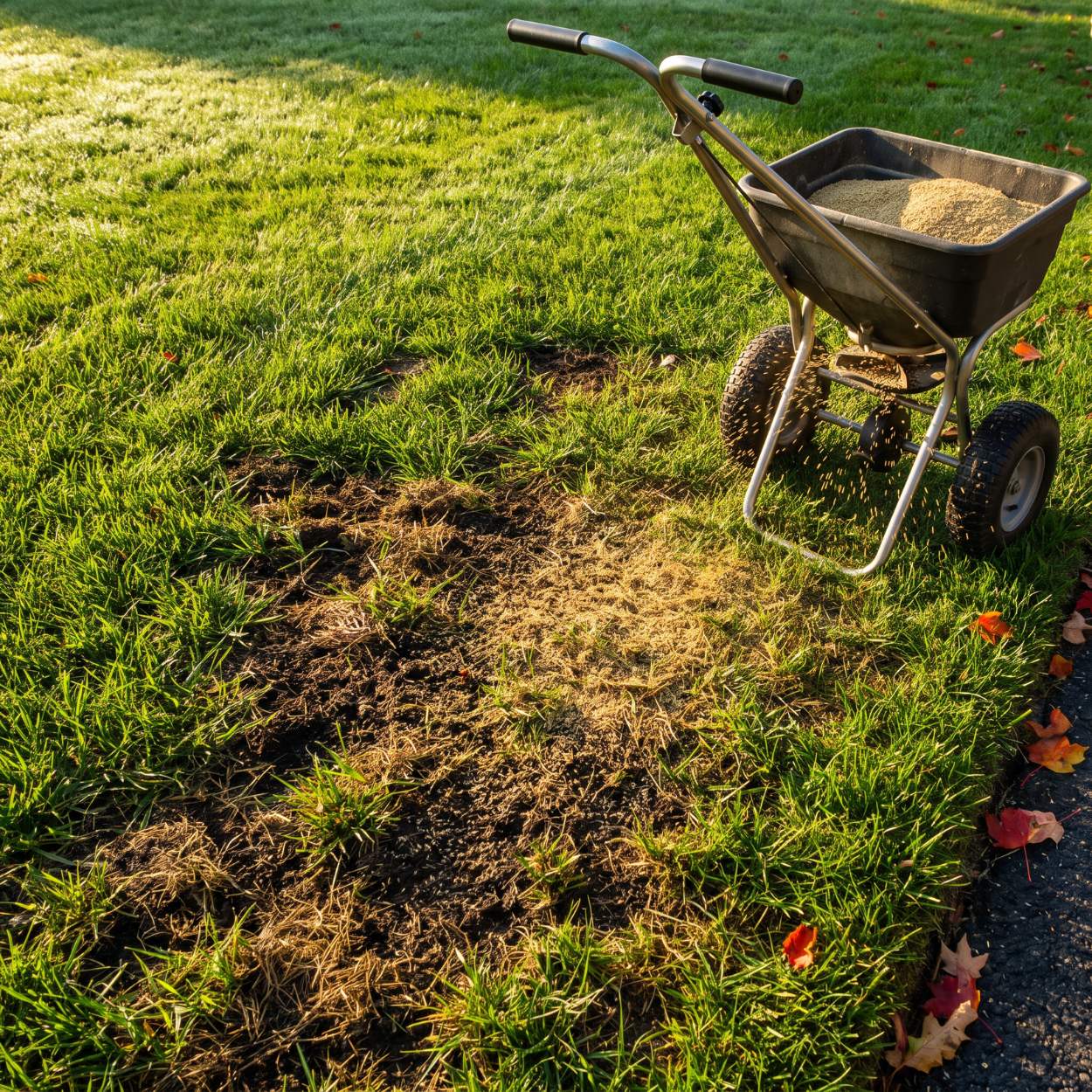
Then open the surface. Mow lower than usual and collect the clippings so the soil is visible between plants. Rake out dead thatch and debris until seed can reach mineral soil. Core aeration is a separate service that many thin lawns need before seed goes down, and Matthew Boyes will tell you on a walkthrough whether your lawn is compacted enough to warrant it.
Topdressing helps on sand. Rutgers guidance for New Jersey lawns cites peat moss at 1 to 2 cubic yards per 1000 square feet as a topdressing over new seed, which holds moisture at the surface exactly where a new seedling needs it. On fast draining shore soil, that moisture buffer is often the difference between a stand and a scattering.
Which Grass Seed Belongs on a Sandy Shore Lawn?
Seed choice on the coast is a salt and drought question before it is a color question. A mix that performs beautifully inland can fade out in one season on a lot two blocks from the bay. Boyes keeps a working selection of coastal grass seed options for exactly this reason.
Turf-type tall fescue as the backbone
Tall fescue is the workhorse for most lawns in Del Haven, Erma, and North Cape May. The Rutgers fescue guidance notes that turf-type tall fescue suits sites where mowing height is 2 inches or taller and inputs are kept minimal, which describes the majority of shore properties honestly. Rutgers also lists tall fescue among the species with the best tolerance to salinity.
There is one caution worth repeating. Rutgers advises against mixing tall fescue with perennial ryegrass, because the ryegrass can dominate the stand. A bag that looks like a bargain because it leans on ryegrass will give you fast green and a different lawn than the one you paid for.
Fine fescue where the ground is dry or shaded
Fine fescues earn their place on the dry sandy edges, under tree lines, and along beds where the mower rarely goes. Rutgers names slender creeping red fescue, a fine fescue, among the species generally considered to have the best tolerance to salinity, alongside tall fescue and perennial ryegrass.
For contrast, the same Rutgers guidance identifies annual bluegrass and colonial bentgrass as the most salt sensitive. Neither belongs in a seed plan for a lot that takes bay spray.
Kentucky bluegrass in a supporting role
Kentucky bluegrass spreads laterally and knits a stand together, which is useful, but it is not the base of a shore lawn. Rutgers puts tall fescue and Kentucky bluegrass blends at 80 to 95 percent tall fescue with 5 to 20 percent Kentucky bluegrass by weight. That ratio is the point: bluegrass supports the stand, it does not carry it.
How Much Seed Does a Lawn Actually Need?
Rate matters in both directions. Too little seed leaves the same gaps you started with, and too much creates seedlings competing with each other for water that sandy soil is not holding anyway.
Rutgers publishes seeding rates for New Jersey lawns of 4 to 6 pounds per 1000 square feet for tall fescue and fine fescue, and approximately 2 pounds per 1000 square feet for Kentucky bluegrass. Those figures are set for establishing a lawn. When you are overseeding into turf that is still partly alive, a crew works inside that range and reads the lawn, leaning toward the lower end where the existing stand is reasonably dense and toward the upper end where it has gone genuinely thin.
Mix ratio and rate are two separate decisions, and both change by property. Our breakdown of coastal seed mixes covers how the ratios shift for full sun, salt exposure, and shaded lots along the bay side.
How Do You Overseed a Lawn Step by Step?
The sequence below is the working order for a fall overseeding on a shore property. Nothing in it is optional, and the steps are in this order for a reason.
- Test the soil for pH and soluble salts, and set a seeding date inside the August 20 to October 10 window Rutgers identifies for southern New Jersey.
- Where the test shows elevated salts, flush the root zone with fresh water first, using gypsum as an amendment as Rutgers describes, and let the ground drain before seeding.
- Mow lower than your normal height and collect every clipping so soil is visible between plants.
- Rake out dead thatch, matted grass, and debris until seed has a clear path to mineral soil.
- Correct low spots and grade problems now, because a puddle that sits for two days will drown new seedlings before they root.
- Choose the mix for the site, weighting tall fescue for open sun and fine fescue for dry or shaded ground.
- Set the spreader inside the Rutgers rate range for the species in the bag, and calibrate on a small measured area before you cover the lawn.
- Spread in two passes at right angles to each other, each at half the total rate, so the coverage is even rather than striped.
- Work the seed into contact with the soil by raking lightly or running a slit seeder, then topdress thinly with peat moss at the Rutgers rate of 1 to 2 cubic yards per 1000 square feet.
- Water the same day and start counting the four week clock from that first watering.
Where a lawn is more bare than grass, straw mulch helps hold moisture and keeps seed in place. Rutgers gives a rate of 50 to 90 pounds, or 1 to 2 bales, per 1000 square feet, spread thin enough that you can still see soil through it.
What Does the Four Week Aftercare Schedule Look Like?
This is where most overseedings on the coast are won or lost. Sandy soil dries from the top down, fast, and a seedling with a root system measured in fractions of an inch has no reserve to draw on. Everything below is about the top inch of soil and nothing else. Our detailed notes on germination and aftercare go deeper on what to watch week by week.
Days 1 through 7: keep the surface damp
The goal is a surface that never fully dries, not a soaked lawn. Light, frequent watering by hose beats one long soak, because a heavy flood on sand moves seed downhill and carries it into the low corners of the yard. Keep foot traffic off entirely, and keep pets off with it.
Days 8 through 14: the week that decides it
Germination is uneven. Some seed is up, some is still swelling, and the temptation to declare the job done and go back to a normal watering habit is strongest right here. Hold the schedule. A single hot, windy afternoon in week two will take out the seedlings that emerged first, and they are the ones you were counting on.
Days 15 through 28: first mow and hardening off
Once new grass is tall enough to cut, mow high with a sharp blade and take no more than a third of the leaf. Begin stretching the interval between waterings so roots chase moisture downward instead of living at the surface. Keep leaves off the new stand as they start dropping, since a wet mat of leaves will smother young turf faster than any weather.
Season pressure is real here. September and October are also when leaves come down and when second home owners are visiting less often, which is exactly when a new stand needs attention most.
What Makes Lower Cape May County Different?
Four local conditions change the plan on nearly every property we walk.
Sandy soil is first. Water and nutrients move through it quickly, which means shallow watering does almost nothing and heavy watering wastes what you put down. This is why the topdressing step matters more here than it does inland.
Salt is second. Wind driven spray, tidal push, and storm flooding all deposit salt in the root zone. The Rutgers Center for Turfgrass Science guidance on saltwater flooding recommends improving drainage and removing flood water first, then applying fresh water to leach residual salts below the root zone, with gypsum as an amendment and testing for soluble salts and pH to confirm where you stand.
The water table is third. On low ground in Del Haven and along the bay in Town Bank, water sits close to the surface, so a low spot that looks minor in August becomes a standing puddle in October. Fixing the grade before seeding costs less than seeding the same low spot twice.
Season and occupancy are fourth. The window opens right as the summer season winds down, which is good for access and bad for attention, because many properties in Erma and North Cape May are second homes standing empty through the exact four weeks when seed needs daily eyes on it. If nobody will be at the house, the seeding plan has to account for that before the spreader comes out, not after. A year-round care schedule makes that easier to plan around.
What Goes Wrong Most Often?
Seeding outside the window is the first failure, and it is unrecoverable. Seed sown in November has no path to a mature root system before winter.
Skipping contact is the second. Seed broadcast over thatch or matted clippings never reaches soil, and no watering schedule fixes that.
Letting the surface dry in week two is the third, and on sandy shore lots it is the most common of all. The fourth is mowing too early or too low, which tears young plants out by the roots rather than cutting them.
The fifth is a seed bag chosen on price. A ryegrass heavy mix greens up fast and then leaves you with a stand Rutgers specifically warns can crowd out the tall fescue you actually wanted. Our full lawn care service line exists partly because these five mistakes repeat on the same properties year after year.
Frequently Asked Questions
Can I overseed and keep mowing on my normal schedule?
Not for the first few weeks. Mow low once immediately before seeding, then stay off the lawn until new grass is tall enough to cut, which generally falls in the back half of the four week window. When you resume, mow high with a sharp blade and remove no more than a third of the leaf at a time.
Is fall really better than spring for overseeding?
For lower Cape May County, yes. Rutgers identifies August 20 through October 10 as the primary lawn establishment period for New Jersey from Trenton south, because seed goes into warm soil under cooling air with more reliable rainfall. Spring seedlings face summer heat and drought before their roots are deep enough to handle it.
Do I have to aerate before I overseed?
Not always, but compacted ground is a common reason overseeding fails. Core aeration is a separate service that opens the soil surface and improves seed to soil contact where a lawn has been driven on, walked on, or left on hard packed ground. A walkthrough will tell you whether your lawn needs it or whether raking is enough.
How long before the lawn looks full again?
Longer than most people expect. New seedlings emerge over a stretch of days rather than all at once, and the stand keeps filling well after the four week aftercare period ends. Judge the result the following spring, not in October.
What if bay water floods the lawn after I seed?
Test the soil for soluble salts and pH first, because the reading determines the response. Rutgers directs you to improve drainage and remove standing flood water, then apply fresh water to leach residual salts below the root zone, using gypsum as an amendment. A stand seeded with salt tolerant fescues has a real chance of coming through it.
Matthew Boyes walks each property himself before a seeding plan is set, because the right mix and the right rate depend on what is already growing there and how much salt the ground has taken. Planning fall seeding on a shore lawn? Call Boyes at 856-386-4600 to walk the property before the window closes.