TLDR: Plant selection for a coastal Cape May County yard runs through four filters in order: salt tolerance, wind tolerance, soil and moisture conditions, and deer pressure. A plant that fails any one of them will fail on the property regardless of how well it is planted or maintained. The filters also vary sharply within short distances here, so an exposed lot in Cape May Point and a sheltered inland lot in Erma need genuinely different plant lists even though they sit a few miles apart. Selection is the decision that determines whether a landscape holds up, and it should come before design, not after.
Most failed coastal plants we are called to replace in lower Cape May County were the wrong plant, correctly installed. The homeowner watered it, the bed was prepared, the drainage was fine, and the plant died anyway because it was never going to survive that exposure. This guide covers how to choose in the first place.
What Coastal Plant Selection Means in Lower Cape May County
Coastal plant selection is the process of matching plant species to a specific site’s salt exposure, wind exposure, soil type, moisture conditions, and browsing pressure, before design or installation begins. In lower Cape May County these conditions vary substantially within a single property, so selection is site-specific rather than regional.
That last point is the one that surprises homeowners. People expect a coastal plant list to be a county-wide list. It is not. On a single lot, the ocean-facing side, the leeward side of the house, and a sheltered courtyard can each support meaningfully different palettes.
Lower Cape May County sits in USDA hardiness zone 7b, which can be confirmed for a specific address on the USDA hardiness zone map. Zone is the starting constraint, not the finishing one. Zone tells you what survives the winter. It says nothing about salt, wind, sand, or deer, which is where plants here actually die.
Coastal Plants and Salt Tolerance as the First Filter
Salt is the constraint that eliminates the most options fastest, and it arrives in two different ways that plants respond to differently.
Salt spray is airborne salt carried on onshore wind and deposited on foliage. It desiccates leaf tissue directly, which is why salt damage shows up first on the windward side of a plant and produces browning at leaf tips and margins. Exposed lots in Cape May Point and along the barrier-island edge in Diamond Beach take the most of it, but it travels considerably further inland than most people assume, particularly during and after coastal storms.
Soil salt is salt in the root zone, from storm surge, from high groundwater, or from accumulated spray washed off foliage by rain. It interferes with the plant’s ability to take up water, so a plant in salty soil shows drought symptoms even when the soil is wet.
A plant can tolerate one and not the other. That distinction is worth knowing because it changes where a species can be used. Something with good spray tolerance but poor soil salt tolerance works on an exposed slope well above the water table and fails in a low area that took surge.
How to apply the filter practically:
Walk the property and identify the exposure zones. The unobstructed side facing prevailing onshore wind is the harshest. Behind the house, behind a fence, behind an existing hedge, and behind a dune line are progressively more sheltered. On an interior lot in Erma with mature trees and neighboring houses in the way, salt exposure may be low enough that the filter barely applies.
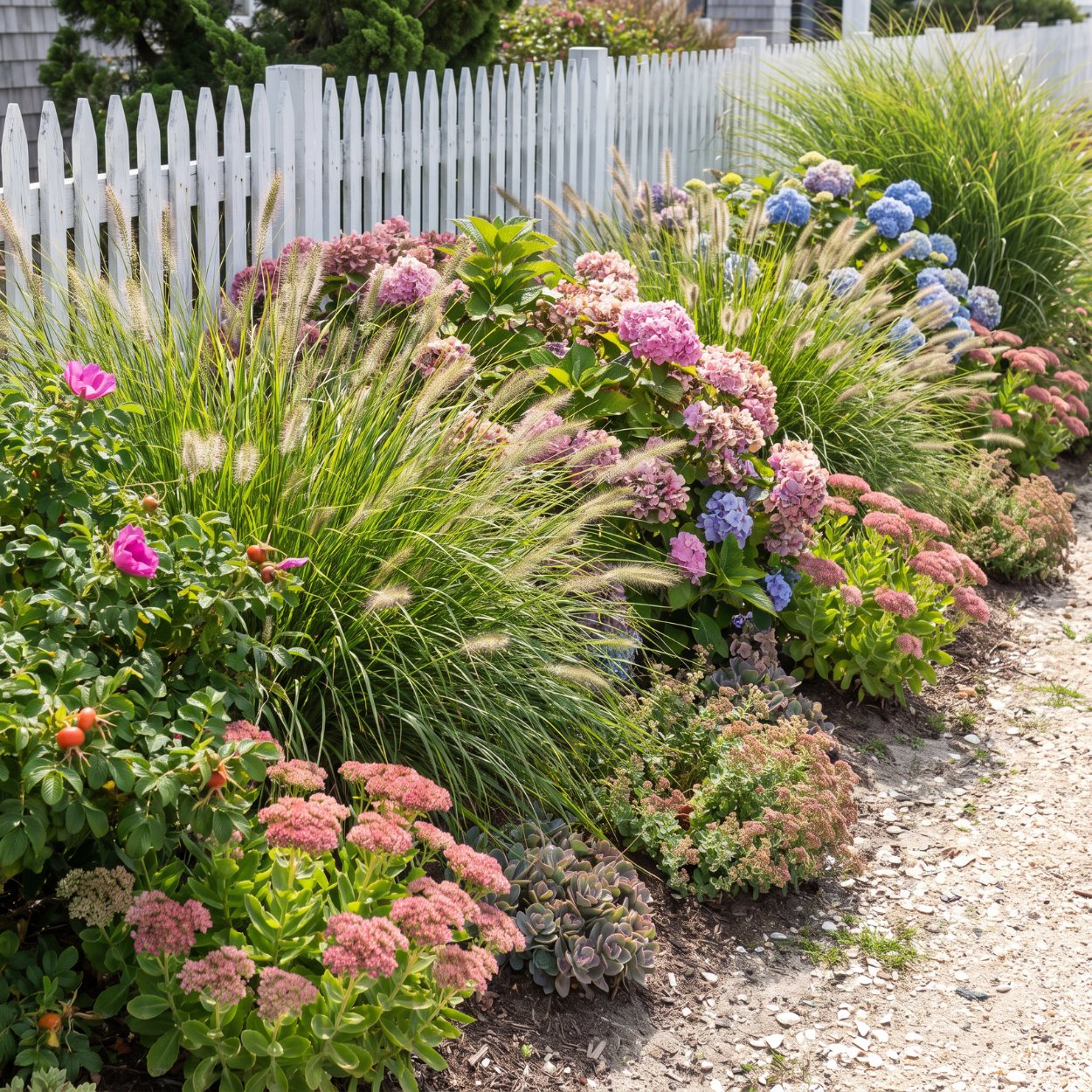
Put the most salt-tolerant material in the exposed zones. Use those plants as the outer layer that shelters everything behind them, which is the working principle behind a coastal planting plan: the tough material takes the hit and creates a protected microclimate for the less tolerant material inside it.
Do not put a marginal plant in an exposed position and plan to protect it. That plan does not survive the winter the homeowner is away.
Our approach to salt and sandy soil planting is built around zoning the property this way before any species get named. On the bed side, the same logic drives salt-tolerant flowerbed plants, where the seasonal color has to survive the same conditions the shrubs do.
Wind Tolerance for Exposed Lots
Wind is a separate filter from salt even though they usually arrive together.
Physical damage. Sustained wind breaks branches, shreds large soft leaves, and can rock a newly planted shrub enough to break the fine roots that were establishing. Large-leafed plants that look lush in a sheltered garden get torn on an exposed lot.
Desiccation. Wind pulls moisture out of foliage faster than roots can replace it, particularly on sandy soil that holds little water. This is a major factor in winter, when the ground is cold, root activity is low, and evergreen foliage keeps losing water to wind. Winter burn on wide-leaved evergreens here is usually a wind and moisture problem rather than a cold problem.
Growth deformation. Persistent directional wind produces asymmetric growth. Plants lean and flag away from the wind. On an exposed site this is not preventable, so it should be planned for rather than fought. A row of shrubs on an exposed edge will not stay symmetrical.
Practical selection response: favor small-leafed, flexible, low-to-medium plants in exposed positions. Favor species with a naturally dense branching habit, which self-shelters. Avoid brittle wood and avoid large soft foliage anywhere the wind reaches. Build the planting in layers so the outer layer takes the wind and the inner layers benefit.
Where privacy is the goal on an exposed lot, this becomes the whole design problem, because the plants that give the fastest privacy are often the least wind tolerant. That trade-off is the core of our privacy screening and tree lines work: choosing material that will still be there in ten years rather than material that looks impressive in year two.
Soil and Moisture Conditions
Sandy soil is the third filter and it works in two directions at once.
Sand drains fast and holds little water. Most of the county’s soils are sandy or sandy loam, and the USDA’s Web Soil Survey gives a parcel-level baseline picture, though we always confirm with hand inspection on the walk. Plants that need consistently moist soil will struggle on sand unless the bed is amended and the homeowner is prepared to water attentively.
At the same time, lower Cape May County has a high water table, and low areas on a lot can sit wet for extended periods. That produces a genuinely awkward combination on many properties: sharply drained ground a few feet from ground that stays saturated. Species that tolerate one rarely tolerate the other.
This is why we map wet and dry zones on the walk rather than treating the yard as uniform. A plant list built for “sandy soil” that gets installed in the low corner where water collects will fail there and nowhere else, and the homeowner will reasonably conclude the plant was wrong when the placement was wrong.
Practical response:
Amend beds with organic matter where the soil is sharply drained, which improves water retention in the root zone. Do not amend a hole and leave the surrounding soil untouched, because that creates a bathtub effect where water collects in the amended pocket.
In genuinely wet low areas, either select species that tolerate periodic saturation or correct the grade first. Selecting a wet-tolerant plant is usually cheaper and always more reliable than fighting the water.
Establishment watering matters more here than in most places, because a plant on sandy soil has a narrow margin during its first season. Our ground prep and establishment process is built around getting plants through that first year, which is when most losses happen.
Deer Pressure Considerations
Deer are a serious constraint across much of lower Cape May County, particularly on properties near woodland edges around Cape May Court House, Green Creek, and the more rural inland areas, and they range considerably further than people expect.
A few things worth being honest about.
No plant is deer proof. Deer eat what is available under pressure. Lists describe relative preference, not immunity.
Pressure varies by season and by year. Late winter, when other food is scarce, is when deer eat things they normally ignore. A planting that survived three years can be browsed heavily in a hard winter.
New plantings are more attractive than established ones. Nursery-grown foliage is tender and appealing. The first year is the highest-risk year, and it is also the year a plant can least afford to lose foliage.
Protection is a real strategy. Physical barriers during establishment often make more sense than restricting the plant list to only the most resistant species, which can produce a monotonous landscape.
Rutgers Cooperative Extension maintains a widely used reference on plants rated by deer resistance, which rates species on a relative scale rather than promising immunity. It is the right starting point for a New Jersey property, and it should be cross-referenced against salt and wind tolerance rather than used on its own. Plants that clear all three filters are the ones worth building a landscape around.
Bayfront, Oceanfront, and Inland Plant Differences
The three exposure situations in this county are genuinely distinct.
Oceanfront and near-ocean exposure, including Diamond Beach and the ocean-facing barrier-island lots, is the harshest. Direct salt spray, unobstructed wind, sharply drained sandy soil, and reflected heat. The plant list here is short and should stay short. Low, tough, small-leafed, salt-tolerant material. This is not the place to experiment, and it is the place where dense evergreen structure earns its keep by sheltering everything behind it.
Bayfront exposure, along the Delaware Bay side through Villas, Town Bank, and Cold Spring, is different in character. Wind comes off the water but the salt load is generally lower than on the ocean side, and bayside lots more often have drainage and high-water-table issues rather than sharp drainage. The list is wider than oceanfront but narrower than inland, and the wet-zone question matters more.
Inland and sheltered lots, through Erma, Cape May Court House, Green Creek, and the interior of Lower Township, support a much broader palette. Salt is a storm-event consideration rather than a daily one. Here the binding constraints shift to deer pressure, shade from mature trees, and the wet and dry variation across the lot.
The mistake to avoid is applying an oceanfront list to an inland lot, which produces a needlessly limited and often visually harsh landscape, or applying an inland list to an oceanfront lot, which produces replacement work within two seasons.
Building a Plant Palette That Survives the Shore
Once the filters are applied, the design work begins. A few principles that hold up here.
Build in layers from the exposure inward. Toughest material on the windward edge, progressively less tolerant material behind it. This is a functional structure, not just a visual one, and it is what makes an ambitious planting possible on a difficult lot.
Weight the palette toward structure over color. On an exposed coastal lot, the plants that carry the landscape through the year are the evergreen and structural ones. Seasonal color is layered into protected positions.
Limit the species count. A coastal palette built from a smaller number of proven species, repeated in drifts, reads as intentional and performs better than a collection of one-of-each. It also means a loss is easier to replace.
Plan for mature size. This applies everywhere and gets ignored everywhere. A plant that fits at installation and is twice the size in five years will be crowding a walk, blocking a window, or being sheared into a shape it does not want to hold. Species that need constant cutting back to stay in bounds were the wrong species, and our approach to trimming timed to plant type is easier to execute when the plant was chosen for the space it has.
Consider natives seriously. Native species evolved in these conditions and generally need less intervention once established. Rutgers guidance on incorporating native plants into residential landscapes covers the case and the practical approach. Native does not automatically mean coastal-tolerant, since New Jersey natives include plenty of species from inland habitats, so the filters still apply.
Be realistic about maintenance capacity. On a second-home property where nobody is present for stretches, the palette has to survive absence. That is a design constraint as real as salt.
Foundation Plantings Deserve Their Own Thinking
Foundation beds are where the most plant losses happen on properties in this county, and the reasons are specific.
The area against the house has its own microclimate. It is drier, because the roof sheds water away from it. It is hotter on south and west exposures, because of reflected heat off siding. It is often the most compacted soil on the property, from construction. And it is where homeowners most often plant things that will outgrow the space within a few years.
The practical rules: set plants far enough from the wall that they have room at mature size and that air can move behind them, choose material that tolerates drier conditions than the rest of the yard, and check the soil at the foundation separately rather than assuming it matches the lawn. Our foundation and shrub planting work starts from those conditions rather than from a standard plant list.
Who We Are
Boyes Lawncare & Landscaping is a family-run, owner-led lawn care, landscaping, and hardscaping company based in Villas, serving lower Cape May County. Owner Matthew Boyes walks every property before quoting, and on planting work that walk is where the exposure zones, the wet and dry areas, and the deer pressure get mapped. We carry a 5.0 Google rating built on landscapes that are still there in year five.
Frequently Asked Questions About Coastal Plant Selection in Cape May County
What plants survive salt spray in lower Cape May County?
The species that hold up in exposed positions here are generally small-leafed, dense, and tough, with foliage that tolerates airborne salt deposition. Rather than a fixed list, the practical approach is zoning the property by exposure and putting the most tolerant material on the windward edge to shelter everything behind it. Salt spray tolerance and soil salt tolerance are different traits, and a plant can have one without the other.
How far inland does salt spray affect plants in Cape May County?
Considerably further than most homeowners expect, and much further during and after coastal storms when onshore wind carries salt well past the beach blocks. Sheltered interior lots with mature trees and neighboring structures in the way see far less than exposed lots, which is why exposure mapping on the specific property matters more than distance from the water.
Are native plants a good choice for coastal New Jersey landscapes?
Often yes, because native species generally need less intervention once established and are adapted to regional conditions. Native does not automatically mean coastal-tolerant, though, since New Jersey natives include many inland species. The salt, wind, soil, and deer filters still have to be applied to any native selection.
How do I deal with deer eating my new plantings?
Expect the first year to be the highest-risk year, because nursery-grown foliage is more attractive than established growth. Physical protection during establishment is often more practical than limiting the plant list to only the most resistant species. Rutgers maintains a relative deer-resistance rating for landscape plants that is a useful cross-reference, though no plant is genuinely deer proof under pressure.
Why do plants that do well at my inland friend’s house die at my shore house?
Almost always exposure. Salt deposition, sustained wind that desiccates foliage, and sharply drained sandy soil combine to create conditions an inland lot does not have. The plant is not weak and the care is not wrong. It is the wrong plant for that site, and no amount of maintenance corrects a selection problem.
When is the best time to plant on a coastal Cape May County property?
Fall is generally the strongest window here, because soil stays warm while air temperatures moderate, which favors root establishment without top-growth stress. Spring is the second option but sends a young root system straight into summer. Midsummer planting is possible but demands watering attention that many second-home owners cannot realistically provide.
Ready to Talk About Your Planting Plan
If you are planning a planting anywhere in lower Cape May County, from the exposed lots in Cape May Point and Diamond Beach to the sheltered properties inland around Erma and West Cape May, the useful first step is walking the property and mapping the actual conditions.
Call 856-386-4600 or use the contact page to set up a walkthrough, and see the full range of our planting services and the rest of our landscaping work for the county.